
Conservatives are criticizing Prime Minister Mark Carney’s remarks during his visit to China after he said his government is pursuing a strategic partnership with Beijing to prepare for a “new world order.”
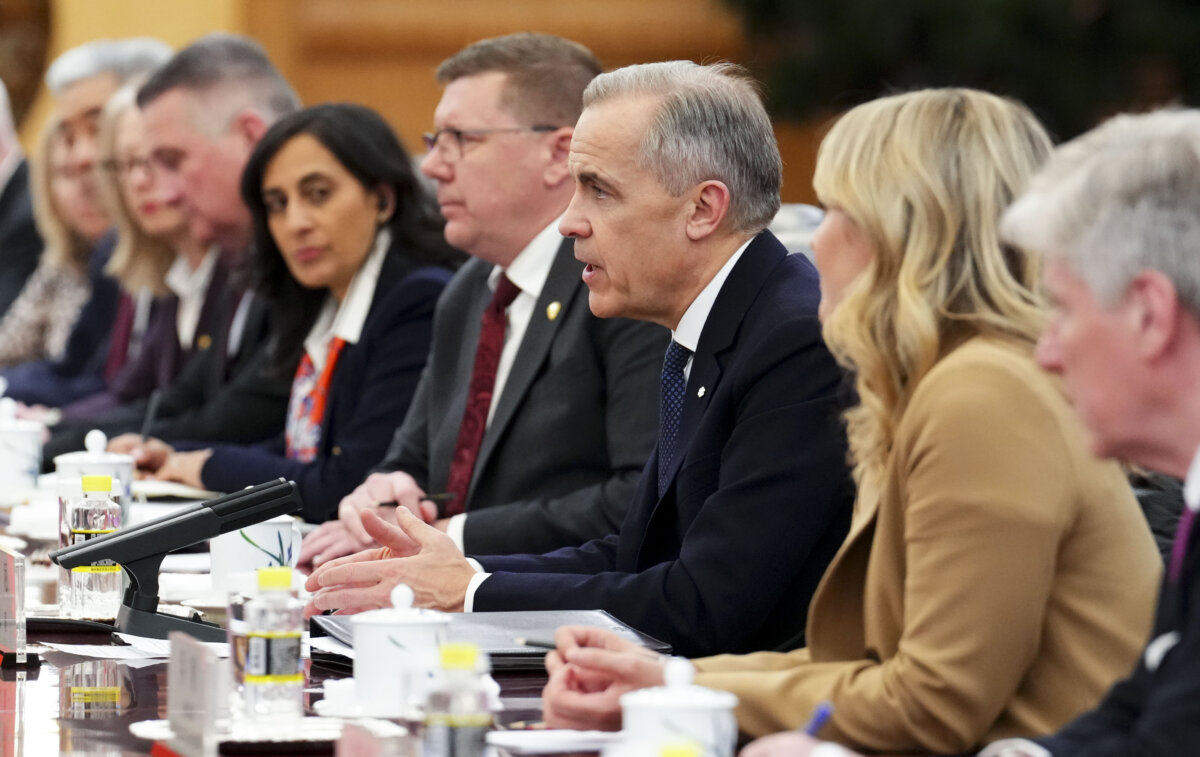
“Canada does not belong in Beijing’s ‘New World Order.’ Our people deserve freedom, not subjugation before the Chinese Communist Party,” Conservative MP Shuv Majumdar said on X in reaction to Carney’s comments while meeting with Chinese Premier Li Qiang in Beijing on Jan. 15.
During the meeting, Carney thanked Chinese leader Xi Jinping for his work on the relationship between Ottawa and Beijing in the lead-up to his visit.
“This sets the stage for these important discussions on a wide range of issues where we can be strategic partners,” Carney said, adding that Canada is entering a “new era of relations” with China. “I believe the progress that we have made in the partnership sets us up well for the new world order.”
He added that his government wants to cooperate with China on issues related to energy, security, people-to-people ties, and multilateralism.
Carney has said that Canada’s relationship with the United States has changed with the Trump presidency, and that his government wants to double non-U.S.-trade over the next decade.
During the 2025 election campaign, Carney said China is the number one security threat to Canada. While discussing trade partners to diversify trade away from the United States, he talked about the importance of Asian markets, but singled out China, saying that China doesn’t share Canada’s values.
However, in recent months, his government has noticeably changed its tone on China. Foreign Affairs Minister Anita Anand recently sidestepped questions on whether the Liberal government still believes China is a “disruptive” global power as the government’s current Indo-Pacific Strategy states. Instead, Ottawa is referring to China as a “strategic partner,” saying it’s important to collaborate on issues related to energy, agriculture, security, and the environment.
While in Beijing, Carney also met with Chinese leader Xi, who said through a translator that he is “heartened by the progress” Beijing and Ottawa have made on “resuming and restarting cooperation across the board.”
In his address to Xi, Carney said, “Together, we can build on the best of what this relationship has been in the past to create a new one, adapt it to new global realities that will deliver stability, security, and prosperity to our peoples on both sides of the Pacific.”
Breaking with the United States, Carney said on Jan. 16 that he has agreed to lower Canada’s 100 percent tariffs on Chinese EVs to 6.1 percent for the first 49,000 vehicles imported each year, in exchange for China lowering its 84 percent tariffs on Canadian canola to 15 percent.
‘Ruled by a Communist Dictatorship’
Majumdar said instead of communist China, Carney should have sought closer ties with countries such as South Korea and Japan and others in the Indo-Pacific region.
Fellow Conservative MP Michelle Rempel Garner questioned what Carney means by the “new world order,” asking if it means transforming to a communist model or one with more state-control.
“This was a deeply disturbing comment. Things just got really real for Canada,” she said on X.
Other Conservative MPs criticized how Ottawa is promoting the trip, creating videos with dramatic music and posting them on the government’s social media accounts.
“China is ruled by a communist dictatorship currently perpetrating genocide. This tweet is dark as hell,” Tory MP Matt Strauss said in response to a video posted on Carney’s social media pages on Jan. 14, carrying the caption, “The relationship between Canada and China has created opportunities and prosperity on both sides of the Pacific.”
Dennis Molinaro, an academic and former national security analyst and policy adviser to the federal government, said how Ottawa is framing its relationship with Beijing is worrying.
“Concerns with the Canada PRC [People’s Republic of China] trip are not about whether Canada sells oil and gas to China, which the US does, or uranium, which Canada has sold. The deeper issue is the framing of a ‘new era’ and a ‘partnership’ while largely ignoring security realities,” Molinaro said on X. “This is not a partner.”
David Mulroney, a former Canadian ambassador to China, said it’s concerning that Canada no longer considers China an international threat.
“The Liberals have effectively smothered the foreign interference scandal and abandoned ridings to Beijing’s growing influence,” Mulroney said.
A public inquiry into foreign interference said last year that China is the most active foreign power meddling in Canada’s affairs.
Canada has also in the past issued statements condemning Beijing’s human rights violations and clampdown on Hong Kong democracy activists, as well as China’s aggressions in the South China Sea.
Canada itself has been subjected to the CCP’s aggressions on numerous occasions, including Chinese fighter pilots buzzing Canadian ships and planes in international waters or airspace multiple times in recent years. Other such acts include the arrest of Canadian citizens Michael Kovrig and Michael Spavor and banning Canadian agricultural imports in retaliation for Canada’s arrest of Huawei executive Meng Wanzhou on a U.S. extradition request in 2018.
Industry Minister Mélanie Joly, who accompanied Carney on the trip, said Ottawa is engaging with China with “eyes wide open.” Her comments came in response to questions from reporters who asked if Beijing is the right kind of partner for Canada given concerns with foreign interference, espionage, and human rights.
“We’re eyes wide open. We know this, but there’s been investments by Canadian companies for years,” Joly said.
“When we engage with China and we engage with businesses like [Energy Minister Tim Hodgson] and I have been doing, we put everything on the table to address these risks.”
Carney and some of his cabinet ministers will be in China until Jan. 17. Saskatchewan Premier Scott Moe accompanied Carney for part of the trip.
Besides agreements on EV and canola tariffs, the trip, which began on Jan. 13, saw Canada and China sign several agreements to cooperate in areas such as energy and lumber.
 Friends Read Free
Copy
Facebook
Tweet
Friends Read Free
Copy
Facebook
Tweet