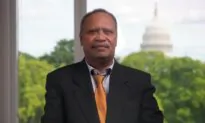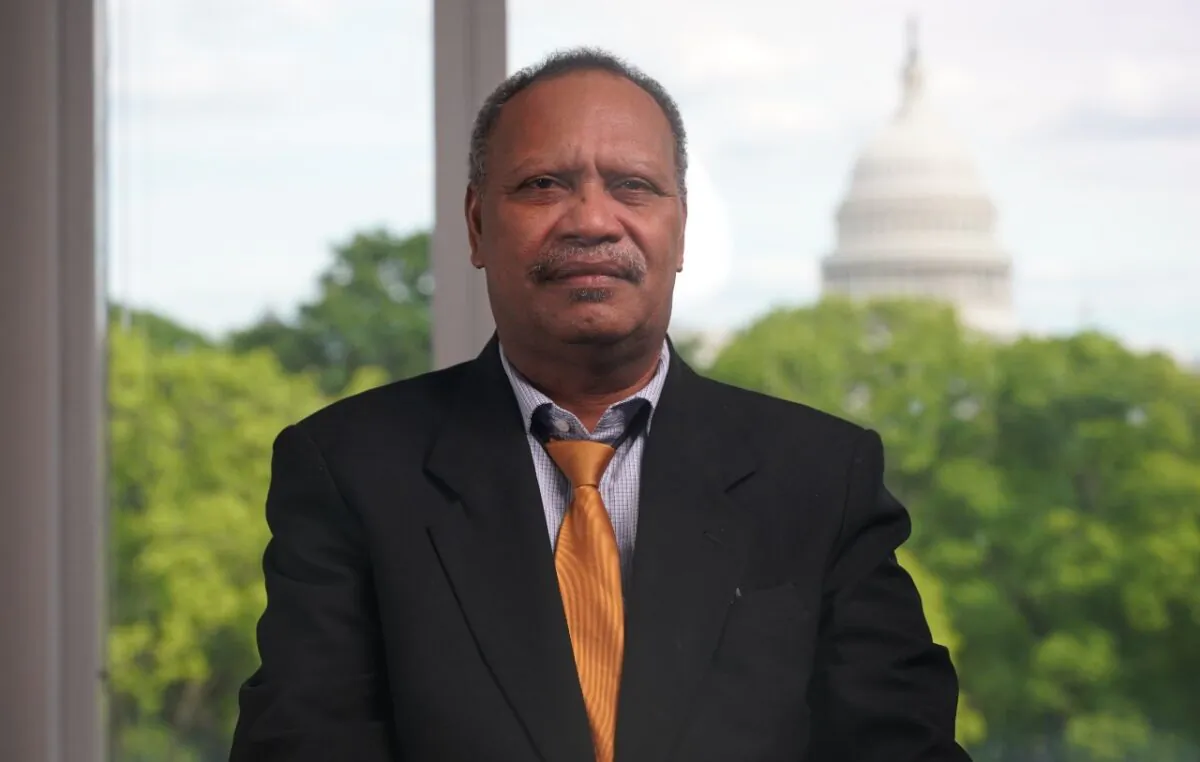

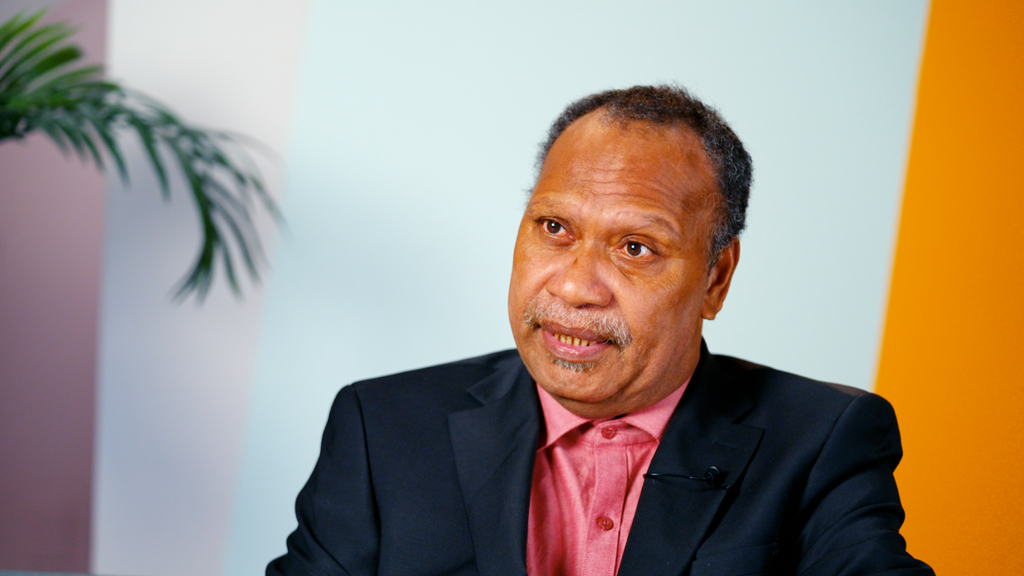
Former Solomon Islands provincial Premier Daniel Suidani, an outspoken critic of his country’s embrace of Beijing, has died.
His former advisor Celsus Talifilu announced his death on the morning of Oct. 21 at the National Referral Hospital (NRH) in Honiara, the capital of the Solomons.
“It is with deep sorrow and heartfelt sadness that we announce the passing of Honourable Daniel Suidani, Member of Malaita Provincial Assembly Ward 5, West Baegu/Fataleka, who passed away this morning at NRH.
“Further details regarding funeral arrangements and official commemorations will be announced in due course,” he said in a statement posted online.
Suidani was the head of Malaita, the most heavily populated province of the Solmon Islands. The former premier was frequently at loggerheads with the former Prime Minister of the Solomons Manessah Sogavare over funding issues, service delivery, but also Chinese Communist Party (CCP) ties.
Suidani famously introduced the Auki Communique in 2019, which imposed a moratorium on licenses for businesses linked to the CCP, while maintaining ties with Taiwan.
“[Malaita Provincial Government or MPG] specifically observed the need to be free from unwarranted interference of persons and therefore reject any notion of a police state,” states Clause 5 of the document.
“MPG acknowledges the freedom of religion as a fundamental right and further observes the entrenched Christian faith and the belief in God by Malaitan and [Malaita Outer Islands] peoples and therefore rejects the [CCP] and its formal systems based on atheist ideology,” Clause 7 reads.
In 2023, Suidani was ousted from power in a contentious move by fellow parliamentary members.
Even after leaving office, he kept up his critique, and only a month ago was before the court, along with Talifilu, charged with unlawful assembly over a 2021 riot.
He gave several exclusive interviews to The Epoch Times and Epoch TV over the years. In one he alleged that the payment of bribes by the CCP to local politicians was commonplace. He complained this year that he could not get any leaders in Canberra, Australia to listen to his concerns.
While in Taiwan receiving medical treatment in 2023, Sudiani admitted he was scared to return home.
“We are so frightened to go back, but we have no choice,” he said. “We must go back to fight for the rights of our people. Standing for our people will make them become strong in their own place.”
The Solomons’ Switch
The Solomon Islands switched diplomatic recognition from Taiwan to China in September 2019 and has benefited financially as a result, receiving a $30 million bailout (US$20 million) last year.
The two countries formalised their relationship with a contentious 2022 pact called the “Framework Agreement Between the Government of the People’s Republic of China and the Government of Solomon Islands on Security Cooperation,” which permits Beijing to station naval ships, troops, weapons, and armed personnel on the island to “protect the safety of Chinese personnel and major projects.”
It has seen the increasingly visible presence of uniformed Chinese police officers on Honiara’s streets.
If implemented to its full extent, the framework would give the Chinese Communist Party (CCP) a major position right in the middle of key shipping lanes and air links connecting the United States to Australia and New Zealand, according to China expert Gordon Chang.
It has since been supplemented by a “Comprehensive Strategic Partnership” signed in 2023.
Growing Allegiance to Beijing
Successive prime ministers, although from different parties, have both been strongly pro-China.
It was under Sogavare that the diplomatic switch was made, and his replacement, Jeremiah Manele, a former foreign minister, pledged to continue the country’s policy.
In May this year, the CCP embassy in the Solomon Islands was accused of forcing Rural Development Minister Daniel Waneoroa of quitting the Inter-Parliamentary Alliance on China (IPAC), which takes a tough stance on Beijing’s transgressions and features members from over three dozen countries.
The international parliamentarians’ group accused Beijing of “bullying behaviour,” saying it had issued a “direct and shocking challenge” to the sovereignty of the Solomon Islands.
Daniel Y. Teng contributed to this article.
 Friends Read Free
Copy
Facebook
Tweet
Friends Read Free
Copy
Facebook
Tweet