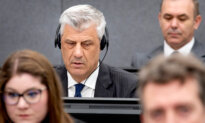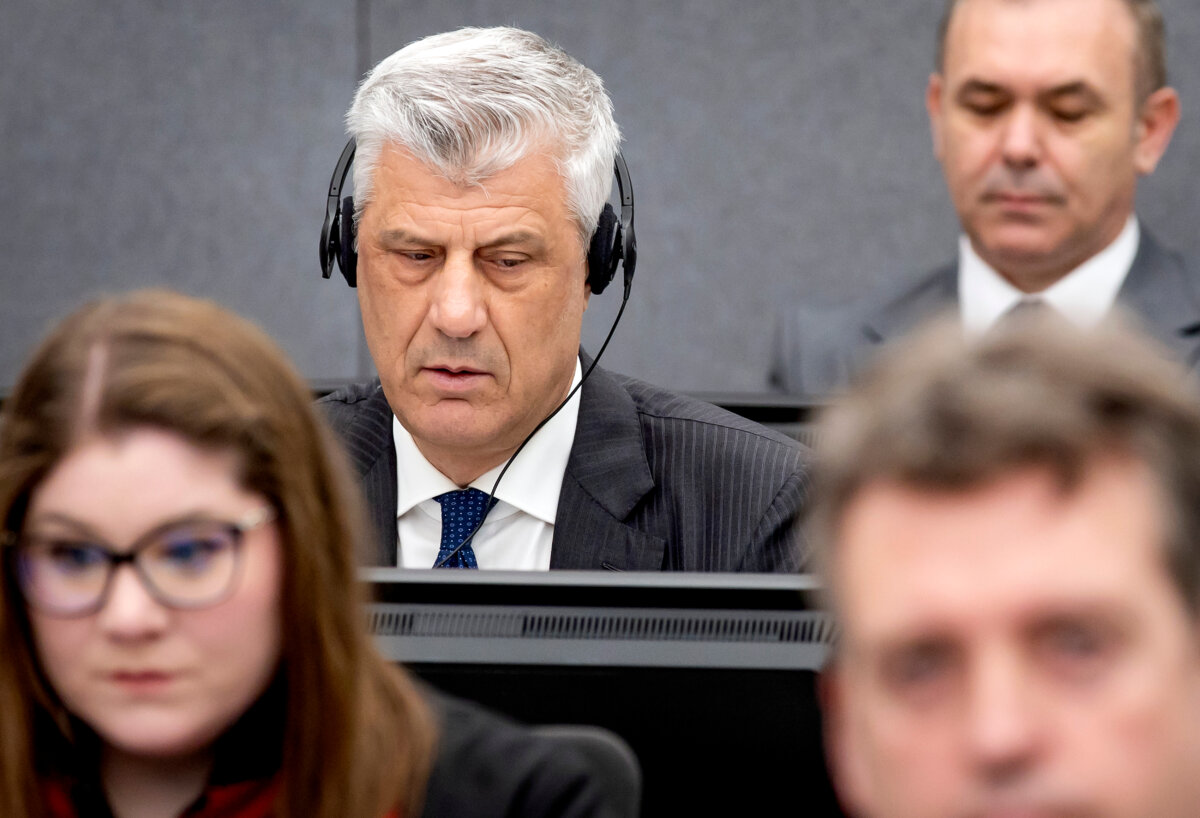
Former Kosovan President Hashim Thaci was found guilty of murdering 96 people and other war crimes by a panel of international judges sitting in The Hague on Wednesday.
Thaci, 58, was a former leader of the Kosovo Liberation Army (KLA) during the war against Serbia in 1998–1999 and was the Kosovan president from 2016 until 2020.
On Sept. 16, in a hearing that was livestreamed, Thaci and his three co-defendants were found guilty at the Kosovo Specialist Chambers of several counts of war crimes and crimes against humanity, which involved the murder of 96 people and the torture and persecution of others during the KLA’s war to gain independence.
Judge Charles Smith III, a U.S. citizen and former judge in Iowa, said Thaci was found guilty of the illegal and arbitrary arrest and detention of 385 people, the cruel treatment of 49 people, the torture of 303 people, and the murder of 96 people.
Smith sentenced Thaci to 25 years in prison, giving credit for time served.
Prosecutors had asked for the maximum sentence—45 years in prison—for Thaci and his three co-defendants, Kadri Veseli, Rexhep Selimi, and Jakup Krasniqi, who were all KLA leaders. All four denied all the charges against them.
Smith sentenced Krasniqi to 25 years, Veseli to 18 years, and Selimi to 13 years.
The Kosovo Specialist Chambers was set up to investigate crimes “which were commenced or committed in Kosovo between 1 January 1998 and 31 December 2000 by or against citizens of Kosovo or the Federal Republic of Yugoslavia,” according to its website.
The prosecutors—who were led by Kimberly West, a former U.S. federal prosecutor—said the four KLA leaders targeted political opponents and Kosovans who were perceived as collaborators or traitors, killing or torturing them.
Thaci resigned “to protect the integrity of the state” on Nov. 5, 2020, after he was indicted, and was then arrested and extradited to the Netherlands.
The trial has lasted three years. Thaci made a statement to the judges at a hearing in February.
“Throughout my life, I stood with the people of Kosovo defending freedom, life, and dignity. I was always guided by the Western ideals of democracy, equality, and justice,” he said.
Ethnic Conflict
Reading the verdict on Wednesday, Smith went into some detail about the facts of the charges Thaci and the others had been convicted.
“Some individuals were arrested and detained together with family members, and had to hear and witness the treatment of, and killing of their family members,” Smith said.
“Other individuals faced a heightened degree of vulnerability because of their old age. For example, a 70-year-old man was severely beaten to the extent that his face was ‘smashed up’ and covered in blood.”
Ethnic conflict between Kosovans, who are ethnically Albanian and make up the majority in Kosovo, and the Serbs grew throughout the 1990s.
In April 1999, NATO accused Serbian President Slobodan Milosevic of a “deliberate policy of oppression, ethnic cleansing and violence.”
Milosevic refused to back down, but after NATO carried out a 78-day air campaign against his regime in Belgrade, he accepted peace terms on June 10, 1999, withdrawing his troops and agreeing to an international peacekeeping force.
On the weekend, thousands of people rallied in the Kosovan capital, Pristina, in support of Thaci and his co-defendants.
Murals depicting the four have been painted across the city, and a huge digital clock counted down to Wednesday’s verdict, which was delivered at 10 a.m. local time.
“In the name of the people, declare them innocent,” said one banner in Pristina.
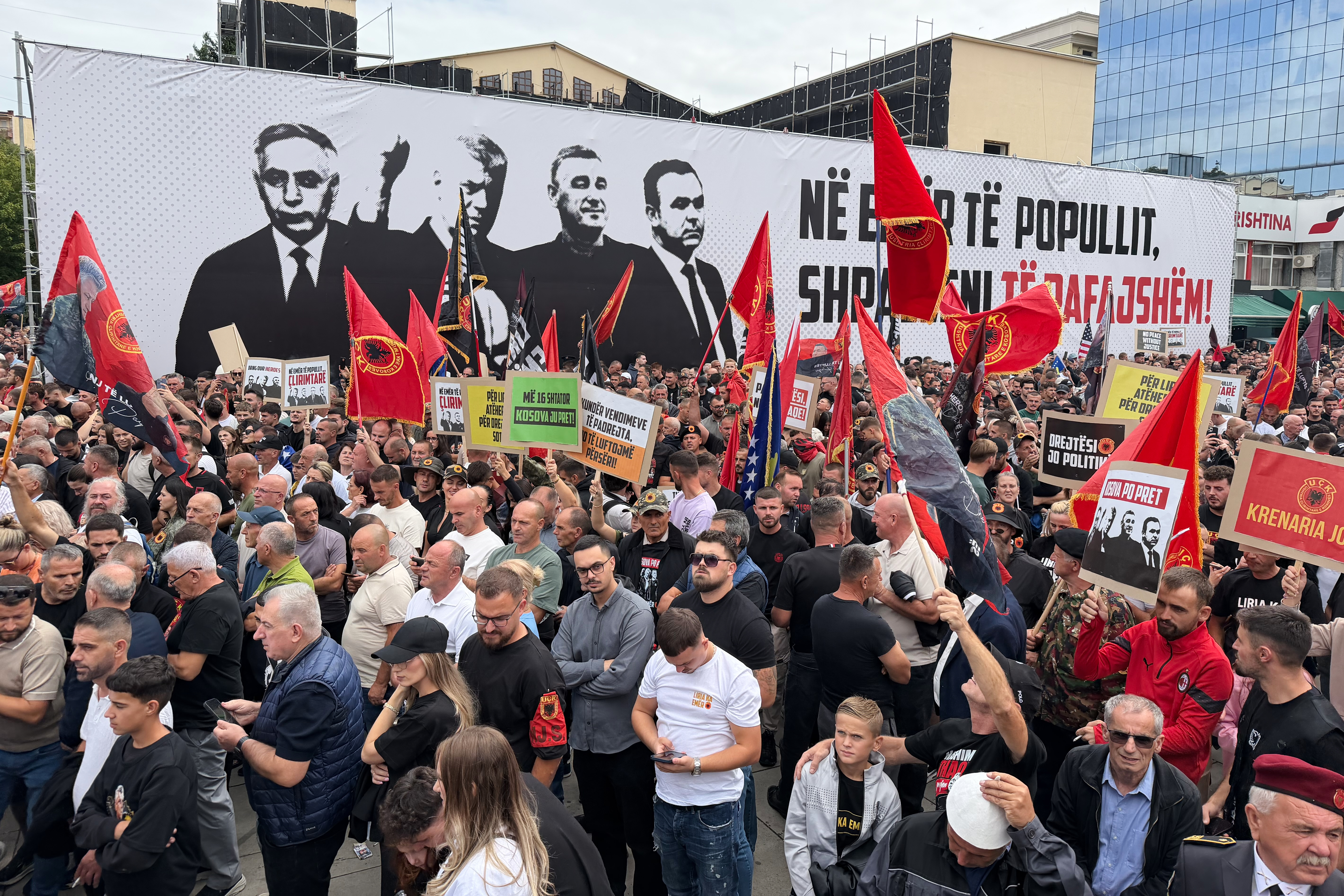 People rally in support of former Kosovan President Hashim Thaci and co-defendants, Kadri Veseli, Rexhep Selimi, and Jakup Krasniqi, in Pristina, Kosovo, on Sept. 12, 2026. (Zana Cimili /AP)
Kosovo Specialist Chambers
Thaci was invited to 1999 peace talks in France, in his role as political director of the Kosovo Liberation Army.
The Kosovo Specialist Chambers was set up with funding by the European Union, Norway, Switzerland, and the United States.
However, the majority of the court’s 100 million-euro ($115 million) budget is funded by the EU and, after U.S. President Donald Trump announced in January 2025 that he was stopping contributions to Kosovo, it was reported that the Kosovo Specialist Chambers was largely unaffected, as Washington mainly funded the salary of the prosecutor.
Some clashes broke out in 2023 and 2024 between the majority ethnic Albanian population in Kosovo and the Serb minority, but the situation has since calmed down.
Serbia still refuses to recognize Kosovo, which seceded in the late 1990s and declared full independence in 2008, which has been recognized by the United States and many other Western countries.
The Associated Press contributed to this report.
 Friends Read Free
Copy
Facebook
Tweet
Friends Read Free
Copy
Facebook
Tweet