
France’s European Minister Benjamin Haddad urged the European Union to use Google’s multibillion-euro fines to cut what each member state pays into the bloc’s budget.
“This is a new revenue for the European Union—worth 4.6 billion euros [approximately $5billion]—that should automatically lower the contributions of all member states,” Haddad said in an interview with Franceinfo TV station on Sept. 29.
In 2018, the European Commission fined Google for breaching EU antitrust rules. Europe’s highest court on July 2 upheld the 4.1 billion-euro ($4.7 billion) penalty, after ruling that Google abused its dominant position by using Android agreements to strengthen its search business and limit competition.
The Court of Justice of the European Union (CJEU) dismissed the appeal filed by Google and its parent company, Alphabet, ending an eight-year legal battle over one of the biggest competition cases ever brought against a technology company.
EU governments are negotiating the budget for the 2028 to 2034 period, including at a Brussels summit in October, in an effort to secure a deal before year-end.
However, France has deteriorating public finances and a major debt burden.
According to a July 29 statement from France’s national statistical agency INSEE, at the end of the second quarter of 2026, the public debt ratio stood at 119 percent of Gross Domestic Product (GDP), up from 117.5 percent in the first quarter.
It said that total gross public debt reached 3.5 trillion euros ($4 trillion) at the end of June. That represents a quarterly increase of 59.6 billion euros ($67.6 billion).
France is currently under the EU’s Excessive Deficit Procedure because its national borrowing and spending break EU fiscal rules. The EU limits a country’s total public debt to 60 percent of GDP.
The EU theoretically has a large pool of fines from its internet laws to dip into.
The Digital Markets Act (DMA) targets very large online platforms (VLOPs) and very large online search engines (VLOSEs), including U.S. companies Alphabet, Amazon, Apple, Meta Platforms, and Microsoft.
The Digital Services Act (DSA) requires large online platforms to do more to tackle illegal and harmful content.
The European Commission fined Google a total of 890 million euros ($1 billion) on July 23 after finding the company breached the bloc’s legislation by favoring its own services in Google Search and restricting app developers from directing customers to alternative purchasing channels outside Google Play.
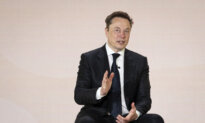
The European Commission fined Elon Musk’s X social media company 120 million euros ($140 million) on Dec. 5 following a two-year investigation, under the DSA.
The commission said that X breached several transparency obligations, with “deceptive design of its ‘blue checkmark,’” lack of transparency in its advertising repository, and failure to provide researchers access to public data.
Under the DSA, Chinese online retailer Temu was fined 200 million euros ($232 million) in May, and AliExpress 550 million euros ($629 million) in July.
Under the DMA, Apple was hit with a 500 million-euro ($570 million) fine, Meta with 200 million euros ($228 million), and Google with 890 million euros ($1.02 billion).
The EU faces a showdown with the Trump administration, which has asked Europe’s second-highest court to allow it to join Elon Musk’s lawsuit seeking to block the fine.
On Sept. 24, the Department of Justice (DOJ) said it had filed an application with the EU’s General Court in support of X’s effort to “annul the case.”
“The European Commission inappropriately attempted to expand its regulatory authority to reach American companies not present or operating within its jurisdiction,” Assistant Attorney General Brett Shumate of the DOJ’s civil division said.
The DOJ said that the United States “has a clear interest in ensuring that the effect of any judgment concerning the Commission’s Decision is consistent with how territorial jurisdiction is generally understood in international law, and does not otherwise prejudice U.S.-headquartered digital services companies, which contribute significantly to the U.S. economy.”
The Epoch Times has contacted Google and the European Commission for comment.
Reuters and Evgenia Filimianova contributed to this report.
 Friends Read Free
Copy
Facebook
Tweet