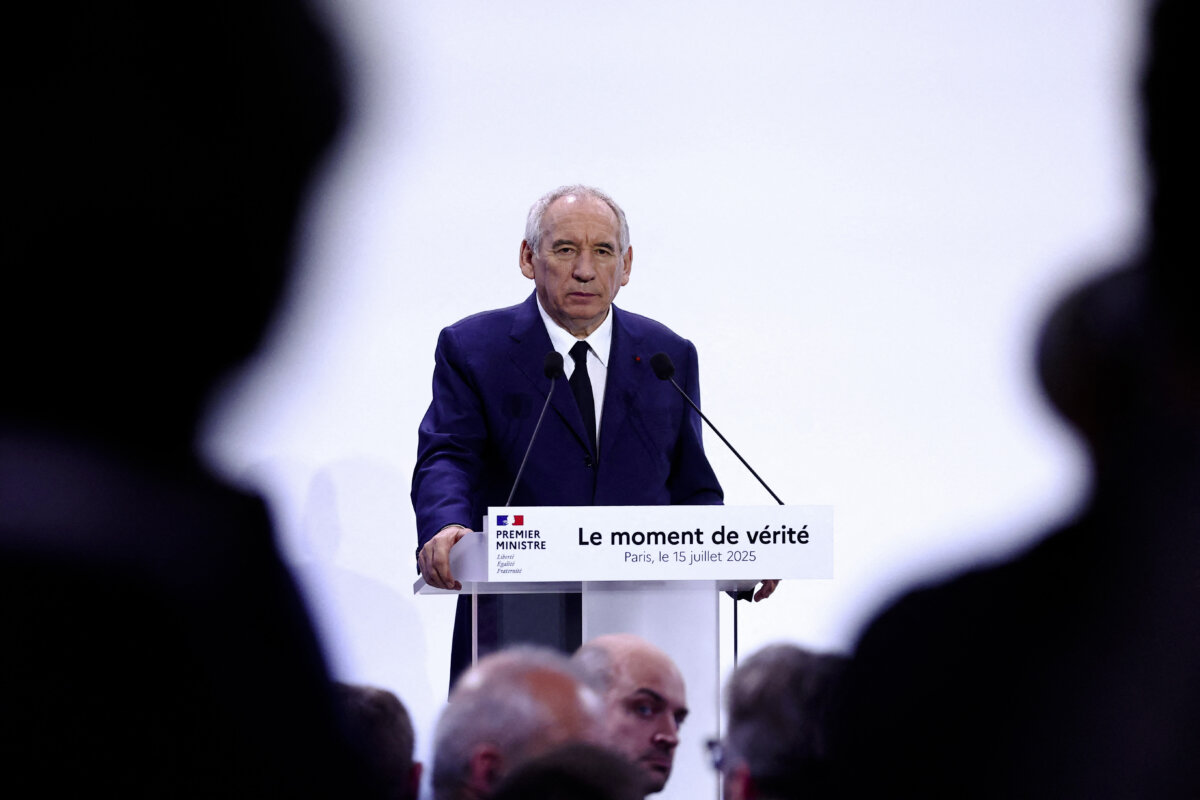

French Prime Minister François Bayrou lost a confidence vote on Sept. 8, deepening a political and economic impasse in the Eurozone’s second-largest economy after opposition leaders from across the political spectrum pledged to oust him.
The minority government’s collapse looks set to deepen France’s problems, leaving President Emmanuel Macron with the task of finding yet another politician to steer a controversial budget through parliament.
The government lost the confidence vote by 194 votes to 364, according to Le Monde.
Macron’s centrist party, Renaissance, heads a fragile minority coalition that relied on allies such as Bayrou’s Democratic Movement (MoDem) to govern.
“You have the power to bring down the government, but you do not have the power to erase reality,” Bayrou told lawmakers before the confidence vote.
“Reality will remain relentless: Expenses will continue to rise, and the burden of debt, already unbearable, will grow heavier and more costly.”
France’s “very survival is at stake,” Bayrou added.
On July 15, Bayrou announced drastic measures to the Senate to reduce the public deficit by 43.8 billion euros (nearly $51 billion) in 2026.
Bayrou’s plan involves freezing welfare spending and even scrapping some public holidays.
Bayrou suggested cutting Easter Monday, as it has no “religious significance,” and May 8, Victory in Europe Day (VE Day).
The plan is aimed at reducing France’s debt, projected to soar to more than 3 trillion euros (about $3.49 trillion) this year, with public debt hovering at about 110 percent of gross domestic product (GDP).
The European Union advises member states to bring their public debts below 60 percent of GDP, and it advises them to not let budget deficits exceed 3 percent of GDP.
According to official EU estimates from May, France’s government deficit is forecast to decline to 5.6 percent of GDP in 2025, and to edge up to 5.7 percent in 2026.
Marine Le Pen, leader of the right-wing National Rally party, said in a Sept. 8 post on X, “Mr. Bayrou and his friends want to make the French pay by increasing taxes by 20 billion. How dare they still tell the people that the only solution would be to make them pay, pay again, always pay?”
Jean-Luc Mélenchon, a leading figure of the left’s France Unbowed (LFI) party, said on Sept. 6 on X: “We want to give birth to the New France, that of women, of the sea, of space, and so many others. Free the homeland from the chains of money, of capitalism! Free humanity.”
Manuel Bompard, LFI national coordinator, wrote in a Sept. 8 post on X: “Bayrou’s downfall is good news for France and its people. We are fighting for genuine policy change, no question of participating in shady deals and betrayals for positions.”
In an earlier post on the same day, Bompard said, “Ready to take down Bayrou and Macron.”
In a speech on Sept. 8, Laurent Wauquiez, the leader of the right-wing Republicans, supported Bayrou and warned of “the path of instability” in politics.
“Political instability is economic poison,” Wauquiez said.
The collapse of former Prime Minister Michel Barnier’s government in early December 2024, after only a couple of months in power, meant that France was unable to pass the budget before the year-end deadline.
Bayrou was named the new French prime minister later that month.
He survived a vote of no confidence on Jan. 16, which was called by the far-left La France Insoumise, the Greens, and the Communists.
Bayrou then used special constitutional powers to force through the 2025 budget.
Article 49.3 allows the government to pass legislation without a vote and was written into the French constitution to bypass deadlocks on important matters.
Defense spending did not face any cuts in the July 15 announcement, however.
Bayrou, born in 1951, argued that some of the economic blame lies with his own generation, the over-60s of France’s population.
“When we were 20 years old, France had zero debt and magnificent growth,” Bayrou said in an interview on Aug. 31.
“That generation should be with me in reducing the debt burden on younger people.”
Reuters contributed to this report.
 Friends Read Free
Copy
Facebook
Tweet
Friends Read Free
Copy
Facebook
Tweet