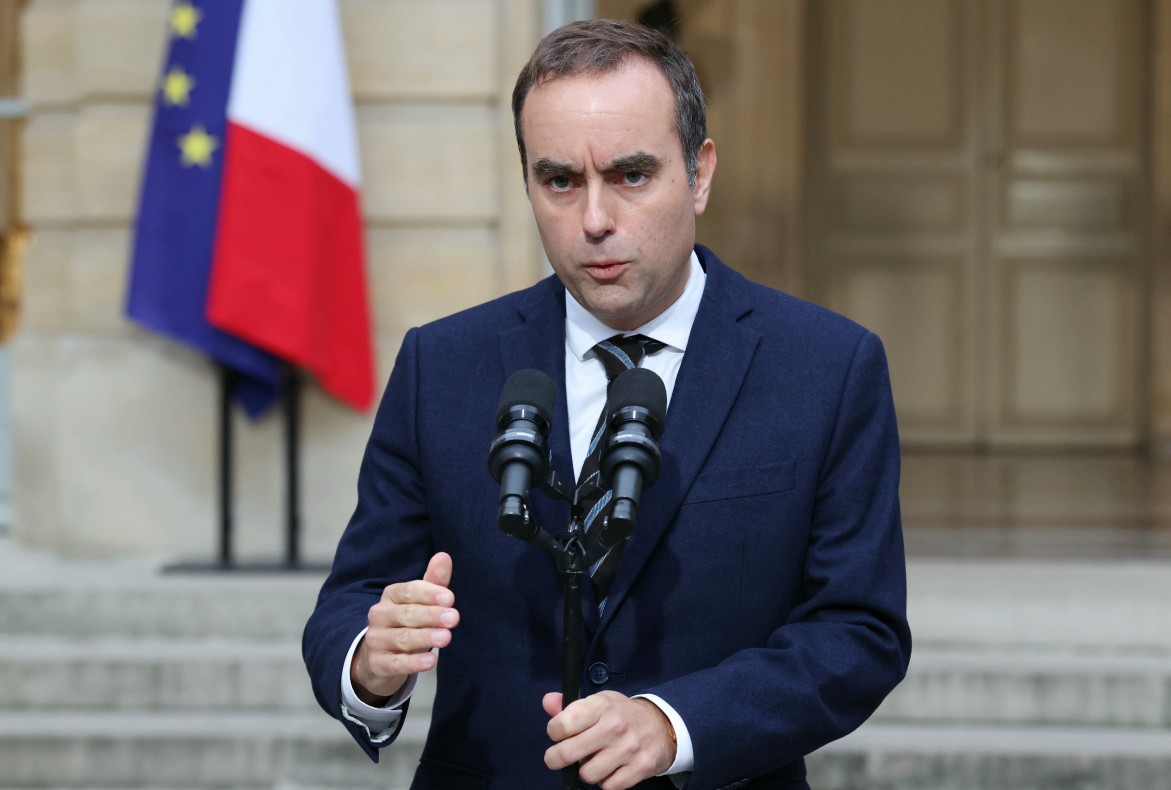
French Prime Minister Sébastien Lecornu has resigned after less than a month in office, the French presidency stated on Oct. 6.
The announcement came a day after Lecornu, a former defense minister, put together a new government and named Roland Lescure as finance minister.
Lecornu, 39, was France’s fourth prime minister in barely a year and was appointed by Macron on Sept. 9.
In his resignation speech, Lecornu said, “By being more selfless for many, by knowing how to show humility. One must always put one’s country before one’s party.”
The Eurozone’s second-largest economy faces a political and economic impasse as Macron struggles to find someone who can guide his controversial budget through the National Assembly.
On Oct. 7, Lecornu was due to give a speech to the National Assembly, outlining his government’s plans for the future, but his sudden resignation means that Macron will have to seek a fifth prime minister.
Unions and left-wing activists protesting at planned cuts to public services have staged three days of nationwide protests since Lecornu’s appointment, including one that shut down the Eiffel Tower on Oct. 2.
French stocks fell on the morning of Oct. 6 following the news, with the CAC-40 index down 2 percent from its Oct. 3 close.
Macron has not spoken publicly since Lecornu resigned.
Marine Le Pen, the former leader of the right-wing National Rally who lost to Macron in the 2022 presidential election, said the resignation raises a question for the president.
“Can he continue to resist the legislature’s dissolution?” Le Pen said. “We have reached the end of the road. There is no other solution. The only wise course of action in these circumstances is to return to the polls.”
In March, Le Pen was convicted of embezzlement and banned from public office for five years, ruling her out of the 2027 election.
Agnès Pannier-Runacher, who had just been reappointed as ecology minister on Oct. 5, said in a post on X that France cannot move forward without “reaching out to those who, despite our differences, share the same demand: that of serving France and the French people.”
“Like many of you, I despair of this circus where everyone plays their part, but no one takes responsibility,” Pannier-Runacher wrote. “Today, I call on everyone to pull themselves together. We won’t get out of this rut by cultivating divisions.”
Lecornu’s predecessor, François Bayrou, was ousted in a no-confidence vote on Sept. 8, after being appointed to the job by Macron in December 2024.
Macron was reelected as president in 2022, but in 2024 his Ensemble pour la République coalition fared badly in legislative elections, losing 86 seats.
The left-wing Nouveau Front Populaire (NPF) coalition became the biggest party in the National Assembly, and the right-wing National Rally, led by Jordan Bardella, also gained a large number of seats.
Between them, they objected to spending cuts in Macron’s proposed budget.
France is not due to have a presidential election until April 2027.
‘No Room to Maneuver’
Bardella told BFM TV on Oct. 6: “There is no doubt that the ephemeral prime minister had no room to maneuver, and it was certainly Emmanuel Macron himself who formed his government. … There can be no stability without a return to the polls and a dissolution of the National Assembly.”
On Oct. 5, Lecornu had reshuffled his ministers, giving Lescure the finance minister’s job and moving Bruno Le Maire to defense. He kept Bruno Retailleau as interior minister, Jean-Noël Barrot as foreign minister, and Gérald Darmanin as justice minister.
Lecornu had announced that he would not employ a special constitutional power that his predecessors used to force a budget through Parliament without a vote and would seek a compromise with lawmakers in the National Assembly.
The NPF had already threatened Lecornu with a no-confidence vote, and the National Rally is pushing for fresh legislative elections.
Jean-Luc Mélenchon, one of the leaders of the NPF, wrote in an Oct. 6 post on X, “Following the resignation of Sebastien Lecornu, we call for the immediate consideration of the motion tabled by 104 MPs for the impeachment of Emmanuel Macron.”
France’s political instability threatens to weaken Macron’s position as he wrestles with international issues, including wars in Ukraine and Gaza, and seeks to improve relations with U.S. President Donald Trump.
Macron’s predicament is based on his decision in June 2024 to dissolve the National Assembly, the French Parliament’s lower house, in the hope of gaining a stronger hand. He ended up losing a large number of seats and now finds himself at the whim of the opposition parties.
No French president has been impeached and removed from office, leading to a new presidential election, since the start of the Fifth Republic, the modern era of French politics, which began in 1958.
Élisabeth Borne was the first prime minister to serve under Macron during his second term, from May 2022 to January 2024, and her successor, Gabriel Attal, lasted only 8 months.
Michel Barnier, the European Union’s chief Brexit negotiator, then took over for 99 days before Bayrou was appointed in December 2024.
The Associated Press and Reuters contributed to this report.
 Friends Read Free
Copy
Facebook
Tweet
Friends Read Free
Copy
Facebook
Tweet