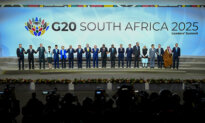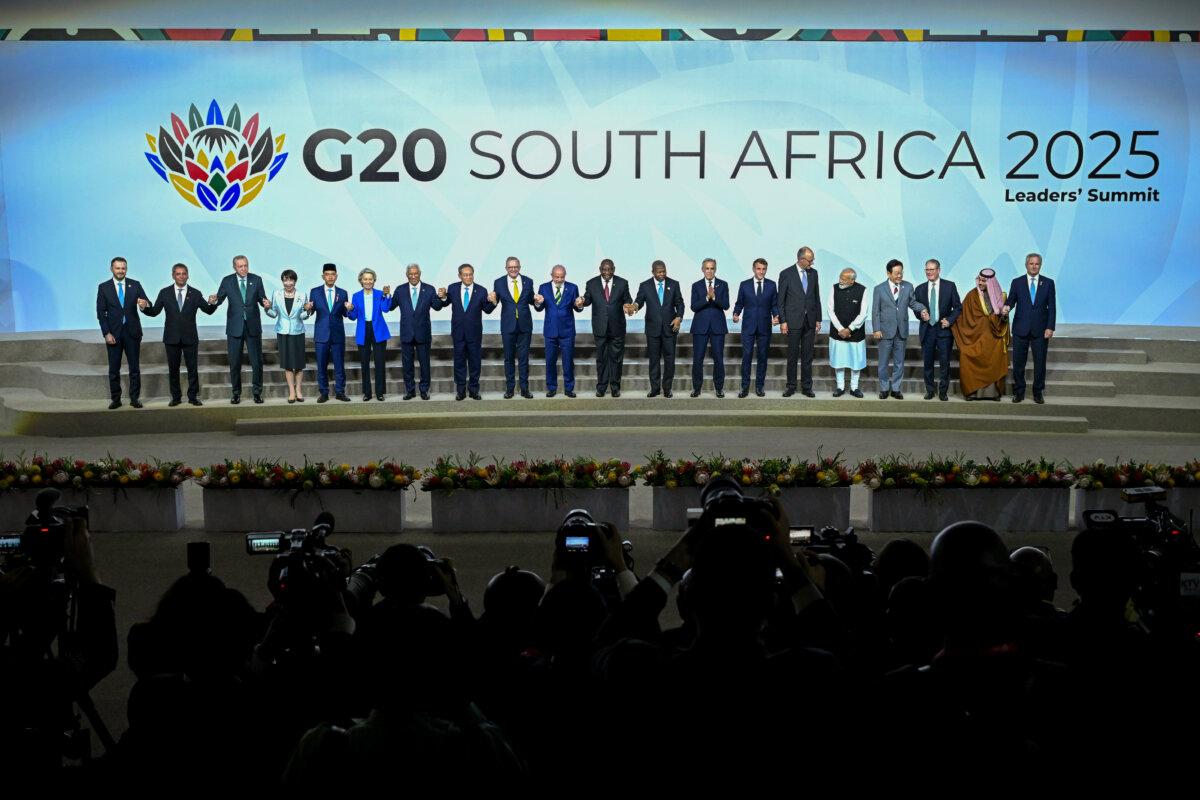

World leaders of the Group of 20 nations adopted a new declaration covering a range of topics on Nov. 22, without input or buy-in from the United States.
While declarations are typically passed at the end of a given G20 summit, the gathered global leaders this time elected to adopt their declaration shortly after convening their two-day summit in South Africa.
“Normally the adoption happens right at the end but throughout the day yesterday, during various bilateral talks, there was a sense that we should actually move to have the summit declaration adopted first as a first order of the day and then proceed with the rest of the day,” said Vincent Magwenya, a spokesman for South African President Cyril Ramaphosa.
The 122-point declaration calls for global efforts to help developing nations better contend with natural disasters, as well as climate-related efforts. Other sections of the declaration seek to help poorer countries manage their sovereign debt and increase economic stability.
Additional points in the declaration encourage efforts to address food and energy security in the developing world, and cover critical mineral and artificial intelligence development initiatives and frameworks.
The declaration also includes statements reaffirming the position of the United Nations Charter, in opposing countries seizing territory from one another by force.
“We will work for a just, comprehensive, and lasting peace in Sudan, the Democratic Republic of Congo, the Occupied Palestinian Territory, Ukraine, as well as ending other conflicts and wars around the globe,” one point reads.
U.S. President Donald Trump announced in early November that he would boycott the G20 leaders’ summit, and condemned the human rights record of the host nation.
“It is a total disgrace that the G20 will be held in South Africa,” Trump wrote in a Nov. 7 post on his Truth Social platform.
“Afrikaners (People who are descended from Dutch settlers, and also French and German immigrants) are being killed and slaughtered, and their land and farms are being illegally confiscated. No U.S. Government Official will attend as long as these Human Rights abuses continue.”
Trump ended his boycott announcement by stating that he looks forward to hosting next year’s G20 leaders’ summit in Miami.
In addition to the United States, the G20 consists of Argentina, Australia, Brazil, Canada, China, France, Germany, India, Indonesia, Italy, Japan, Mexico, Russia, Saudi Arabia, South Africa, South Korea, Turkey, and the UK, as well as the European Union and the African Union.
Argentine President Javier Milei also did not attend the summit, and Argentina was instead represented by its foreign minister, Pablo Quirno. Buenos Aires likewise rejected the declaration adopted by the other G20 members on Nov. 22.
“We appreciate the firm stance of the great Republic of Argentina in rejecting a document that speaks of ‘solidarity,’ ‘equality,’ and ‘sustainability’ without grounding those principles in the framework of freedom, the rule of law, and economic growth,” U.S. Deputy Secretary of State Christopher Landau said in a post on X on Nov. 22.
Other attendees at the summit used the occasion to discuss a proposal offered by the Trump administration to end the fighting in Ukraine.
In a joint statement issued at the G20 summit, the leaders of the European Union, France, Germany, Italy, Canada, and the UK said the draft “includes important elements that will be essential for a just and lasting peace,” but called it a “basis which will require additional work.” They were joined in their statement by non-G20 members, including the prime ministers of Poland, Ireland, Norway, and Spain.
Tom Ozimek contributed to this report.
 Friends Read Free
Copy
Facebook
Tweet
Friends Read Free
Copy
Facebook
Tweet