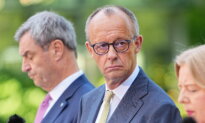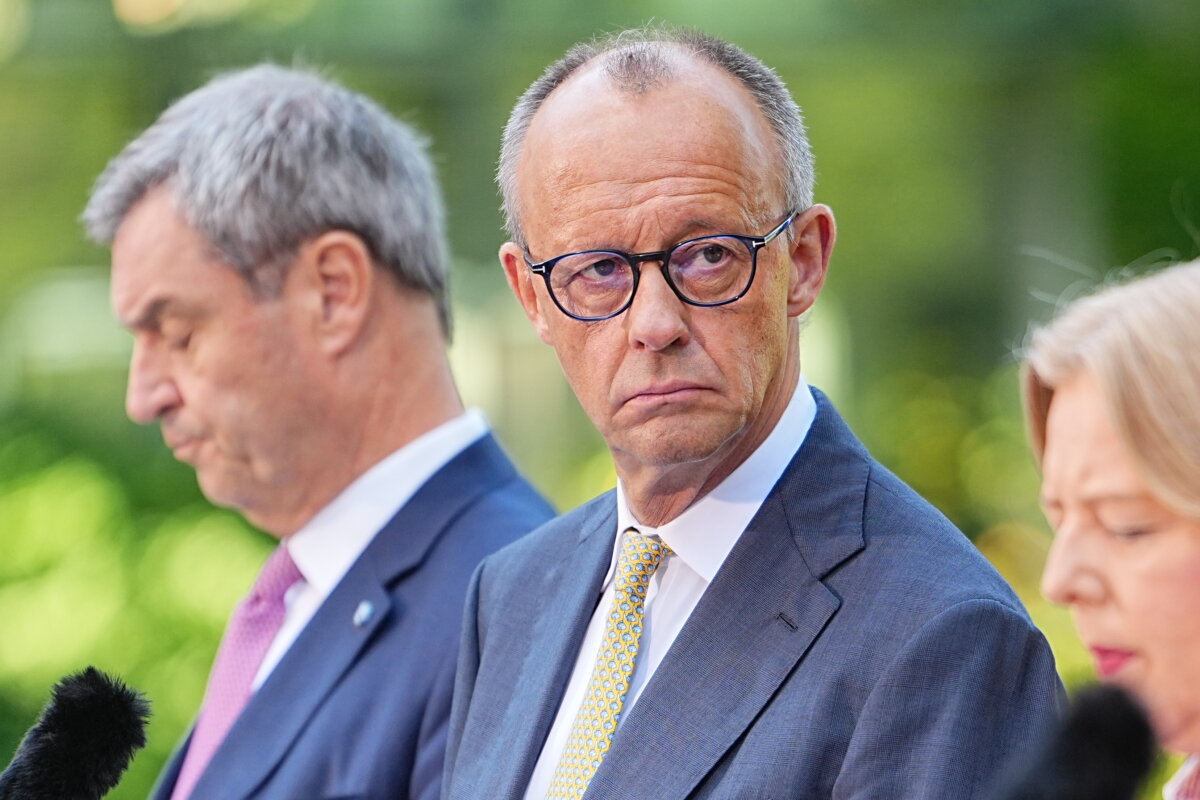

German Chancellor Friedrich Merz on July 2 announced a 34-point reform package featuring 10 billion euros ($11 billion) in annual tax relief, an 8 percent reduction in federal ministry staffing, and stricter requirements for workers to provide medical certificates when taking sick leave.
German Chancellor Friedrich Merz outlined the pension, tax, and labor reform package on July 2.
Merz said the government aimed to pass the main elements of the 34-point package through parliament by the end of the year.
“We want to get Germany back on track,” Merz told reporters on July 2.
The government also wants to cut staffing in federal ministries by 8 percent through digitization.
The tax relief will be mainly funded by raising the top rate of tax to 47 percent from 45 percent for the highest earners with an annual income of 280,000 euros ($320,000) or more.
In April, Germany’s economy ministry cut its growth forecasts in half for 2026 and 2027 amid the war in Iran.
“The economic recovery expected for this year will once again be slowed down by external geopolitical shocks,” German Economy Minister Katherina Reiche said in an April 22 post on Facebook presenting Germany’s spring forecast.
The government said it expects 0.5 percent growth for 2026, down from an earlier projection of 1 percent, and cut its 2027 growth outlook to 0.9 percent from 1.3 percent.
Germany, Europe’s largest economy, known for its skilled labor force and high-end exports, was already facing significant hurdles prior to the Iran conflict.
In Germany, a combination of energy crises, political instability, and declining competitiveness has already been threatening the country’s long-standing status as the major industrial force of the European Union.
After two years of contraction in 2023 and 2024 and stagnation in 2025, the country has been struggling with the loss of affordable Russian gas, historic Volkswagen plant closures, and fierce competition from cheaper Chinese electric vehicles.
“The reform train has no brakes … this is a substantial package designed to strengthen Germany as a business location in the long run and put public finances on a sustainable footing,” said Carsten Brzeski, global head of macro at ING.
“One is tempted to shout, ‘Finally!’ It took a year, but the ‘summer of reform’ has arrived,” he said.
“Amongst measures to cut red tape are plans to make working on Sundays and public holidays financially more attractive, the obligation to hand in a doctor’s attestation not only on the fourth day of sick leave but from the first day onwards, and a simplification of data protection rules as well as an end to gold-plating of European regulations,” Brzeski continued in an ING post July 2.
“Most of today’s announced measures have not come out of the blue. The bureaucracy detox and simplifications were already presented in two important reports at the end of last year. What is new is the tax relief for lower and middle-income households,” he added.
Employers’ Association president Rainer Dulger welcomed the package as a “long-overdue change of course.”
Christiane Benner, chair of Germany’s largest union, IG Metall, welcomed tax relief for employees but criticized the rise in fixed-term employment contracts as an “attack on workers’ rights.”
“The government has demonstrated its ability to agree on key structural reforms and implement them by the end of the year,” said Marion Muehlberger from Deutsche Bank Research, calling it one of the most significant reform packages in decades.
“This is likely to boost sentiment and reinforces our forecast of accelerating economic growth in the second half of the year.”
Merz governs through a coalition comprising his conservative CDU/CSU alliance and the center-left Social Democratic Party (SPD).
Recent polling from Politpro has put the right-wing Alternative for Germany (AfD) in the lead.
In a July 2 post on X, AfD co-leader Alice Weidel described Merz’s recent agreement as “another broken CDU election promise, even more left-wing redistribution and minimal compromises that don’t deserve the name ‘reform.'”
Reuters contributed to this report.
 Friends Read Free
Copy
Facebook
Tweet
Friends Read Free
Copy
Facebook
Tweet