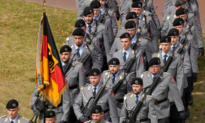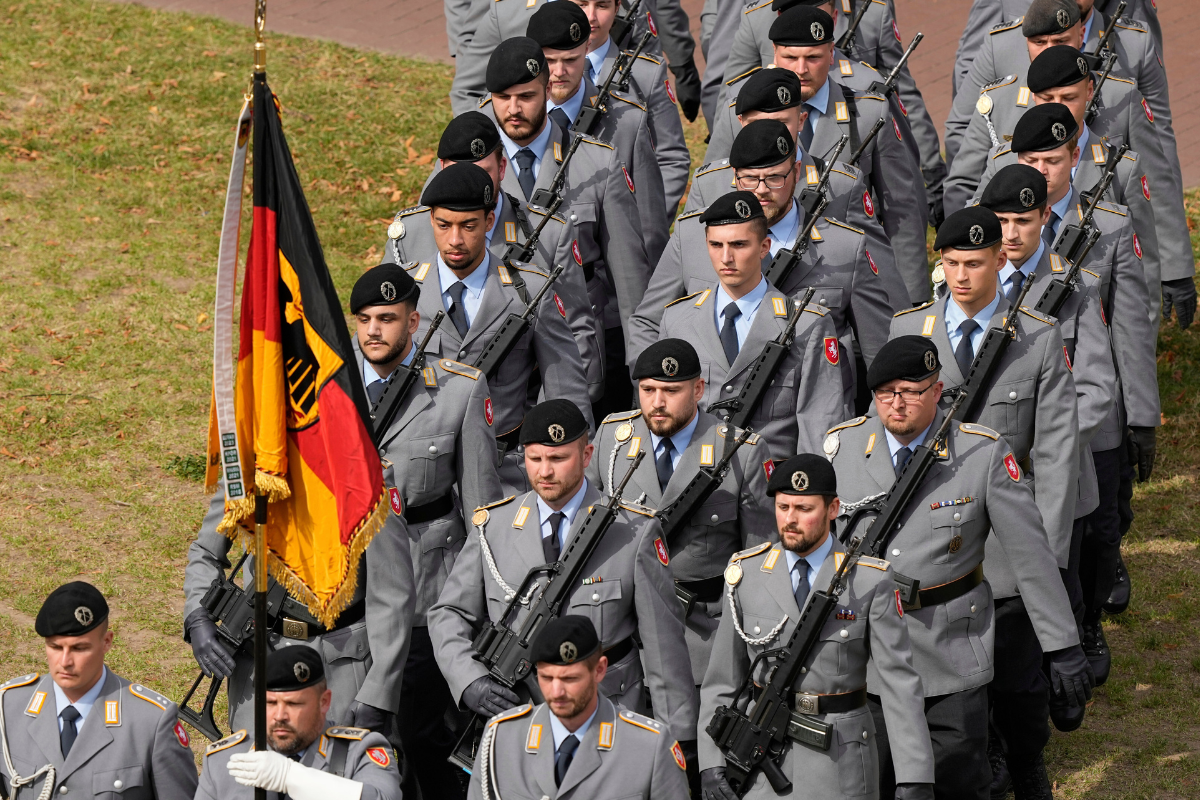

NATO will add another tactical headquarters, led by Germany and the Netherlands, to strengthen the alliance’s defense of its eastern flank and deter Russian aggression.
In a May 28 joint press release, the German and Dutch ministries of defense said that 1 German-Netherlands Corps (1GNC) will assume a command role specifically in the region of Estonia and Latvia. The role will be formalized this summer.
“The deployment of an additional tactical headquarters to the region strengthens the cohesion of NATO and supports the deterrence of Russia,” the statement said.
In its role, 1GNC will be responsible for directing exercises and other activities to prepare for conflict, and in the event of conflict, defending the eastern flank.
Currently, this responsibility lies with the Multinational Corps North East (MNC NE), which is based in Szczecin, Poland. MNC NE has around 20 contributing NATO members. It was set up in 2017 in response to Russia’s 2014 annexation of Crimea.
Creating this second command zone could allow NATO to devote more troops to the Baltic region, which is most at risk from a potential Russian attack.
NATO has said Russia could launch a major assault on allied territory as early as 2029, if its armament efforts persist—an intention that Moscow denies.
German Defense Minister Boris Pistorius said the integration of this second corps headquarters in the region shows Germany and the Netherlands “are assuming further responsibility for the security of Europe.”
Pistorius said the two countries were committed to their roles, and that this corps will provide a “success story of multinational cooperation.”
“This is what interoperability and responsibility for Europe look like,” he said.
1GNC was established in 1995 and can command an international military force of approximately 50,000 personnel, according to the German and Dutch defense ministries.
NATO Working for All Members
Pressure on European NATO members to take more responsibility for their own defense has mounted following criticism from President Donald Trump, who has accused the bloc of not pulling its military weight.
The Trump administration has also accused some members of failing in their obligation to support the United States in its missions—specifically over their lack of support during the Iran conflict, including Spain, which has denied the United States use of its bases for Iranian missions.
U.S. Secretary of State Marco Rubio said last week that the NATO alliance must work for all its members.
“Like any alliance, it has to be good for everyone who’s involved. There has to be a clear understanding of what the expectations are,” Rubio said on May 22.
“I don’t think anyone is shocked to know that the United States and the president, in particular, is very disappointed at NATO right now. … Why is NATO good for America? Because it gives us bases in the region that allow us to project power during a contingency in the Middle East or somewhere else.”
“So, when that is the key rationale for why you’re in NATO, and then you have countries like Spain denying us the use of these bases, well then, why are you in NATO?”
US Reorients Security Priorities
The drive for Europe to do more to secure its own defense also comes as the United States reorients its defense and security priorities.
The Pentagon, on Jan. 23, released its National Defense Strategy, which outlines the U.S. plan to prioritize homeland defense, including by “defending America’s interests throughout the Western Hemisphere.”
It also stated that the United States would encourage partners in other parts of the world, including Europe, to take primary responsibility for their own defense “with critical but limited support from U.S. forces.”
At the European Political Community summit in Armenia on May 4, British Prime Minister Keir Starmer said that there needs to be a “stronger European element in NATO.”
Starmer said that while Europe needed to take more of a security lead, it has “been behind the curve for too long: over dependencies, over reliance, and assumptions about the world that we live in—they’ve gone.”
“We now need to lead out of this, and we need to do it at pace because these impacts are real,” he said.
Reuters contributed to this report.
 Friends Read Free
Copy
Facebook
Tweet
Friends Read Free
Copy
Facebook
Tweet