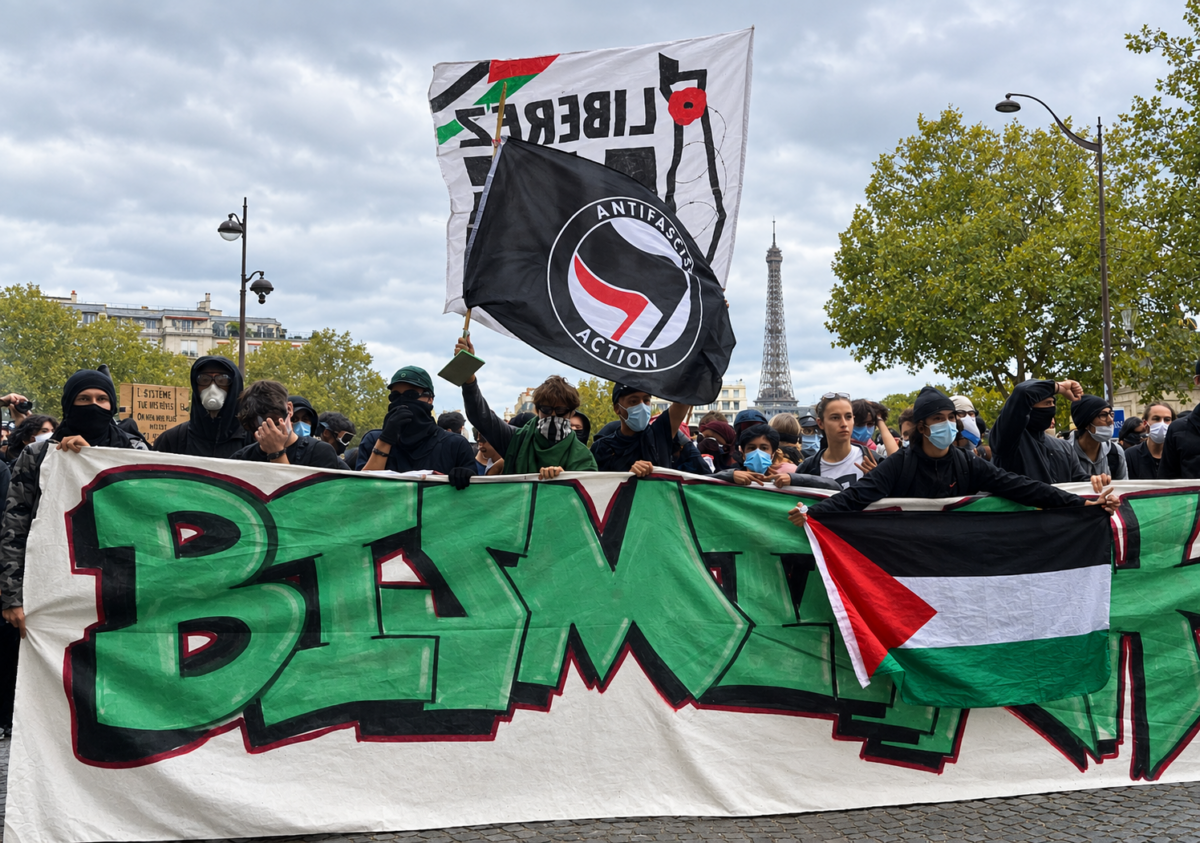

PARIS—“Only one solution, revolution!” shouted the first protesters as they arrived at Place Vauban late Tuesday afternoon. They were leading one of two marches converging on the square behind Les Invalides, the historic military complex in central Paris.
Familiar refrains followed. “Down with the state, the cops and the fascists,” “Everyone hates the police,” and the Italian chant “Siamo tutti antifascisti” (“We are all antifascists”) rose from a crowd in which, as on previous days, some carried Palestinian and communist flags alongside placards calling to “tax the rich” and “resist fascism.”
Tuesday marked the fifth nationwide day of protests since the movement began on Sept. 18, when students started blocking high schools in the Paris suburbs. The unrest has since spread to universities and attracted support from teachers’ unions and left-wing political groups.
Thunberg Joins Protesters in Saint-Denis
Earlier that morning, Swedish climate activist and pro-Palestinian campaigner Greta Thunberg had made an appearance outside the Lycée Paul-Éluard high school in Saint-Denis, a suburb north of Paris with a large immigrant population that has become one of the main centers of the protests.
There, she joined more than a hundred protesters gathering to blockade the school.
“I am extremely proud of French students,” Thunberg told reporters. “Our future is being robbed away from us.”
Her visit was welcomed by Saint-Denis Mayor Bally Bagayoko, a member of the far-left France Unbowed party, or LFI, who described the city on X as “the capital of resistance and of the convergence of struggles.”
On the right, National Rally MP Jean-Philippe Tanguy dismissed Thunberg’s presence as “political [opportunism] at its absolute lowest.”
“Poor Miss Thunberg doesn’t even speak French. Let her stay in Sweden,” he said.
Thunberg appeared only in the morning, outside the Saint-Denis high school, and was not seen at the main protest in the afternoon.
Government Sees Movement Fading
According to the Interior Ministry, 161,500 people took to the streets across France, including 41,500 in Paris, where two separate marches were held. The far-left student organizations behind the mobilization put the nationwide turnout much higher, at 480,000.
The government’s figures pointed to a decline in participation from the previous week, when 266,000 demonstrators had been counted.
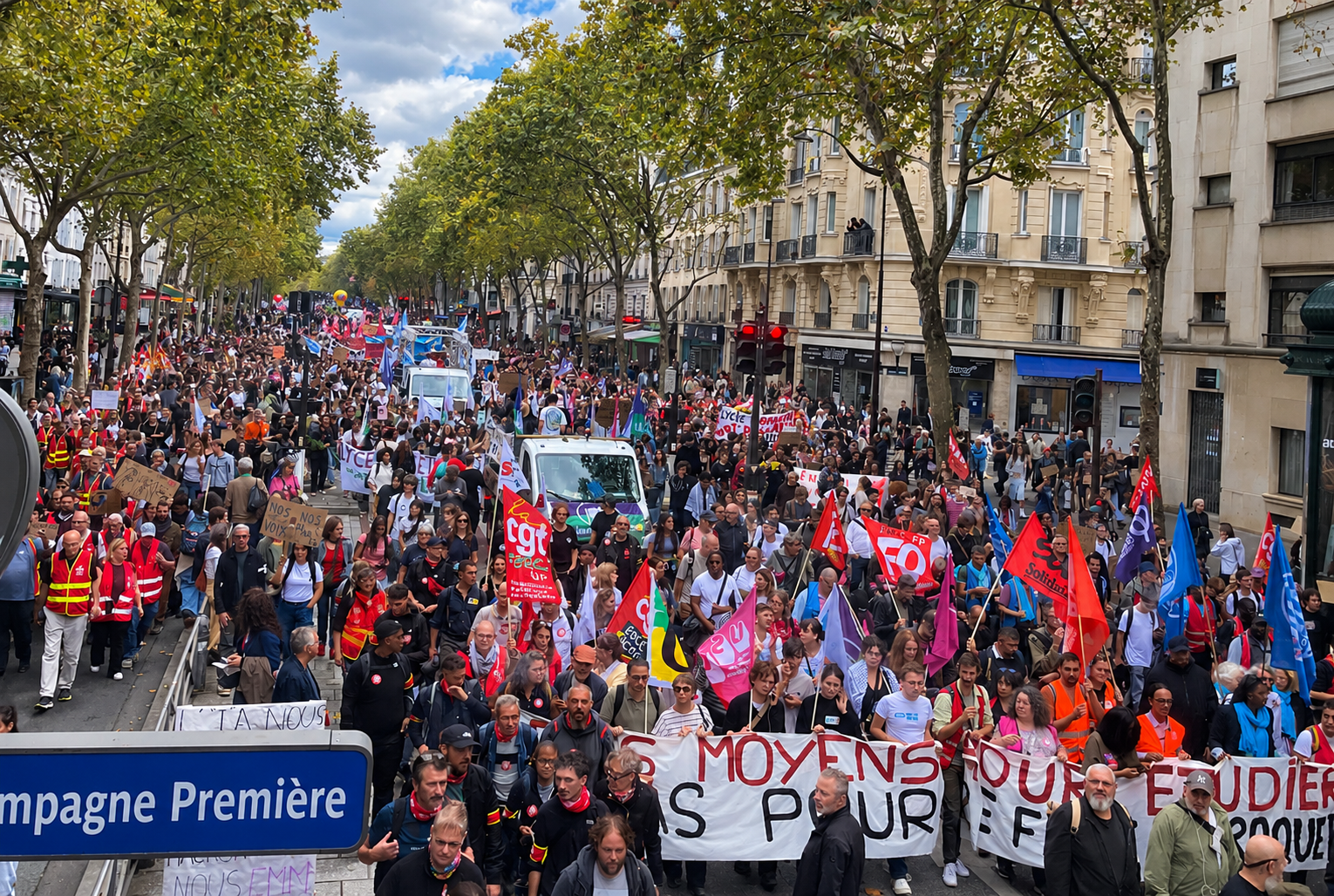 Thousands of demonstrators, including students, teachers and trade union members, march through Paris on Oct. 13, 2026. (Etienne Fauchaire/The Epoch Times)
The violence, however, remained a serious concern for the ministry, which described the situation as “very worrying.” On Monday alone, 20 school staff members, including five principals, were injured, bringing the total to 147 since the unrest began.
Like the turnout estimates, figures at the universities differed. The left-wing Student Union claimed that 90 percent of universities had been blocked or closed; the Higher Education Ministry reported disruptions at 35 percent of institutions.
Car Set Ablaze, Shops Attacked
On Tuesday evening, Interior Minister Laurent Nuñez told reporters that 50 police officers had been injured in the capital, warning that the toll could rise.
Eleven officers had been hospitalized, two of whom required surgery for what Nuñez described as “deep injuries.” He blamed far-left protesters, some of whom had torn up large numbers of cobblestones from Place Vauban to throw at police.
At Place Vauban, tensions escalated soon after the demonstrators arrived in the afternoon. Groups of protesters confronted lines of riot police, while others farther back threw stones and glass bottles at officers. Police responded with tear gas and eventually brought in water cannons to disperse those who refused to leave the square.
At around 5 p.m., the storefront of a Nicolas wine shop near Duroc metro station was smashed. Shortly afterward, a car was set ablaze on Boulevard des Invalides, before firefighters arrived to extinguish the flames.
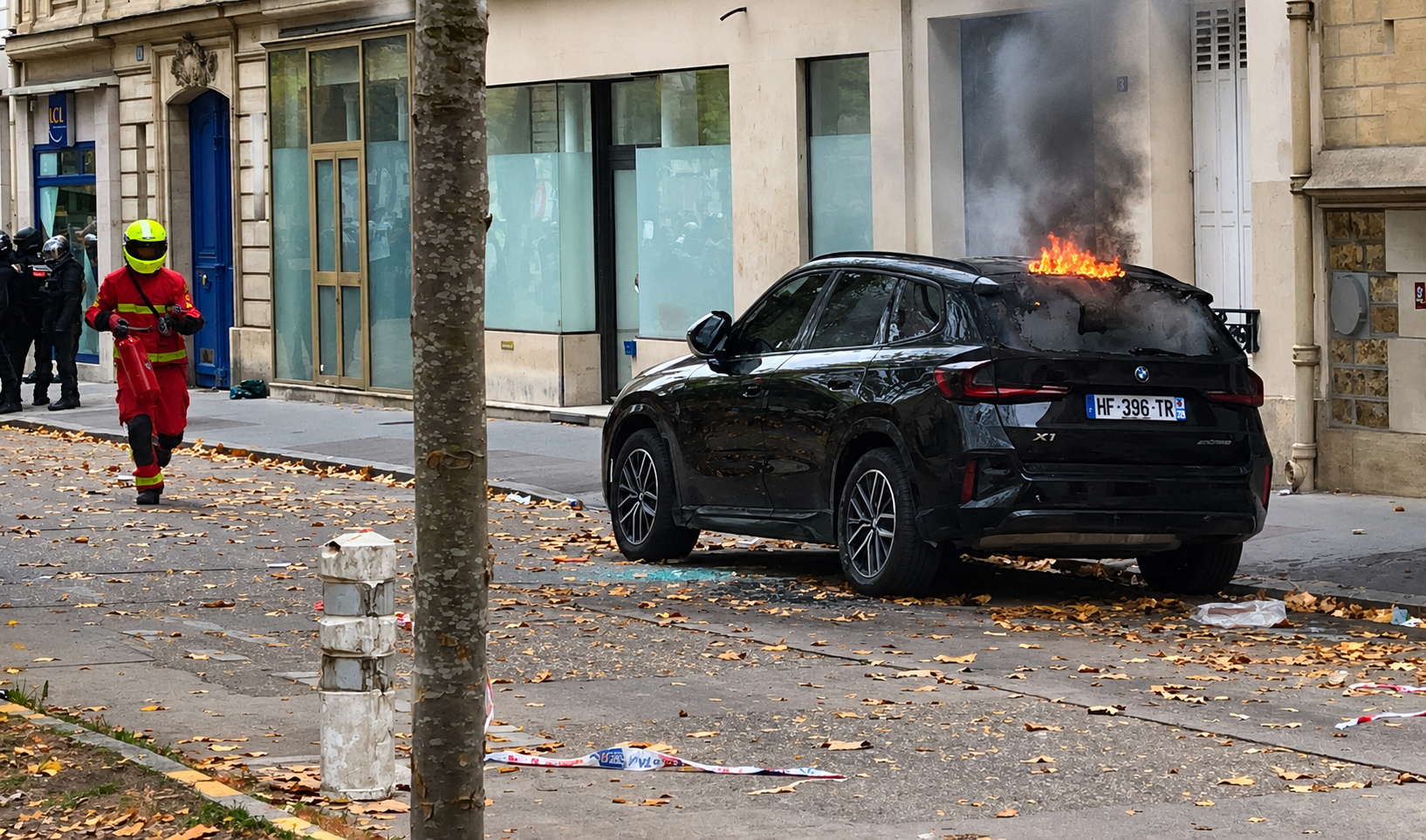 A BMW SUV set on fire by rioters burns on Boulevard des Invalides in Paris as a firefighter approaches the vehicle on Oct. 13, 2026. (Etienne Fauchaire/The Epoch Times)
Paris was not the only city to see violence.
In Lyon, France’s third-largest city, police ordered demonstrators to disperse shortly after 1:30 p.m local time. The regional prefecture reported that “a group made up of very hostile individuals at the front of the procession” had damaged businesses, attacked a gas station and assaulted police officers.
Riot police also used tear gas against protesters in Nantes and Strasbourg, while two people were arrested in Rennes, in western France.
Summing up the day’s unrest, Nuñez said police “had to intervene everywhere across the country.”
‘Convergence of Struggles’
The revolutionary slogans heard Tuesday also reflected how far the movement is beyond students’ grievances: deteriorating school buildings, teacher shortages, and long school hours.
Leading the march from Place d’Italie were several lawmakers from the France Unbowed party, including its founder, Jean-Luc Mélenchon, and national coordinator Manuel Bompard.
On X, Mélenchon accused the police of trying to “beat them up and injure them,” referring to the students, and said the media were underreporting police violence.
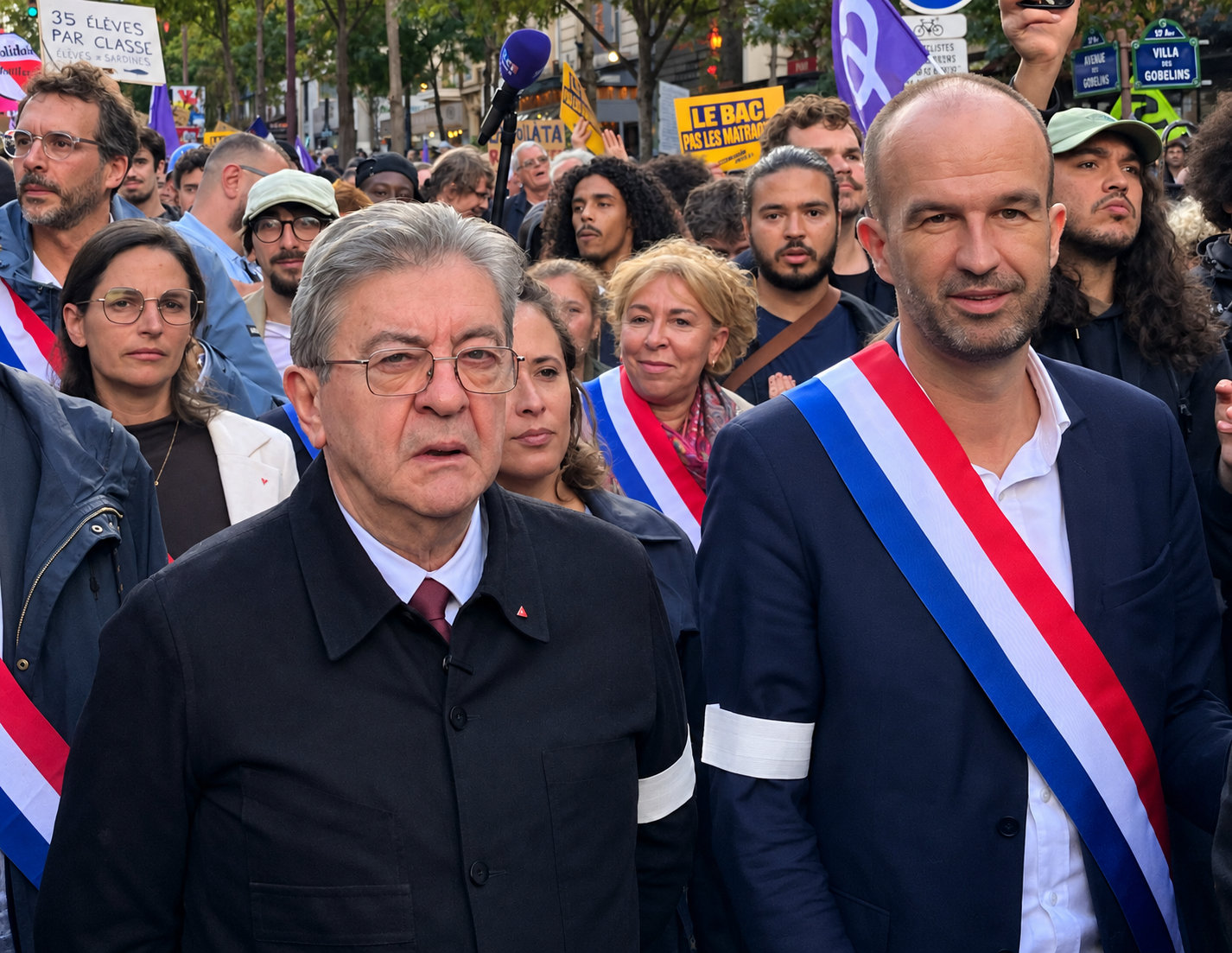 Jean-Luc Mélenchon (L), founder of the left-wing France Unbowed party, and Manuel Bompard (R), the party’s national coordinator, march with protesters in Paris on Oct. 13, 2026. (Etienne Fauchaire / The Epoch Times)
“Today in Palestine, pupils cannot go to school properly,” she told The Epoch Times. She went on to deplore the “catastrophic state” of French high schools and hospitals before declaring that “the only solution is LFI in power” in 2027.
Noah, a 21-year-old film student, carried a megaphone bearing an antifascist symbol. He told The Epoch Times that he had come primarily to support the high school students, but also to protest the rising cost of higher education.
He said he intended to return to the streets on Oct. 17, this time to demonstrate “against the government and the system in place.”
Next Up: Oct. 17
Another day of protests is already being planned for Saturday, with organizers hoping to bring together students and the Yellow Vest movement, a populist movement that began in 2018 with protests against fuel prices but grew into a nationwide uprising against income inequality and the high cost of living.
Before Tuesday’s march, Ryad Rani, president of the High School Students’ Union, told demonstrators: “We will not give up anything and we will not sell anything off.”
He then called on supporters to “massively join the Yellow Vest movement on Saturday to finally bring this convergence of struggles to life.”
The Oct. 17 mobilization first emerged on social media, without any formal organizing body. Centered on fuel prices and the rising cost of living, it is expected to involve marches and blockades across France. The date also coincides with the start of the autumn school holidays.
Thunberg added her voice to the call on Tuesday evening. In a video posted on Instagram, she denounced what she called “extreme police brutality” against French students and urged people to join the Oct. 17 demonstrations.
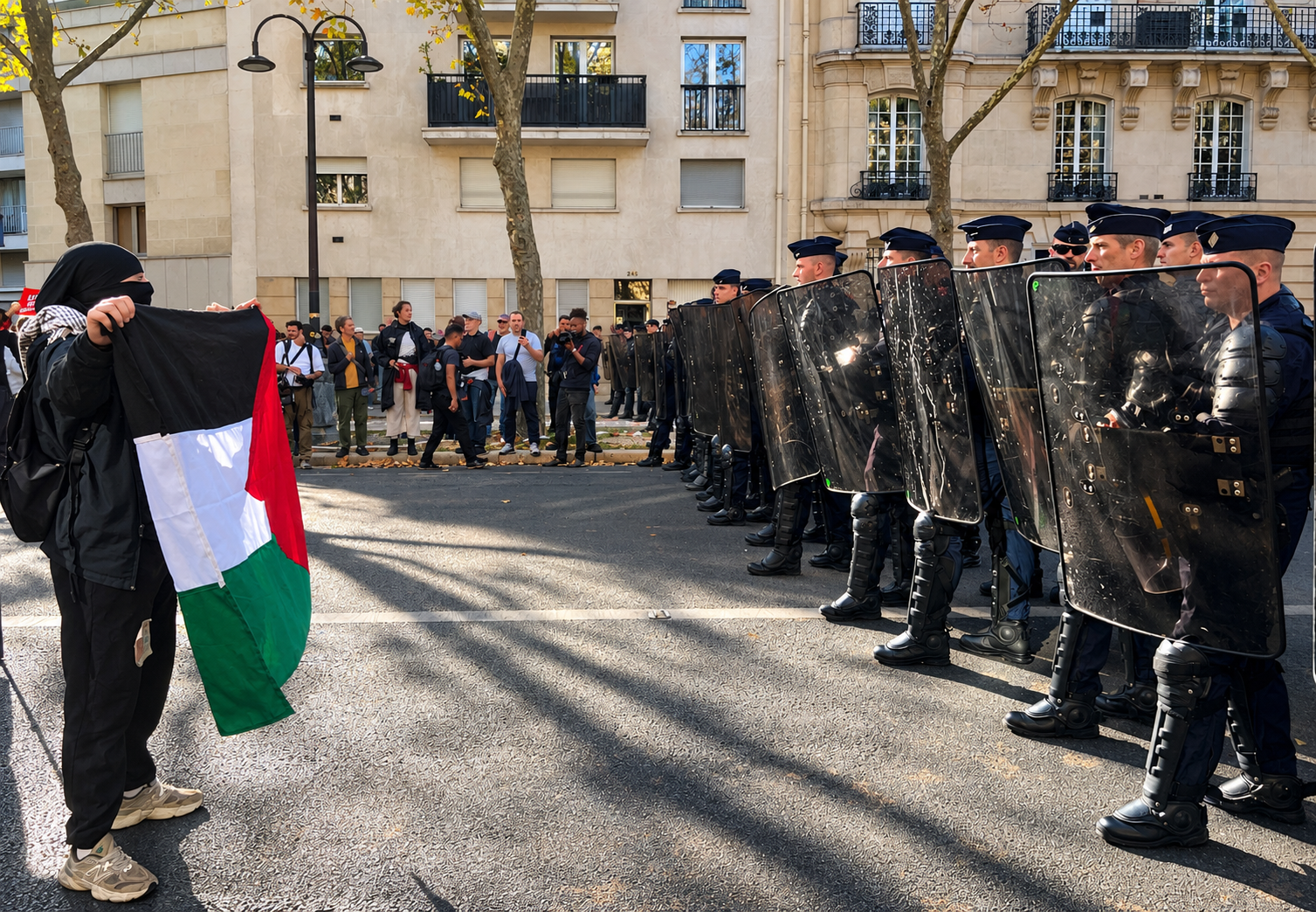 A masked protester waves a Palestinian flag in front of a line of riot police on Oct. 13, 2026. (Etienne Fauchaire/The Epoch Times)
The accusation has also been leveled in the opposite direction. Some on the right accuse the left of having infiltrated and taken control of this movement.
The Yellow Vest movement was initially met with suspicion from the left.
CGT leader Sophie Binet, who joined Tuesday’s march in Paris, has already called for another nationwide day of strikes on Nov. 5.
 Friends Read Free
Copy
Facebook
Tweet
Friends Read Free
Copy
Facebook
Tweet