
Terrorist group Hamas said on Aug. 3 it is willing to allow aid to reach Israeli hostages held in the Gaza Strip, but only if Israel agrees to permanently open humanitarian corridors and halts its airstrikes during aid distribution.
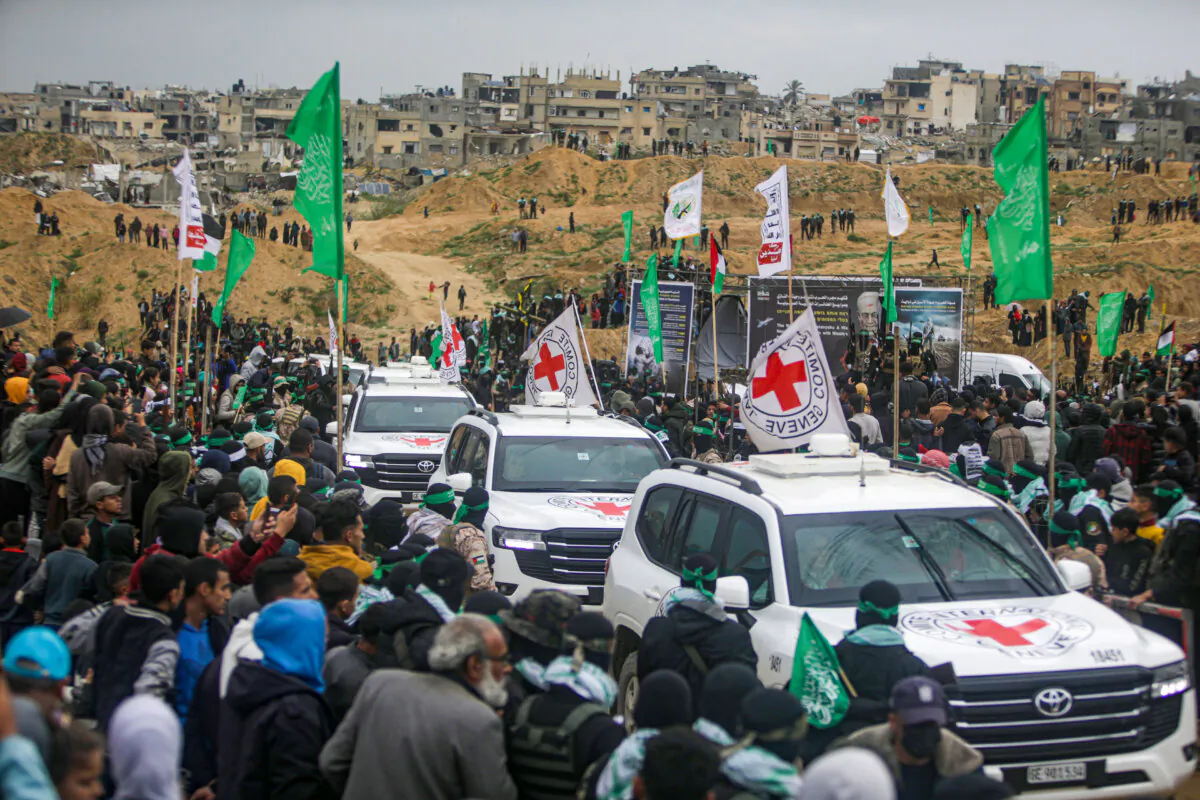
Hamas has so far barred humanitarian organizations, including the International Committee of the Red Cross (ICRC), from accessing the hostages. Coordination with the ICRC, the group said, depends on Israel’s actions on the ground.
The announcement was made amid growing international condemnation over the treatment of hostages held in the Gaza Strip. Fifty hostages remain in captivity following Hamas’s cross-border attack on Israel on Oct. 7, 2023, in which 1,200 people were killed and 251 taken hostage, according to the Israeli Ministry of Affairs.
At a news conference on Aug. 4, Israeli Foreign Minister Gideon Sa’ar described the condition of the hostages as dire, saying they had been starved and tortured. He called for their immediate and unconditional release.
Calls for hostages to be released also came from the United States, European governments, and international aid organizations, including the ICRC.
U.S. President Donald Trump said last week that the fastest way to end the humanitarian crisis in the Gaza Strip is for Hamas to surrender and release the hostages.
The U.N. Security Council is scheduled to hold a special session on Aug. 5 to discuss the situation of hostages in the Gaza Strip. Sa’ar thanked the United States and Panama for helping convene the meeting.
Videos of Emaciated Hostages
Israeli leaders accused Hamas of carrying out systematic starvation and torture of hostages after videos of two of them were released last week.
On July 31, Palestinian Islamic Jihad released video footage of hostage Rom Braslavski, appearing visibly malnourished and distressed, according to The Times of Israel.
The following day, Hamas published a video of Evyatar David, who also appeared to be visibly malnourished, The Times of Israel reported. Sa’ar said David could be seen digging his own grave.
“The cruelty of Hamas knows no bounds,” Israeli Prime Minister Benjamin Netanyahu said in an Aug. 2 statement on X. “While the State of Israel allows the entry of humanitarian aid to the residents of Gaza, Hamas terrorists deliberately starve our hostages, documenting them in a cynical, humiliating, and malicious manner.”
“We see the dire condition of our staff hostages, yet they still have not seen representatives of the Red Cross, despite this being explicitly agreed upon,” he told reporters. “Hamas have also kidnapped civilians in the past, but it was done on a huge scale on Oct. 7.”
French, UK, Canadian, and German leaders have condemned the videos.
French President Emmanuel Macron said the footage reflected the “unlimited inhumanity” of Hamas.
The German Foreign Ministry demanded that Hamas disarm and emphasized that ending the war would require more than a cease-fire. UK Shadow Foreign Secretary David Lammy described the hostage footage as “sickening.” Both the UK and Canada called for the immediate release of hostages.
Some Western leaders recently announced that they would recognize Palestinian statehood at the 80th U.N. General Assembly in September. France, the UK, and Canada have cited concerns over the humanitarian crisis in the Gaza Strip and the deadlock over a long-term political resolution to the conflict.
The United States opposed the move, while Sa’ar described it as “a huge gift for Hamas” that threatens prospects for a hostage deal and cease-fire.
Response by Red Cross, Hostage Families
Netanyahu said on Aug. 3 that Hamas’s actions violate international law and the Geneva Convention. He urged the head of the ICRC delegation in the region, Julien Lerisson, to assist with the provision of food and medical care to hostages.
In response to the latest developments, the ICRC urged immediate and unconditional access to all hostages.
“We are appalled by the recent videos published of Israeli hostages held in Gaza,” the ICRC said on Aug. 4. “All forms of public exposure that humiliate persons deprived of liberty and endanger their safety must be avoided.”
The Hostages and Missing Families Forum, which represents relatives of those held in the Gaza Strip, welcomed the possibility of Red Cross involvement but stressed that only the immediate release of all hostages could prevent further tragedy.
“Hamas’s announcement about their willingness to cooperate with the Red Cross to deliver food to hostages, cannot hide the fact that we are dealing with an evil terrorist organization that has been holding innocent people in impossible conditions for over 660 days,” the group said. “We demand the immediate release of all 50 hostages.”
The hostage crisis remains a major obstacle to any cease-fire agreement or long-term political resolution in the region.
In a separate statement, the ICRC said on Aug. 3 that it was appalled by the death of a Palestine Red Crescent Society (PRCS) worker in an Israeli strike overnight.
Omar Mansour Isleem was killed and two others were injured at the PRCS headquarters in Khan Younis, Gaza Strip, the ICRC said.
“Omar and the other injured colleagues were on duty in a clearly marked Palestine Red Crescent Society’s building,” it said. “PRCS provides essential support to communities in Gaza. It is unacceptable that first responders in Gaza—like Omar and staff and volunteers of the PRCS—go to work every day fearing they may not return to their families.”
 Friends Read Free
Copy
Facebook
Tweet
Friends Read Free
Copy
Facebook
Tweet