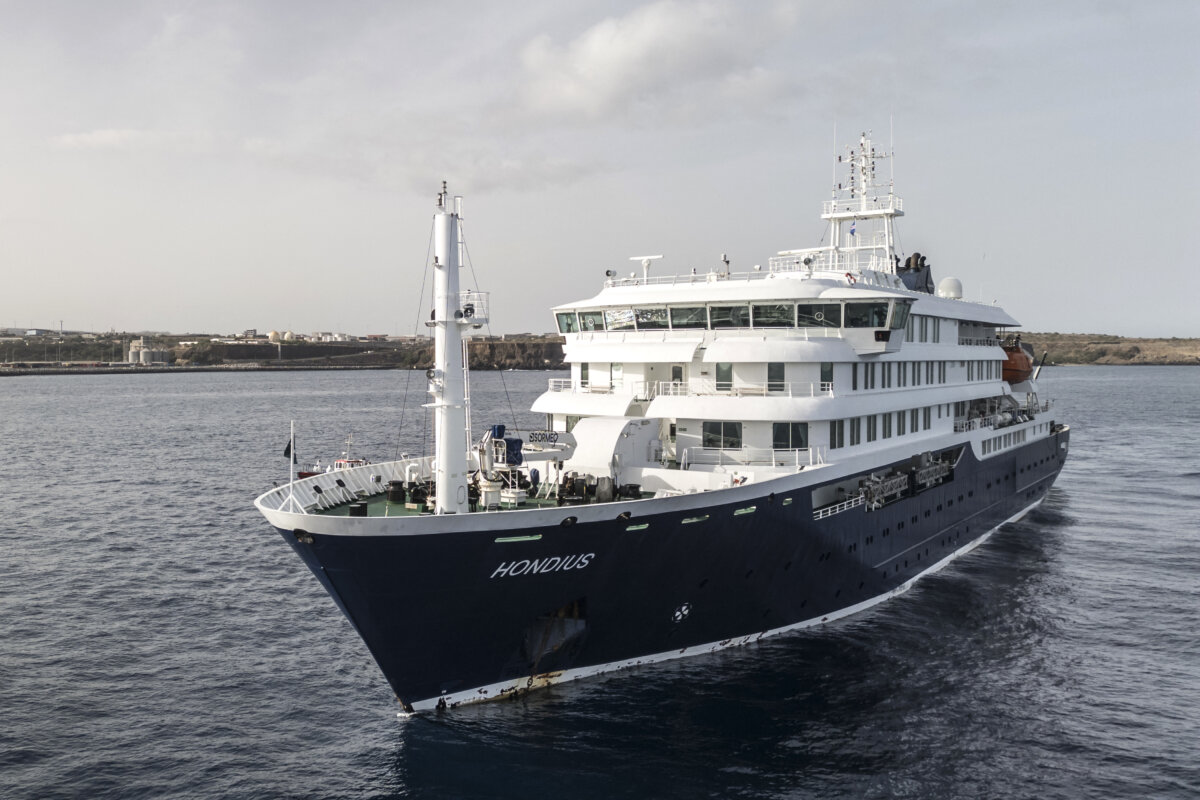

The Spanish Health Ministry said on May 5 that it will receive the MV Hondius, a Dutch-flagged cruise ship that has been at the center of a suspected hantavirus outbreak in the Canary Islands.
The ship has remained off the coast of Cape Verde in West Africa after a suspected hantavirus outbreak was detected. Seven people fell ill, with three of them dying, according to the World Health Organization (WHO).
The ministry said health officials will determine which individuals need urgent evacuation from Cape Verde, while the remaining passengers will head to the Canary Islands, where they will undergo screening.
The ship is expected to arrive in the Canary Islands within three or four days, though the destination port has yet to be confirmed, according to the ministry.
“Once there, the crew and passengers will be properly examined, treated, and transferred to their respective countries,” it stated. “Both medical care and transfers will be carried out in special spaces and transports specifically set up for this situation, avoiding all contact with the local population and ensuring the safety of healthcare personnel at all times.”
The cruise operator, Oceanwide Expeditions, said on May 5 that evacuation is being prepared for two passengers requiring urgent medical care and another guest “associated with” a German national who died aboard the ship on May 2.
The evacuation will be carried out using two specialized aircraft en route to Cape Verde before the individuals are transferred to the Netherlands. But the timeline of the evacuation has yet to be determined, the operator said.
The Spanish government said it had accepted a formal request from the Netherlands to medically evacuate a doctor from the ship who is in “serious condition.” The individual will be transported to the Canary Islands on May 4 aboard a hospital aircraft, it stated.
Oceanwide Expedition said in its May 5 update that the ship will sail to the Canary Islands once the three individuals have been evacuated.
“Our plan is to proceed to the Canary Islands, either Gran Canaria or Tenerife, which will take 3 days of sailing. Discussions are ongoing with relevant authorities,” it stated.
The Canary Islands were the closest destination with the capacity to receive the ship, according to the Spanish government, noting that the WHO had determined Cape Verde was unable to carry out the operation.
“Spain has a moral and legal obligation to assist these people, among whom are several Spanish citizens,” it stated.
WHO officials said on May 5 there may have been human-to-human transmission of the virus on the vessel, which had 149 passengers and crew members from 23 nations on board.
Three people have died, including a Dutch couple and a German national, and one passenger has been evacuated to South Africa.
The first fatality was a 70-year-old man who died on the ship on April 11, though the cause of death could not be determined onboard, according to Oceanwide Expeditions. His body was removed on April 24 in the British territory of Saint Helena in the South Atlantic, with his wife accompanying the repatriation.
On April 27, his wife collapsed at an airport in South Africa while trying to take a flight home to the Netherlands, and later died in hospital. Health officials confirmed on May 4 she tested positive for the virus.
The third fatality, a German passenger, died on board on May 2, though the cause of death has not yet been confirmed.
Another passenger, a British national, fell ill and was evacuated to South Africa on April 27. The passenger was treated in an intensive care unit in Johannesburg and had tested positive for the virus. Oceanwide Expeditions said the passenger is in critical but stable condition.
Hantavirus is a viral disease resulting most often from contact with the urine, feces, or saliva of infected rodents. It has a mortality rate ranging from 30 to 50 percent, making it among the most lethal viruses in the world.
The WHO said the virus generally does not spread between humans, although rare cases of human-to-human transmission have happened in the past.
 Friends Read Free
Copy
Facebook
Tweet
Friends Read Free
Copy
Facebook
Tweet