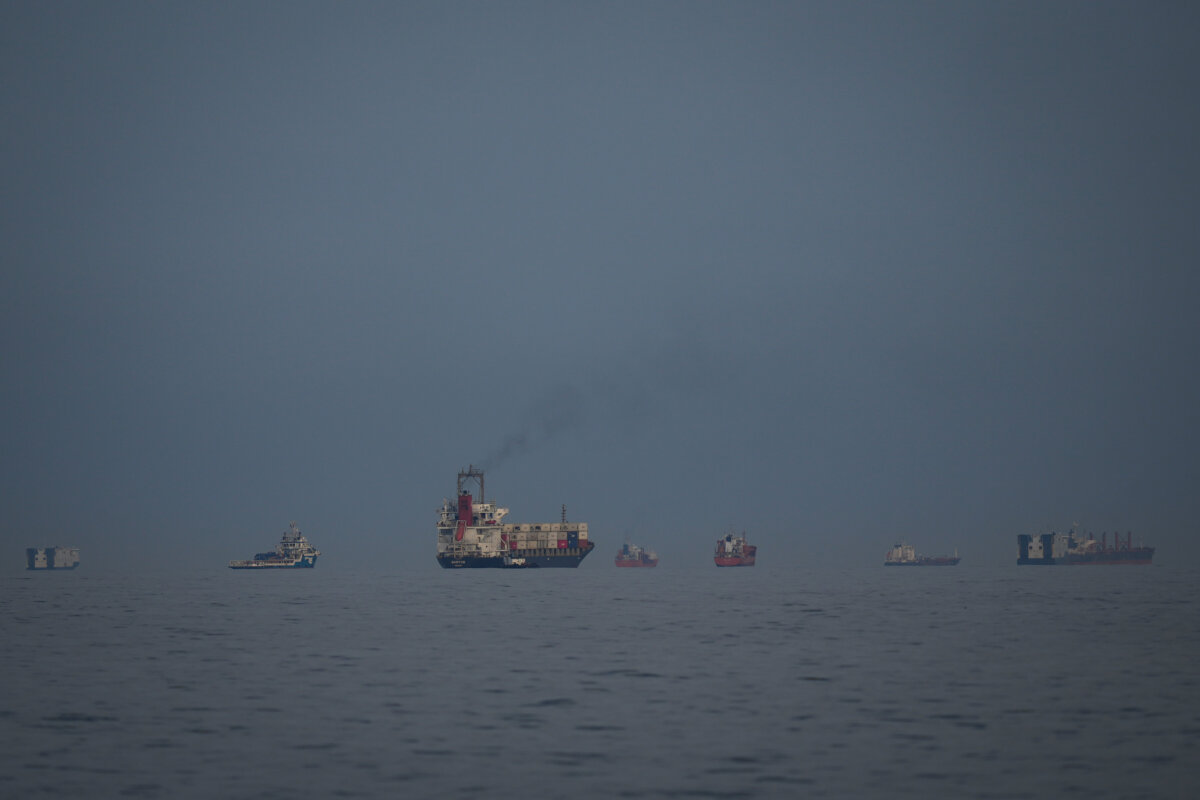

Until only weeks ago, tankers made routine voyages through the Strait of Hormuz, transporting vital oil flows through one of the world’s most important energy corridors.
Roughly 20 percent of the world’s oil and a similar share of liquefied natural gas flow through the narrow waterway between Iran and Oman.
But since the United States and Israel launched their Feb. 28 strikes on Iran, shipping traffic has slowed to a near standstill.
Analysts told The Epoch Times that the scale of disruption could be one of the most significant energy shocks in decades, although some say markets have already priced in much of the risk of a war with the Iranian regime.
Shipping Grinds to a Halt
In normal conditions, roughly 100 ships, including about 50 oil tankers, pass through the Strait of Hormuz each day, according to Lloyd’s List.
Since the conflict began, about 90 ships, including oil tankers, have crossed the strait. However, these are connected to so-called dark transits that bypass Western government sanctions and oversight and likely have ties to Iran.
Matthew “Whiz” Buckley, a former fighter pilot and founder of Top Gun Options, said that the scale of supply at risk could arguably surpass past crises in potential volume but that whether it becomes a larger economic shock depends on several factors.
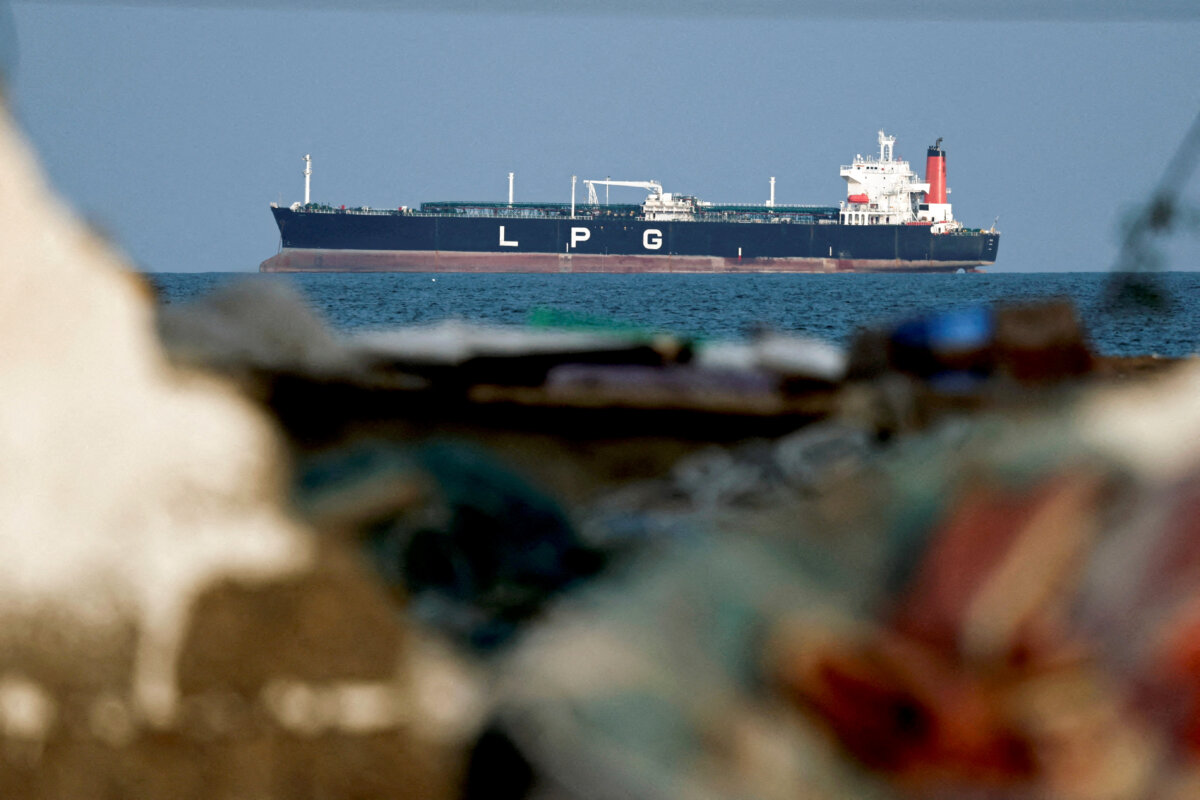 A liquefied petroleum gas tanker at anchor as traffic is down in the Strait of Hormuz, amid the U.S.–Israeli conflict with Iran, in Shinas, Oman, on March 11, 2026. (Benoit Tessier/Reuters)
“I would not say it is automatically the largest economic oil shock in modern history yet,” Buckley told The Epoch Times by email.
“The 1973 Arab oil embargo triggered a global recession, a near-quadrupling in prices, and a deep structural shift in energy policy and inflation psychology.”
In 1973, the oil embargo was triggered by the Yom Kippur War, in which Egypt and Syria attacked Israel in October that year. In response to U.S. and Western support for Israel, major Arab oil producers and members of OPEC cut supplies to those countries, which caused fuel shortages, soaring prices, and a global economic crisis.
Buckley said that today’s shock is “potentially larger in volume, but whether it surpasses 1973 in economic damage depends on duration, actual physical loss of barrels, and whether shipping resumes before inventories and emergency response tools are exhausted.”
Prices Surge as Markets Test the Shock
Oil prices have already surged, with Brent crude briefly approaching $120 per barrel earlier in March.
With no end in sight to the Iran conflict, which has left oil exports from the Middle East largely halted, Brent crude prices have settled above $100 per barrel for four consecutive days, ING reported on March 18.
Sustained prices above $120 could begin to trigger demand destruction, meaning that consumers use less fuel as higher gas costs ripple through transport, industry, and consumer spending.
Earlier in the day on March 18, Brent crude futures were up by 34 cents, or 0.33 percent, to $103.80 per barrel, according to OilPrice.com.
“With no sign of de-escalation in the Middle East, the market continues to consolidate above this key level,” ING analysts said in a March 18 note, predicting that “markets will continue to tighten” until there is a resumption of crude oil and refined product flows through the Strait of Hormuz.
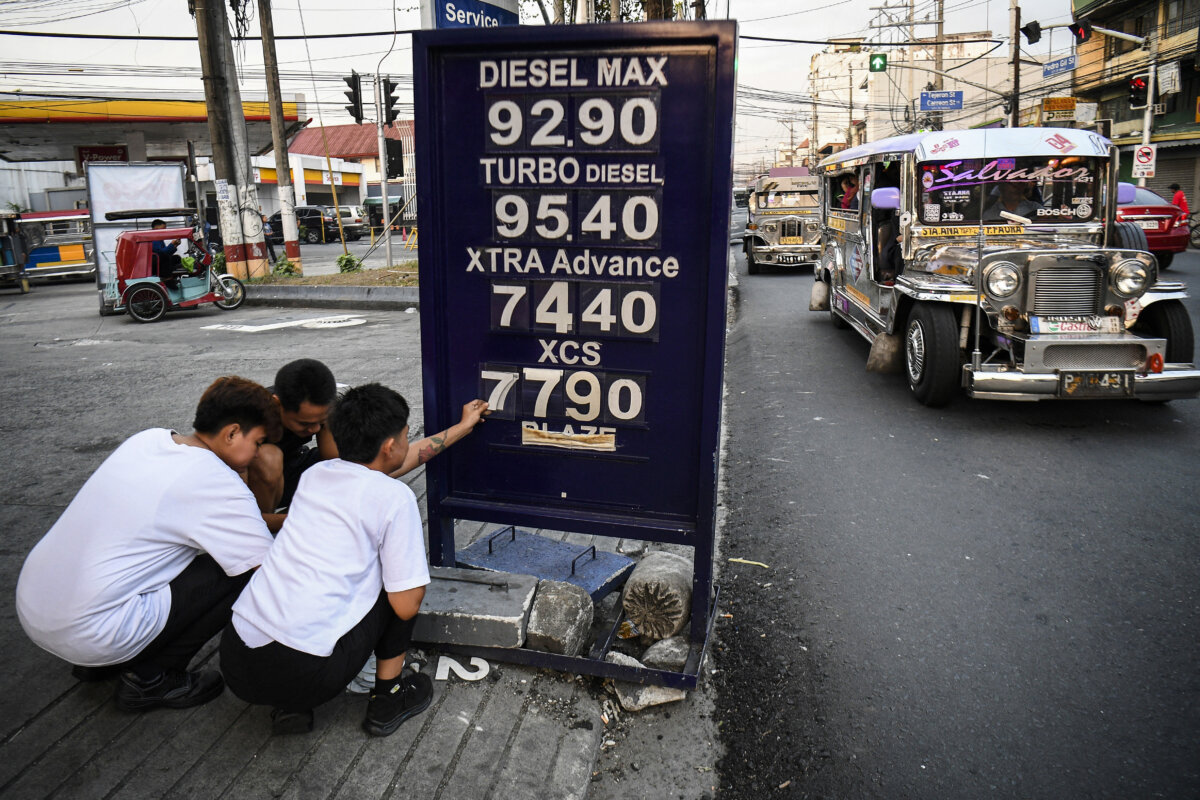 Workers change the price label of fuel at a petrol station in Manila, Philippines, on March 17, 2026. Oil climbed again in Asia on March 17 after prices retreated a day earlier, with investors remaining focused on the Strait of Hormuz. (Ted Aljibe/AFP via Getty Images)
Buckley said, “History says the global economy starts to feel real pain once oil moves and stays well above $100, and the pain becomes much more severe in the $120 to $150 zone.”
Governments are starting to release emergency oil stockpiles.
“Emergency stockpiles are a real buffer, but they are a bridge, not a solution,” Buckley said. “So the stockpile system can buy time, calm panic, and smooth refinery logistics.
“It cannot permanently replace a prolonged Hormuz outage if a meaningful share of Gulf exports stays offline.”
Not a Black Swan, Yet
Brenda Shaffer—nonresident senior fellow at the Atlantic Council’s Global Energy Center and a faculty member at the U.S. Naval Postgraduate School’s Energy Academic Group who specializes in energy security policy and the geopolitics of energy—said markets have long priced in the risk of an Iranian regime disruption.
“The world has been paying an oil premium price for a potential conflict with Iran for years,” she told The Epoch Times. “That’s precisely because Iran has this capacity to disrupt the straits.
“So I don’t think there’s anything unexpected here, certainly not at the level of a black swan, or even a gray swan event.”
Shaffer said the disruption may prove temporary, with Iran’s ability to sustain attacks likely to decline over time.
“The explicit military confrontation between Iran and the U.S. and Israel will end within weeks, or even, probably two weeks,” she said.
Shaffer noted that as the Iranian regime’s capacity to manufacture drones, rockets, missiles, and speed boats runs out, its ability to disrupt the traffic in the straits will decline.
“But Iran will continue with a wave of terror … against shipping, so in order to try to maintain some kind of disruption in the straits,” she said.
War Duration and Spillover Risks
A temporary disruption could have lasting economic scars, analysts say.
Igor Isaev, head of analytics at the European broker Mind Money, said the indefinite duration of this disruption adds to the “common nervousness and uncertainty.”
“Unfortunately, most wars have a great deal of inertia,” Isaev told The Epoch Times by email. “They start quickly but last for months, sometimes, years and even decades.”
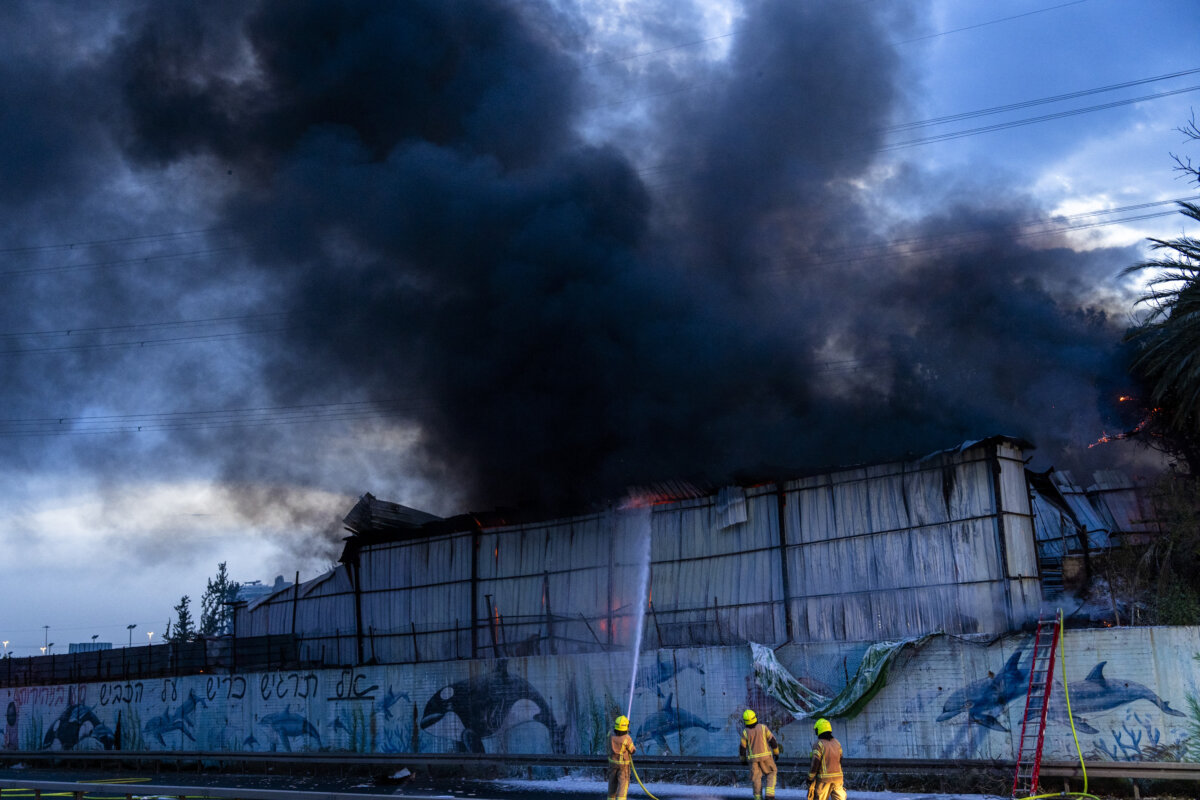 Firefighters try to extinguish a fire at a warehouse that occurred amid a barrage of Iranian missiles in Holon, Israel, on March 13, 2026. (Erik Marmor/Getty Images)
He said the 1982 Israel–Lebanon war offers a useful comparison, noting that although it officially ended in 1985, it continued at varying levels of intensity for years afterward.
Isaev stated that although the 1973 oil embargo removed about 4.4 million barrels per day from global markets and the 1978 Iranian revolution caused a shortfall of roughly 5.5 million barrels per day, “the current crisis is approximately 4.5 times larger than the events of 1973.”
“In this respect, not only do I expect a meaningful rise in gasoline prices, but I should also recognize the ongoing character of this situation,” he said.
The shock is also already feeding into a wave of second-order effects.
Higher oil prices increase fuel costs, which, in turn, raise transportation, manufacturing, and food prices. Gas market tightness also feeds into electricity costs in many regions.
Consumers are likely to feel the impact first at the pump, followed by higher energy bills and increased costs across goods and services.
Airlines, logistics companies, and heavy industry are particularly exposed, with fuel representing a major input cost.
Isaev also said that Indonesia plans to offset the shock of rising oil prices with measures financed by the state budget, while in Vietnam, the nationwide benchmark tariff on unleaded gasoline will likely be reduced from 10 percent to zero for the duration of the supply shock.
‘Very Telling What Russia and China Do Right Now’
Jessica Lewis McFate, senior director of intelligence solutions at Babel Street, focusing on open-source intelligence and national security, said the severity of the current shock may not be defined solely by volumes at risk, but by how the conflict is evolving.
“It’s not only the Strait of Hormuz that is in jeopardy right now,” the former U.S. soldier told The Epoch Times.
She said that data centers getting struck with cheap Iranian drones “changes the nature of what kind of retaliatory strikes that are, quote, unquote, ‘non-lethal’ can look like when you’re attacking another country’s infrastructure.”
On March 2, Amazon confirmed that some of its cloud unit Amazon Web Services data centers in the United Arab Emirates and Bahrain were damaged by Iranian drone strikes.
Gulf states, particularly Saudi Arabia and the United Arab Emirates, offer “abundant, low-cost energy, making them increasingly indispensable to global [artificial intelligence] expansion rather than merely attractive hosts,” said Washington-based think tank Center for Strategic and International Studies in a Feb. 27 report.
McFate said: “So I think what makes this worse is that it’s not only OPEC, not only [liquefied natural gas], it is also infrastructure and data centers and electricity, not only because you have an energy crisis, but also because infrastructure gets hit.
“And I think it can be very telling what Russia and China do right now.
“China definitely needs every kind of energy import there is to keep itself running, so disturbances in the energy force are felt keenly by them.”
McFate said it is a “season of not great options,” and companies will have to figure out how to secure their energy.
“And those who have resources that are not specifically in the Persian Gulf are going to be in incredibly high demand,” she said.
“And I think that the trick for those who are in G7 is to really anticipate that Russia and China are going to be thinking about how they can leverage that position and that need for their advantage.”
The Associated Press and Reuters contributed to this report.
 Friends Read Free
Copy
Facebook
Tweet
Friends Read Free
Copy
Facebook
Tweet