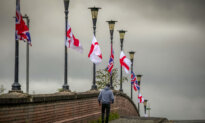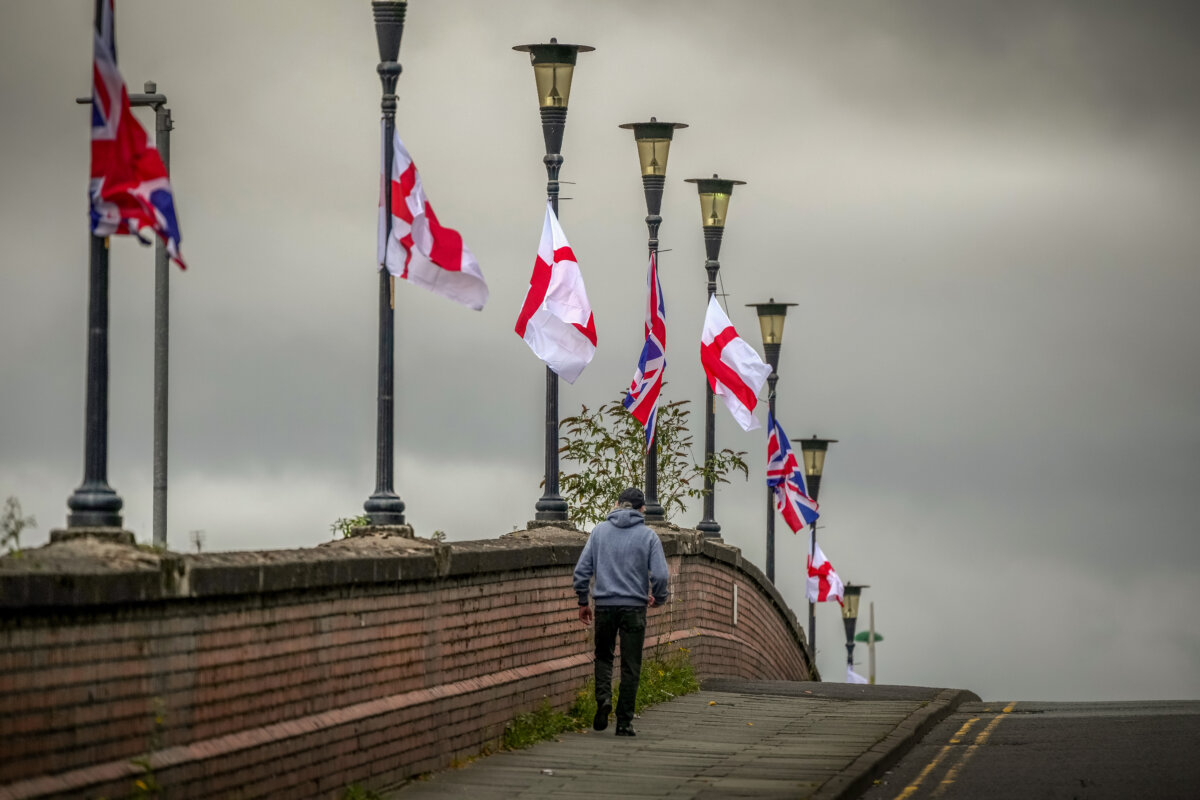

The Cross of St. George is appearing up and down England, in numbers usually only seen during soccer tournaments such as the World Cup.
“Operation Raise the Colours” is the name given to the movement, which first gained interest on social media over the summer and has continued into September.
It has come amid rising concerns and ongoing protests against illegal immigration, centering in particular around the British government’s policy of housing asylum seekers in hotels.
Despite both the Cross of St. George and the Union Flag—also known as the Union Jack—being recognized as national symbols, often flown by national and local governments, their appearance, en masse, across the country has been seen by some as politically polarizing. Flag flying in Britain is not the near ubiquitous practice it is in the United States.
Some on the British left have labeled the movement “racist” or “far-right,” while others supportive of the flag-raising describe it as “patriotic.”
Where It All Began
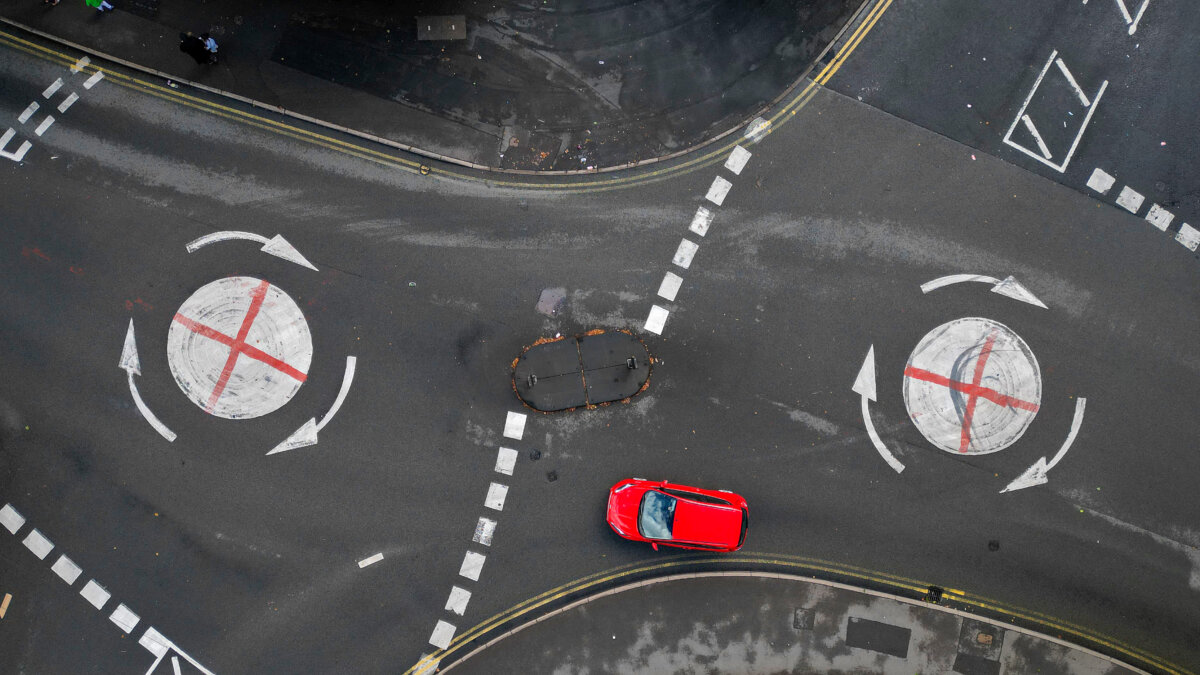
Beginning with flags hung from lampposts in Birmingham, the movement escalated to red crosses spray-painted onto roundabouts and other elements of public infrastructure, sparking an outpouring of both support and derision from within and without the UK.
The Birmingham council moved quickly to remove the flags, citing safety issues and sparking criticism from supporters of the campaign, according to local media.
However, as of Sept. 5, numerous flags were still visible throughout the city.
“Apparently, Birmingham council took down the Union and St George flags that had been displayed by local people—and within a couple of days the flags had been replaced by new ones,” author and political commentator Paul Embery posted on X. “I’ve never been a ‘flag waver’—but I stand with the people who did this.”
Another X user, “Basil the Great,” posted a video showing a street lined with Union flags.
“Birmingham Council took them down, but the patriots put them back up. Rule Britannia,” the user wrote.
Ground-zero for the “operation” was in the heart of England, in the suburbs of the nation’s “second city,” Birmingham.
Weoley Castle, a residential district in the city’s southwest, appears to have been where the movement began. A group calling itself the Weoley Warriors claimed responsibility for hanging up both the flag of England with its Cross of St. George and the Union Flag—the red, white, and blue banner that represents the whole of the UK—from lampposts in the area.
On a “Flags for the Community” GoFundMe page, organizers describe themselves as a “group of proud English men with a common goal to show Birmingham and the rest of the country how proud we are of our history, freedoms, and achievements.”
The page, which has been active since Aug. 10, has currently generated more than 21,500 pounds (about $29,000) in donations, which it says will be spent on purchasing “flags, poles and cable ties.”
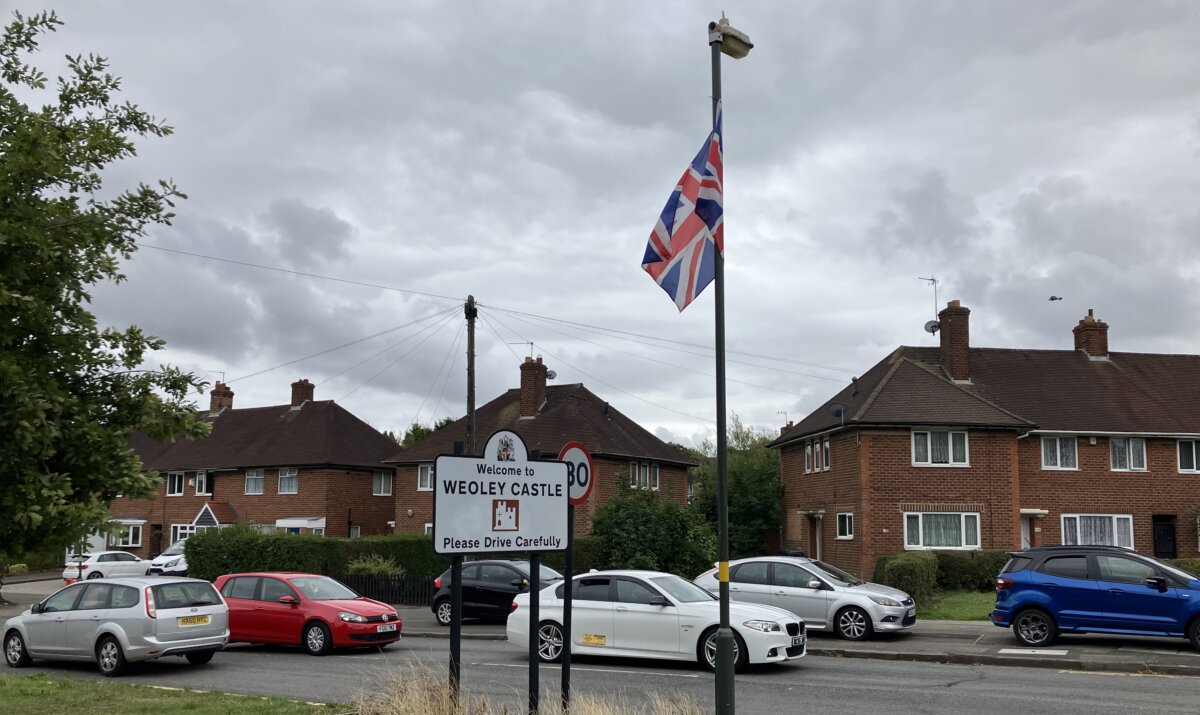
Entering Weoley Castle, the flags appear in their multitudes. Strung from lampposts and hung from windows, Union Jacks and St. George’s flags are everywhere. As far as the eye can see, they flutter in the wind.
A large English flag flies outside the eponymous local pub, the Weoley Castle. Inside, among memorabilia from local soccer teams, famed English rock bands, and the Birmingham-based hit drama “Peaky Blinders,” more flags bedeck the makeshift DJ booth in the corner, along with a permanent memorial to fallen soldiers.
Pub patrons who spoke to The Epoch Times said the flags went up around town some six weeks ago. They expressed universal support for the movement, but said that they had not been directly involved.
One pubgoer, who asked not to be named, said the media had attempted to portray the flags as racist. However, she rejected the notion that there was anything racist about the proliferation of national banners, and said they had been put up by the local community—which she described as “multicultural.”
To Birmingham’s north, in Lichfield, in the county of Staffordshire, flags have also sprung up. One of the main architects of the movement is a 27-year-old flooring installer who goes by the moniker “Ross The Don” on X, where he has almost 12,000 followers. His feed is flush with photos and videos of him installing flags on lampposts around the city.
Ross told The Epoch Times he was inspired by the Weoley Warriors and has a friend in the group, which has been supplying him with flags.
His motivation, he said, was born from frustration with the current state of the UK, but primarily from patriotism.
“So if [the media] want to spin it like that and say it’s against the illegal migrants, they can, but it’s not me,” he said. “Personally, I am all for it being a patriotic thing and a reminder to everybody, this country represents law and order, and we should be proud to be British and not embarrassed.”
Reactions from people who have seen him putting up the flags have been overwhelmingly positive, he said. He has not experienced any pushback from the local council or the police, although he mentioned one incident in which some had suggested what he was doing was “illegal.”
He said he believes the flags serve as a “tangible reminder” to politicians that the people of the UK want it to be a “safer place.”
“I think this is a brilliant way of doing it,” he added. “It’s the most peaceful way that you could do it.”
After images of the national banners fluttering from lampposts went viral on social media, the movement expanded to other cities, including Manchester, York, Portsmouth, and London.
The Reaction
The campaign has been backed by numerous figures on the right of British politics.
Reform UK leader Nigel Farage told GB News last month he found the campaign “rather uplifting.”
And in an August opinion piece in the Daily Mail, Kemi Badenoch, leader of the Conservative Party, said, “[The flags] are a proud expression of who we are—our history, our freedoms and our shared identity.”
Her fellow Tory frontbencher Robert Jenrick posted on X on Aug. 20: “Raise The Colours! While Britain-hating councils take down our own flags, we raise them up. We must be one country, under the Union Flag.”
Independent MP Rupert Lowe also took to X, posting on Sept. 1: “Our flags are everywhere. It is glorious.”
And activist Stephen Yaxley-Lennon, better known as Tommy Robinson, posted on Sept. 2, “Yes boys @rossthedonn unite the kingdom.”
The movement has also garnered support from across the pond, with Elon Musk posting on Aug. 25 on his own platform X an image of the English flag, which garnered 85.4 million views as of Sept. 6, along with posts criticizing the British government.
U.S. Vice President JD Vance also weighed in, saying that people should “push back against the crazies” who are offended by the flags in the UK. In response to a question about the flag campaign, he told Fox News it’s a “good thing to be proud of your country.”
Some on the British left have taken issue with the operation. Campaign group Hope Not Hate alleged that “much of this wave of activism is being organized by well-known racists and extremists,” which it said “does raise questions about the motivations behind much of Operation Raise the Colours.”
Hope Not Hate specifically cited the initiative’s backing by Robinson, among others.
Stand Up To Racism also voiced its opposition to the movement, with Lewis Nielsen, an “anti-fascist officer” for the group, telling The Guardian that he was concerned it was “giving cover for racism driven by the far right.”
“We do feel the movement is quite dangerous and comes at a tipping point where the far right is trying to build,” he said.
The left-wing Labour government has been less critical of the campaign.
Prime Minister Keir Starmer said he was “proud” of the flag of England and has one in his home. However, he also said he thought that sometimes when the flags are “used purely for divisive purposes, actually it devalues the flag.”
“I don’t want to see that,” he told the BBC.
Why Now?
“These things … don’t just emerge,” Robert Oulds of the Bruges Group, an independent think tank based in London, told The Epoch Times, giving his view of the movement.
“They come from long-held beliefs about the country, national notions of national identity, and national symbols are an important part of that.
“British people are particularly proud of and proud of these symbols. They’ve just been suppressed for too, too long by authorities that are not in favor of them, and want to create some new identity.”
That involves “a different notion of national identity,” he said, which precludes the nation state in favor of “a set of values, one of which would be multiculturalism.”
Discussing why he felt the movement had sprung up at this particular moment, he cited long-running economic issues in Britain, including stagnating wages and the rising cost of living, but also historically unprecedented levels of immigration.
“People can see somewhat belatedly, that what they knew, the country that they grew up in, and what they would hope to pass on to their children … is slipping away,” Oulds said.
Correction: A previous version of this article misspelled the name of independent MP Rupert Lowe. The Epoch Times regrets the error.
 Friends Read Free
Copy
Facebook
Tweet
Friends Read Free
Copy
Facebook
Tweet