


America is telling its citizens to rethink what’s on their plates, with the Trump administration embracing protein and shunning processed foods, a stark contrast to Australia’s decade-old dietary guidelines.
In January, the Trump administration updated America’s dietary guidelines, saying it would end “the war on protein.”
Under the tag line “eat real food,” U.S. Health Secretary Robert F. Kennedy Jr has instead declared war on highly processed foods.
“Better health begins on your plate, not in your medicine cabinet,” he said.
Looks Like Meat’s Back on the Menu
The U.S. government’s 2025-2030 Dietary Guidelines for Americans inverts the food pyramid with an emphasis on protein, dairy, healthy fats, vegetables, and fruits.
To support its new guidelines, it cites studies that argue that protein (and amino acids, the building blocks for protein) is the most essential of all nutrients.
“One of the most obvious roles of amino acids is in the development and maintenance of muscles and bones for functional mobility and a body composition consistent with cardiometabolic health,” the report states.
It further highlights that achieving and maintaining healthy body weight is important for health and disease prevention.
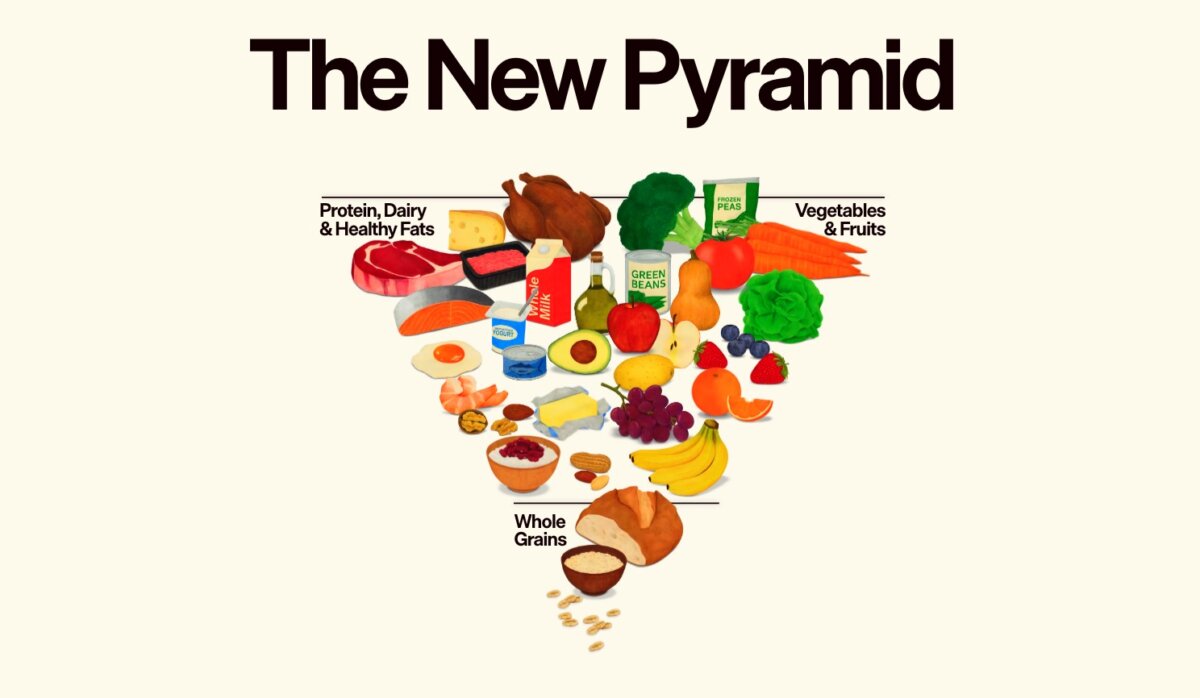
Under the new guidelines, the protein recommendations have increased from 0.8 grams of protein per kilogram per day, to 1.2 grams to 1.6 grams per kilogram.
The guidelines also promote healthy fats in the diet, identifying meat, poultry, eggs, and full-fat dairy.
“When cooking with or adding fats to meals, prioritise oils with essential fatty acids, such as olive oil,” it said. Butter and beef tallow are listed as alternative options.
The guidelines also advise limiting saturated fat consumption to no more than 10 percent of total daily calories.
While whole grains are still encouraged, there is far less emphasis on them in the diet—demonstrated by their location at the bottom “point” of the pyramid.
Highly processed foods, added sugars, and refined carbohydrates are to be avoided or limited.
Refined carbohydrates such as white bread, packaged breakfast options, and crackers are no longer recommended. Foods containing added sugars should be avoided, which includes chips, cookies, and candy.
“We are putting real food back at the center of the American diet,” the guidelines say, adding that they restore common sense and scientific integrity to food and health policy.
Australia Maintains Focus on Vegetables, Grain Foods
In contrast, Australia’s guidelines—a dinner plate divided into five portions—still places a heavy emphasis on grain foods and vegetables. Over half an average person’s diet.
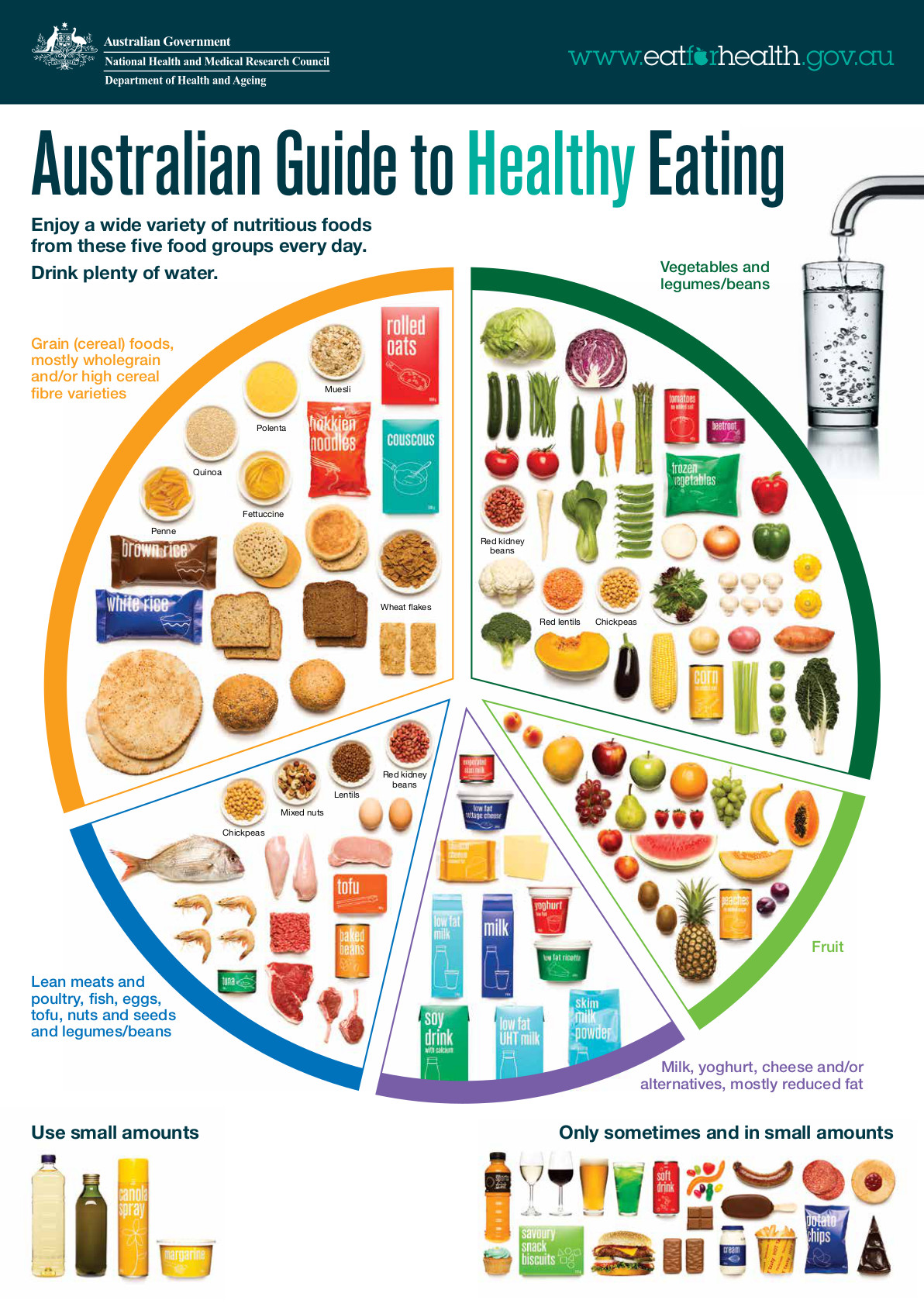
For protein, Australian guidelines recommend 0.84 g/kg per day for men between the ages of 31 and 70, and 0.75 g/kg per day for women in the same age range, while the U.S. guidelines recommend 1.2-1.6 g/kg per day.
Australian guidelines continue to emphasise lower red meat and higher plant-based food consumption, with the Heart Foundation recommending Aussies limit red meat to 350 grams per week.
In contrast, the U.S. guidelines recommend no limits to red meat consumption.
More Carbs, Fats for Australians
For carbohydrates, Australian authorities recommend six serves per day for men, and four to six for women.
Recommended carbs include whole grains, fruits, and vegetables, while focusing on low glycemic index (GI) foods to help manage blood glucose level. The U.S. guidelines recommend two to four servings per day.
For saturated fats, Australian guidelines recommend replacing saturated fats such as butter, cream, cooking margarine, coconut and palm oil, with polyunsaturated and monounsaturated fats such as oils, spreads, nut butters or pastes, and avocado.
The U.S. guidelines recommend limiting the daily intake of saturated fats to 10 percent and have recommended butter and beef tallow as replacement options.
Other Changes
For dairy, Australian guidelines recommend consuming unflavoured milk, yoghurt and cheese, with the Heart Foundation saying that such foods have a “neutral” effect on heart health overall.
Reduced-fat dairy is recommended for people with heart disease or high cholesterol, while full-fat dairy is acceptable for the general population, according to the Heart Foundation. The U.S. guidelines endorse full-fat dairy and recommend two to three servings per day.
For fruits and vegetables, Australian guidelines recommend at least five servings of vegetables per day and two servings of fruit. The U.S. recommends three to five vegetable servings per day and two to four for fruit.
Interestingly, only 4.2 percent of adults and 4.3 percent of children met both fruit and vegetable recommendations in 2022, according to the Australian Bureau of Statistics (ABS).
Health Department Says Australia Guidelines Backed by Evidence
A spokesperson from the Department of Health, Disability and Ageing told The Epoch Times that the Australian guidelines provide “evidence-based advice on the types and amounts of foods that Australians need for good health.”
“The Australian Dietary Guidelines are informed by independent and rigorous scientific reviews of literature on the relationship between dietary patterns and health outcomes.”
Australia’s revised guidelines are “anticipated during 2026,” the Health Department said.
Revisions are set to cover dietary recommendations for all ages and backgrounds and those with common diet-related risk factors (overweight or high blood pressure).
Areas being revised include dietary patterns and nutritional needs across the lifespan, protein-rich foods, and recommendations on ultra-processed foods.
‘Too Soon to Comment’ on Change
While the new U.S. guidelines emphasise a higher protein uptake, Australian guidelines currently recommend eating a variety of nutritious foods.
So will the U.S. guidelines influence Australia’s dietary guidelines that are currently under review?
A spokesperson for the National Health and Medical Research Council (NHMRC) told The Epoch Times that an independent review is still ongoing, adding that it is “too soon to comment” on the similarities and differences between both countries’ guidelines.
For the time being, they recommended that Australians should follow the 2013 Australian Dietary Guidelines until the revised guidelines are released.
“The 2013 guidelines remain current and represent NHMRC’s best advice on dietary patterns for good health,” the NHMRC said.
 Friends Read Free
Copy
Facebook
Tweet
Friends Read Free
Copy
Facebook
Tweet