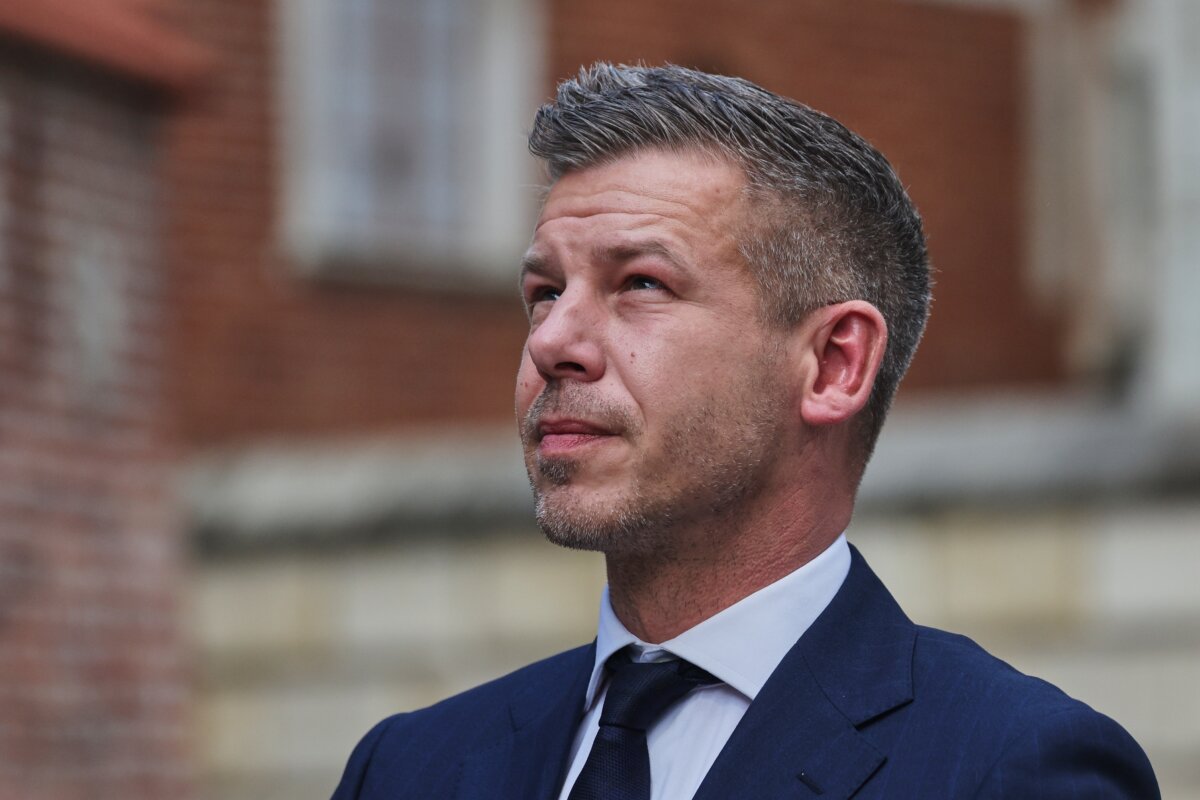
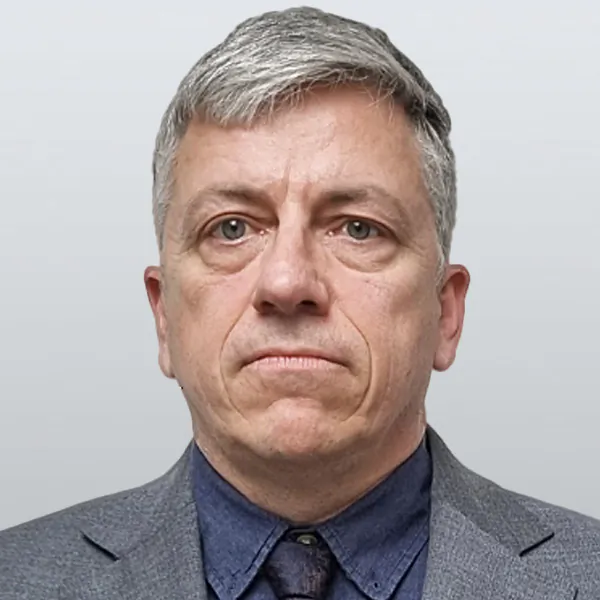
Hungarian Prime Minister Péter Magyar said on June 1 that he would amend the constitution to remove the country’s president, whom he has accused of failing in his duties while Viktor Orbán was prime minister.
The center-right Tisza party, led by Magyar, defeated Orban’s Fidesz-KDNP alliance on April 12, and Magyar became prime minister on May 9.
Magyar met with President Tamás Sulyok at the Sándor Palace—the presidential residence—on June 1, and later at a news conference, he said Sulyok had refused to resign.
“Hungary does not belong to Tamás Sulyok, nor to Viktor Orbán. It doesn’t belong to a single party or political system,” Magyar said.
“The constitution states quite clearly that the president showcases the unity of the nation and guards the democratic functioning of the state.”
In Hungary, the post of president is largely ceremonial—as it is in Germany, Israel, and the Republic of Ireland—and, under the constitution or Fundamental Law, adopted in 2012, the president is chosen in a secret ballot by members of the National Assembly.
The president also has a role in signing legislation into law and has the power to send bills passed by the Hungarian parliament to the constitutional court for review.
Magyar said he would instruct lawmakers from his Tisza party, which has a two-thirds majority in parliament, to immediately begin the “necessary procedures” to remove Sulyok, a process he said might take a month.
He did not give details about how he plans to amend the constitution.
Orbán was in power for 16 years, and Magyar—a former Fidesz politician who left in 2024 to set up Tisza—has repeatedly called on Sulyok to resign or be removed.
Sulyak Labeled ‘Orban’s Puppet’
Magyar has referred to Sulyok as “Orbán’s puppet” and gave him until May 31 to leave office.
“It is in Hungary’s interest that this institution, the office of the president, regain the prestige that has been eroded by its silence and inaction,” Magyar said.
Magyar has accused Sulyok of staying silent when Orbán made statements about his political opponents and when his government passed legislation banning an LGBT Pride event.
Sulyok’s office released a statement on May 29, which said, “The President of the Republic—true to his oath of office—performs his duties in accordance with the Fundamental Law currently in force, as do the members of the Government and the National Assembly.”
In the statement, Sulyok said the ruling Tisza party and the new prime minister had “made it clear that a new political demand has been formulated to redefine the role of the president of the republic.”
Sulyok said Magyar had expressed concern that, as head of state, he had constitutional oversight over the legislative process required to draw down European Union funds, but added that he has “never once hindered the proper and effective functioning of the branches of government.”
Sulyok Reaches Out to Europe
“The fundamental values of the European Union are also constitutional values,” Sulyok said.
“This is why the President of the Republic finds it alarming when anyone views constitutional requirements not as a standard to be upheld, but as obstacles to be circumvented in the legislative process.”
The statement added that Sulyok had requested a legal assessment of the conflict from the European Commission for Democracy through Law, better known as the Venice Commission.
Magyar was elected on a platform of improving relations with the European Union—securing the release of billions of euros in frozen EU funding—and altering course on the Ukraine conflict, where Orban had cordial relations with Russian President Vladimir Putin and frequently clashed with Ukrainian President Volodymyr Zelenskyy.
In April, Magyar’s government said it also planned to fully open the files of the country’s communist-era secret police.
Hungary amended its 1949 constitution in 1989, following the fall of communism, but did not replace it with an entirely new document—the Fundamental Law—until 2012.
The Associated Press contributed to this report.
 Friends Read Free
Copy
Facebook
Tweet
Friends Read Free
Copy
Facebook
Tweet