Hungary vowed to block the European Union’s next batch of anti-Russia sanctions unless Ukraine immediately restarts oil pipeline shipments, Hungarian Foreign Minister Peter Szijjarto said on Feb. 23.
Brussels wants to pass what will be the 20th package of sanctions against Moscow on Feb. 23, but the 27-nation bloc requires unanimity to do so.
Speaking before a Foreign Affairs Council meeting in the Belgian capital, Szijjarto threw a wrench into those plans, saying Kyiv had blocked the shipments through the Druzhba pipeline for purely political reasons.
“We don’t hate Ukraine,” he said. “The problem is that the Ukrainian state hates Hungary, and the Ukrainian state carries out an anti-Hungarian political approach for the last 10 years. Ukraine behaves in a very hostile manner towards Hungary.”
He said, “Please ask the Ukrainians why they have stopped the oil deliveries to Hungary, ask the Ukrainians why they put the security of energy supply of Hungary into risk, why they do not give back the rights to the Hungarian national community, why they endanger our energy security.”
Dismissing allegations that Hungary was financing Russia’s war against Ukraine by continuing to purchase oil from Moscow, Szijjarto said that Budapest’s purchases amounted to just 0.2 percent of Russian gross domestic product.
He further stated that there was no physical or technical reason for Kyiv to have stopped Druzhba pipeline shipments and said that “the ball is in [Ukraine’s] court, not [Hungary’s].” He also accused the Ukrainians of “blackmailing” Hungary.
Ukraine has previously said that the pipeline was damaged by a Russian strike in January.
In addition to blocking the sanctions, Szijjarto said that Budapest would also not be voting in favor of a proposed EU loan of 90 billion euros ($106 billion) to Ukraine because the pipeline was shut off.
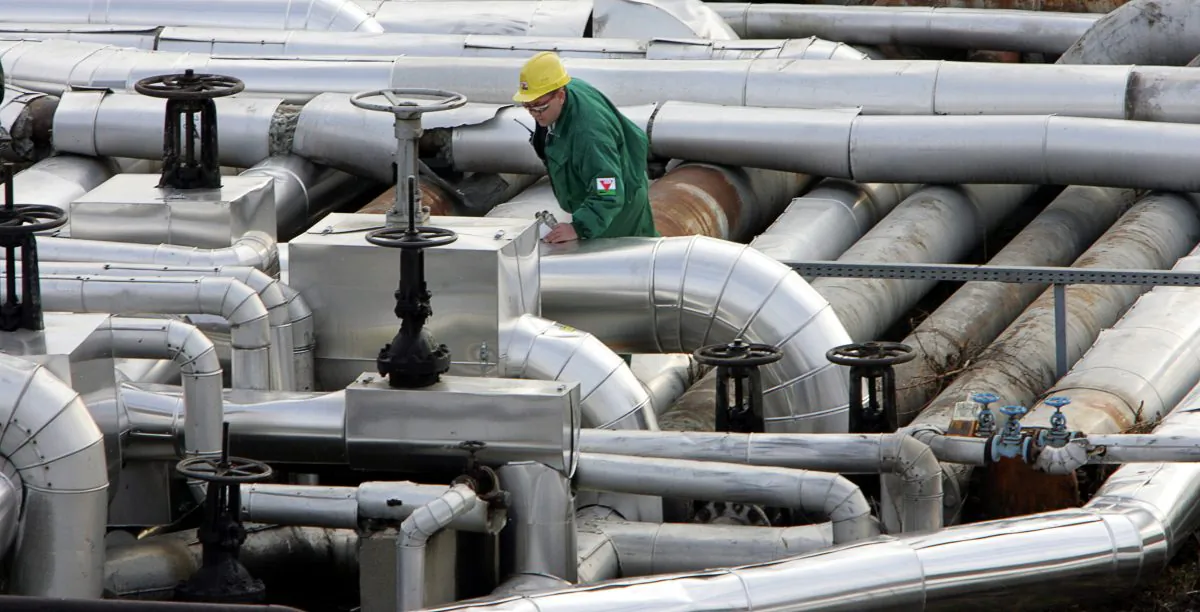
The Druzhba pipeline is a 4,000-kilometer (roughly 2,485-mile) artery carrying Russian oil into the landlocked heart of Europe. “Druzhba” means “friendship” in many Slavic languages.
Hungary’s intransigence will likely mean the package will no longer be passed on Feb. 23, according to EU foreign policy chief Kaja Kallas.
“Tomorrow marks the fourth anniversary of this horrible war,” she said. “So, of course, there’s going to be a discussion on the 20th sanctions package. But as you all know, I think there is not going to be progress regarding this today.”
Kallas also expressed doubt that the war itself was nearing an end, saying that she didn’t share U.S. optimism that the negotiations could herald a breakthrough.
“I don’t share this optimism, because the negotiators on [the] Russian side are not really serious, and they are not willing to talk about anything political,” she said.
“So of course, we have seen a lot of pressure on Ukraine to concede and give up what they are not willing to give up. But it doesn’t bring long-term peace. So I’m not that optimistic that we will see any results in [the] coming weeks and months.”
Hungary’s stance also drew criticism from other EU member states. Poland called its position “shocking.”
“I would have expected a much greater feeling of solidarity from Hungary for Ukraine,” Polish Foreign Minister Radoslaw Sikorski told reporters in Brussels.
“And instead, with the help of state propaganda … the ruling party managed to create a climate of hostility towards the victim of aggression. And now it’s trying to exploit that in the general election. It’s quite shocking.”
German Foreign Minister Johann Wadephul also criticized the move.
“I do not believe it is right for Hungary to betray its own struggle for freedom and European sovereignty,” Wadephul said.
“That is why we will once again present our arguments to the Hungarians in Budapest, but also here in Brussels, of course, and ask them to reconsider their position.”
Along with Hungary, Slovakia has threatened to stop emergency electricity exports to Ukraine if oil shipments fail to resume.
Ukrainian Foreign Minister Andrii Sybiha wrote in a Feb. 23 post on X that Budapest and Bratislava “cannot hold the entire EU hostage.”
“We call on both to engage in constructive cooperation and responsible behaviour,” he wrote, urging them to direct ultimatums toward Moscow.
Reuters contributed to this report.
 Friends Read Free
Copy
Facebook
Tweet
Friends Read Free
Copy
Facebook
Tweet