
The European Council on Feb. 4 approved details of the 90 billion euro ($106 billion) loan for Ukraine to support the country’s budget and defense needs for 2026 and 2027.
The support loan will allocate two-thirds of the funding to military spending and one-third to general economic support, according to a European Council statement.
Cypriot finance minister Makis Keravnos said the agreement “shows that the EU continues to act decisively in support of Ukraine and its people.”
“The new financing will help ensure the country’s fierce resilience in the face of Russian aggression. At the same time, we are sending a strong signal that the sovereignty and territorial integrity of states must be fully respected, in accordance with international law,” Keravnos said.
The European Council, which includes the leaders of the 27 EU member states, said in the statement that the loan will be repayable “only once Russia has paid war reparations to Ukraine.”
In December, European leaders agreed to finance the loan through EU borrowing on their capital markets, backed by the EU budget, rather than use seized Russian assets frozen in the bloc.
The agreement also requires approval from the European Parliament, which comprises 720 members directly elected by citizens of member states. The European Council said it hoped for a “speedy agreement” with the European Parliament, enabling the first payment to Kyiv to be disbursed early in the second quarter of this year.
Writing in a post on X, European Commission President Ursula von der Leyen welcomed this step in financing Ukraine, calling it a “powerful symbol of our ironclad solidarity with Ukraine as we approach four years since Russia’s full-scale invasion began.”
“Our support will further strengthen Ukraine’s position on the battlefield—and its hand at the negotiating table,” von der Leyen wrote.
Ukrainian President Volodymyr Zelenskyy thanked the council for the decision, writing in a post on X that the assistance “not only strengthens Ukraine across various areas, but also reinforces our position at the negotiating table. It is a significant contribution to the security of all of Europe and to our shared future.”
Military Aid
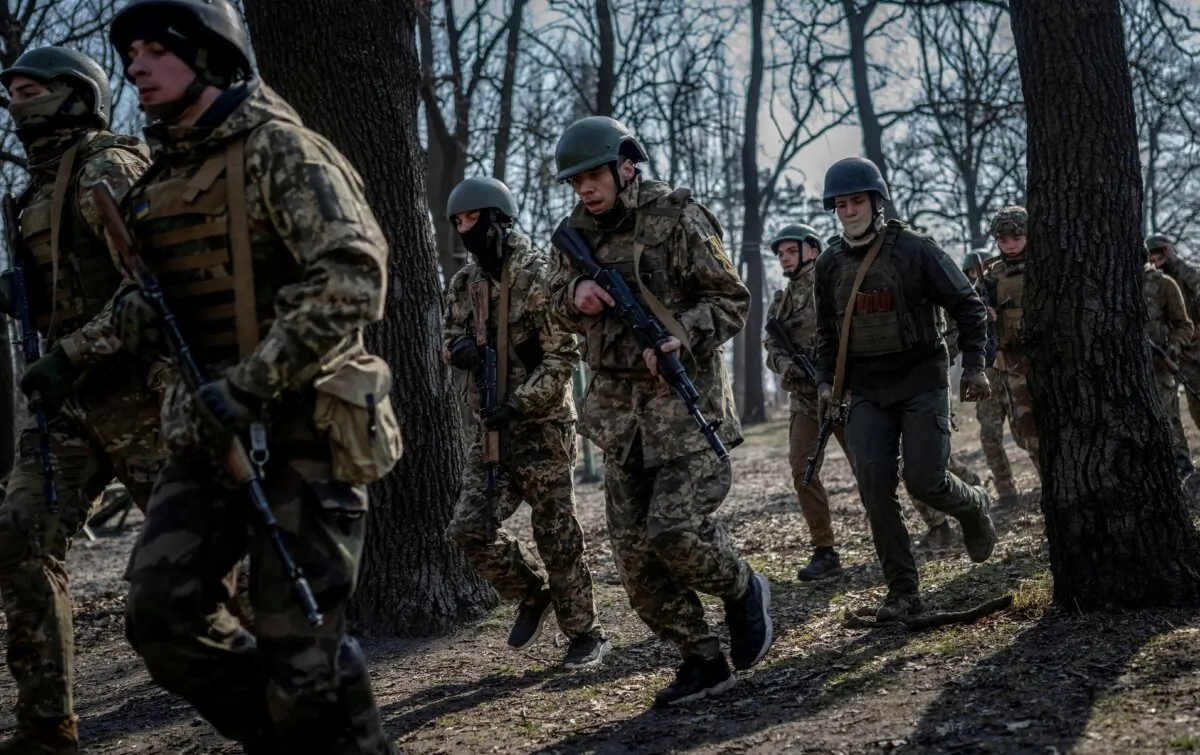
On military aid, the council said that 60 billion euros ($71 billion) can be used for investing in defense industrial capability and to buy military equipment.
The bloc stipulates that defence products should be purchased only from Ukraine, the EU, or countries that are members of the European Economic Area (EEA) and the European Free Trade Area (EFTA), namely Iceland, Liechtenstein, and Norway.
“Should Ukraine’s military needs require the urgent delivery of a defence product which happens not to be available in the EU, Ukraine or an EEA-EFTA country, a set of targeted derogations would apply,” the council said.
The remaining 30 billion euros ($35 billion) “will be provided as macroeconomic support to Ukraine, channelled via macro-financial assistance (MFA) or implemented through the Ukraine Facility, the EU’s dedicated instrument for providing Ukraine with stable and predictable financial support,” the statement said.
The council said the support will be made available in line with the country’s needs.
“In all cases, funding will be linked to strict conditions on Ukraine’s side such as adherence to the rule of law, including the fight against corruption,” the European Council said.
Ukraine is an EU accession state on a path to membership. In the EU’s 2025 enlargement report published on Nov. 4, the bloc said that while Kyiv has made progress on key reforms, it needed to do more to tackle corruption.
 Friends Read Free
Copy
Facebook
Tweet
Friends Read Free
Copy
Facebook
Tweet