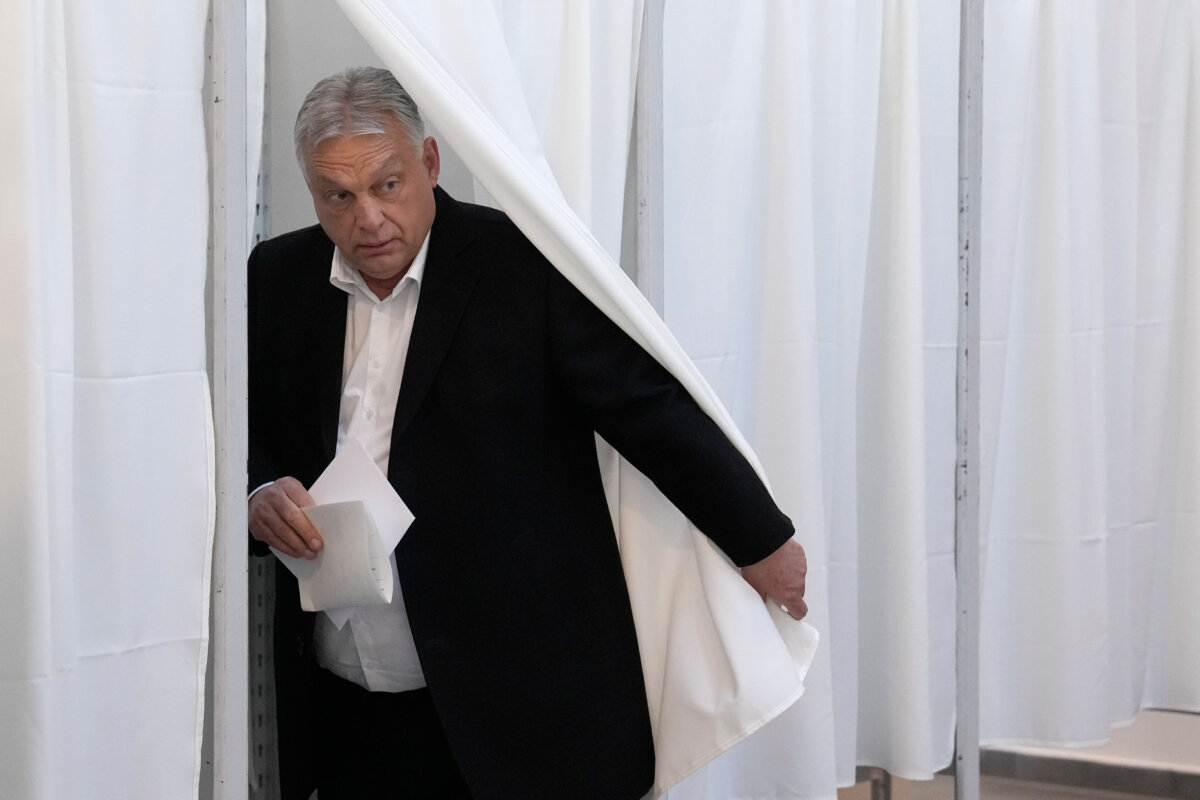

BUDAPEST, Hungary—After 16 years of uninterrupted rule, Viktor Orbán conceded defeat to Péter Magyar following Hungary’s parliamentary election on April 12, in what may be the most consequential political shift in Central Europe since the collapse of communism.
Magyar’s Tisza party secured 138 seats with more than 98 percent of votes counted, enough for a two-thirds supermajority, while Orbán’s Fidesz was expected to hold just 55 seats. Turnout reached 77 percent, the highest recorded in Hungary since 1989.
“You have empowered us to build a functioning and humane country, for all of us,” Magyar told cheering crowds in Budapest on Sunday night. The Chain Bridge was lit in Hungary’s national colors, and along the Danube tens of thousands celebrated, waving national and European Union flags. “Things are finally going to change in this country,” several Tisza supporters told The Epoch Times.
A Conservative Challenger, Not a Liberal One
What made this result difficult to read through a conventional left-right lens is that Magyar is, by most measurable standards, a conservative, experts emphasize.
A former Fidesz insider and trained lawyer who spent years as a Hungarian diplomat in Brussels, he ran on a platform that combined an anti-corruption message with positions on migration that sit well to the right of mainstream European opinion.
During his New Year’s broadcast, Magyar pledged zero importation of non-Hungarian guest workers from outside the EU.
His emergence split the Fidesz electorate not along ideological lines but along a different fault line: between those who remained loyal to Orbán personally and those who decided that their conservative convictions could survive a change of leadership.
Rodrigo Ballester, who heads the Europe program at the Mathias Corvinus Collegium (MCC), Hungary’s flagship conservative research and education institution, frames Magyar’s appeal with care. “Péter Magyar was fully integrated into Fidesz circles before launching his campaign,” he told The Epoch Times. “He founded his entire campaign on the one common denominator of his heterogeneous coalition of voters: hostility to Orbán. In a way, it reflects, on a Hungarian scale, the broad coalition seen in the European Parliament, spanning from the center-right to the far left. This is what underpins Tisza.”
Ballester noted that a representative of the Hungarian Green Party had said that voters “would vote for a goat at this point if it was running against Orbán.”
Roland Tardi, a political analyst at MCC, adds a layer of nuance from the inside. “Magyar has been effective at projecting a conservative image, and in a right-leaning society like Hungary, shaped by four decades of communism and a deep-seated resistance to the left returning to power, that image was electorally necessary,” he told The Epoch Times. “But the image and the underlying reality are two different things.”
He pointed to figures in Magyar’s inner circle as reasons for caution about what the government will actually look like in practice: among them a prospective economy minister who has, what Tardi described as “an extensive globalist network,” and a constituency winner known for progressive cultural positions who may also be handed a ministry.
What the Vote Was About
The scale of the result reflects a confluence of grievances that Orbán’s campaign, focused on the war in Ukraine and the threat from Brussels, failed to defuse, experts said.
Hungary’s economy stagnated for a third consecutive year, with growth of just 0.4 percent in 2025, far behind Poland, Bulgaria, and Romania. Unemployment reached its highest level in a decade. Magyar’s message, centered on accusations of corruption, authoritarianism, and failing public services, resonated in ways that Orbán’s geopolitical framing did not.
Bánk Boros, director of political analysis at the Nézopont Institute, a pro-Orbán think tank, argues, however, that accusations of authoritarianism and corruption against Orbán require scrutiny. “Hungary cannot be an authoritarian regime if free and fair elections take place,” he told The Epoch Times. “Free speech is protected. The media landscape is influenced by outlets hostile to the government. How can a regime be described as authoritarian when such an opposition can exist and organize openly?”
On corruption, he acknowledged it is “unfortunately found in virtually every country,” but pointed to anti-corruption measures and a judiciary that has ruled against Fidesz officials on numerous occasions.
A Campaign Fought on Multiple Fronts
The election had drawn unprecedented international attention in its final days. President Donald Trump announced on Saturday that Washington stood “ready to use the full economic might of the United States to strengthen Hungary’s economy” if Orbán won.
Vice President JD Vance visited Budapest the previous week, calling Orbán “the most important leader in Europe” on energy security, and accused Brussels’s bureaucrats of committing “one of the worst examples of foreign interference I have ever seen.”
On April 8, Vance also stopped at the Mathias Corvinus Collegium, telling a packed audience of young Hungarians: “Civilization wasn’t built overnight. It won’t be saved overnight.” There, he also challenged critics of his visit directly, how a vice-presidential trip to Budapest could be considered foreign interference, while the EU withholding funds from Hungary or Ukraine cutting off its oil pipeline is not?
On April 9, Republican Reps. Christopher H. Smith (New Jersey) and Andy Harris (Maryland) sent a formal letter to European Commission President Ursula von der Leyen, arguing that EU actions “constitute a pattern of direct and indirect intervention in Hungary’s internal political, media, and civil society environment during an active electoral period.”
They cited EU funding to organizations critical of Orbán, and the EU’s Article 7 proceedings against Hungary for its perceived threat to EU values, comparing the pressure to what was applied to Poland’s conservative government, which evaporated the moment a progressive government took office.
The traffic ran in both directions. On Thursday, five senior members of the European Parliament, including Green MEP Tineke Strik and European People’s Party member Michal Wawrykiewicz, urged von der Leyen to take “concrete steps” against what they called “severe threats” to the election’s integrity. They cited alleged Russian interference and leaked recordings of Hungarian Foreign Minister Péter Szijjártó briefing his Russian counterpart, Sergey Lavrov. A separate call published by Bloomberg showed Orbán telling Putin he was ready to help facilitate a U.S.-Russia peace summit in Budapest.
The Epoch Times attended a Nézopont Institute presentation on April 10 in which analysts argued that EU interference had operated through four channels: the approximately 32 billion euro ($37.7 billion) in EU funds suspended following Hungary’s 2022 elections; censorship through the Digital Services Act’s Rapid Response System, which data from MCC Brussels suggested had measurably reduced Orbán’s Facebook reach; what they describe as Ukraine’s suspension of the Druzhba oil pipeline in January; and the mobilization of foreign intelligence services to “depict Hungary as an unreliable partner through the use of leaks.”
“Taken together, these constitute a sustained and multidimensional intervention in a democratic electoral process,” Boros said.
The Generation That Decided the Vote
The generational dimension of the result was among its most striking features. Fidesz drew just 10 percent support among voters aged 18 to 29, compared to three-quarters of under-30s who said they intended to vote for Tisza, according to a Medián poll. The record turnout was partly attributed to younger voters who overwhelmingly opposed Orbán.
The Epoch Times attended a Civic Resistance Movement concert on April 10, where tens of thousands of mostly young Hungarians gathered in central Budapest for a seven-hour event. Their critique of Orbán centered on corruption and authoritarianism, denouncing “rigged public contracts,” the “enrichment of Fidesz-linked networks,” and restrictions on LGBT-related content in schools.
Yet their political profile does not lend itself to easy categorization according to Western left–right frameworks. Every young person The Epoch Times spoke with, despite describing themselves as broadly left-of-center, expressed firm opposition to immigration. “We defend LGBTQ rights, but we do not want to become like Sweden or Germany,” said a 16-year-old not old enough to vote. Another criticized Orbán specifically for allowing “Asian guest workers in and driving down wages at the low end.”
This combination, socially liberal on identity issues but firmly closed on immigration, is not anomalous in Hungary. A Guardian analysis confirmed that Generation Z in Hungary is overwhelmingly opposed to immigration, a stance that sets them apart from their Western European and American peers, where support for LGBT activism and liberal immigration policies tend to travel together as part of a broader progressive worldview.
On the war risk, every attendee The Epoch Times spoke with dismissed Orbán’s warnings as “propaganda,” taking for granted Magyar’s framing as the candidate of peace. In his New Year’s broadcast, Magyar had declared: “Hungary must stay out of every war. Full stop. There will be no war and no conscription under a Tisza government. Anyone who claims otherwise is lying.”
Whether that pledge will hold against the EU’s expectations for Hungary’s posture on Ukraine is one of the more consequential open questions his government now faces.
What Comes Next
Magyar announced his first foreign trip would be to Poland and that he would visit Brussels to launch reforms and secure frozen EU funds.
The reaction to the result divided sharply along political lines. Von der Leyen wrote: “A country reclaims its European path. The Union grows stronger.” French President Emmanuel Macron, German Chancellor Friedrich Merz and Spanish Prime Minister Pedro Sánchez offered warm congratulations, publicly framing Magyar’s victory as a win for the EU.
Italian Prime Minister Giorgia Meloni also offered congratulations to Magyar, but took care to also thank her “friend Viktor Orbán for the intense collaboration over the past years.”
Democrats in Washington framed the result as a harbinger for the November midterms.
Republicans offered a more mixed response, with Sen. Roger Wicker (Mississippi) reading it as a rejection of Russian influence and Elon Musk lamenting that the “Soros Organization has taken over Hungary” after Alex Soros wrote on X that “the people of Hungary have taken back their country.”
Will the frozen EU funds be released? Tardi drew a direct parallel with the case of Poland. “The funds were frozen for ostensibly legal reasons, but the underlying motivation was political: to create economic pressure ahead of the election. I expect the funds to arrive relatively quickly. And when they do, it will be presented as proof that the system works. The more honest interpretation is rather different.”
On energy, he was equally skeptical of a clean break with Russia under the new government: “The Orbán government did not maintain those Russian energy ties out of political solidarity with Moscow: It did so because Russian energy was cheap. That calculus does not disappear with a change of government. Whatever the outcome of the war in Ukraine, Russia will remain a neighbor. Symbolically, a clean break with Russia will be important for Magyar to communicate. But reality will assert itself quickly.”
Magyar has pledged to gradually reduce and eventually eliminate Hungary’s dependence on Russian energy, with a target date of 2035.
On immigration, Tardi believes that the hostility of the Hungarian society toward immigration will force Magyar to maintain a firm line. “Hungarian society demands it, and removing the border fence, for example, would be politically suicidal. The more complex question is the Migration Pact, under which Hungary is currently being fined 1 million euro [$1.2 million] per day. How he navigates that will be telling.”
As the celebrations in Budapest gave way to Monday morning, the question of what Tisza’s supermajority will mean in practice remained unanswered. Magyar has promised to reshape the country’s institutions, raise health care spending until it reaches 7 percent of GDP by 2030, limit state intervention in the economy, and reposition Hungary as “a strong ally of the EU and NATO.”
Whether the government he assembles will match these promises is what the next months will reveal. The new Hungarian government will be established around mid-May.
 Friends Read Free
Copy
Facebook
Tweet
Friends Read Free
Copy
Facebook
Tweet