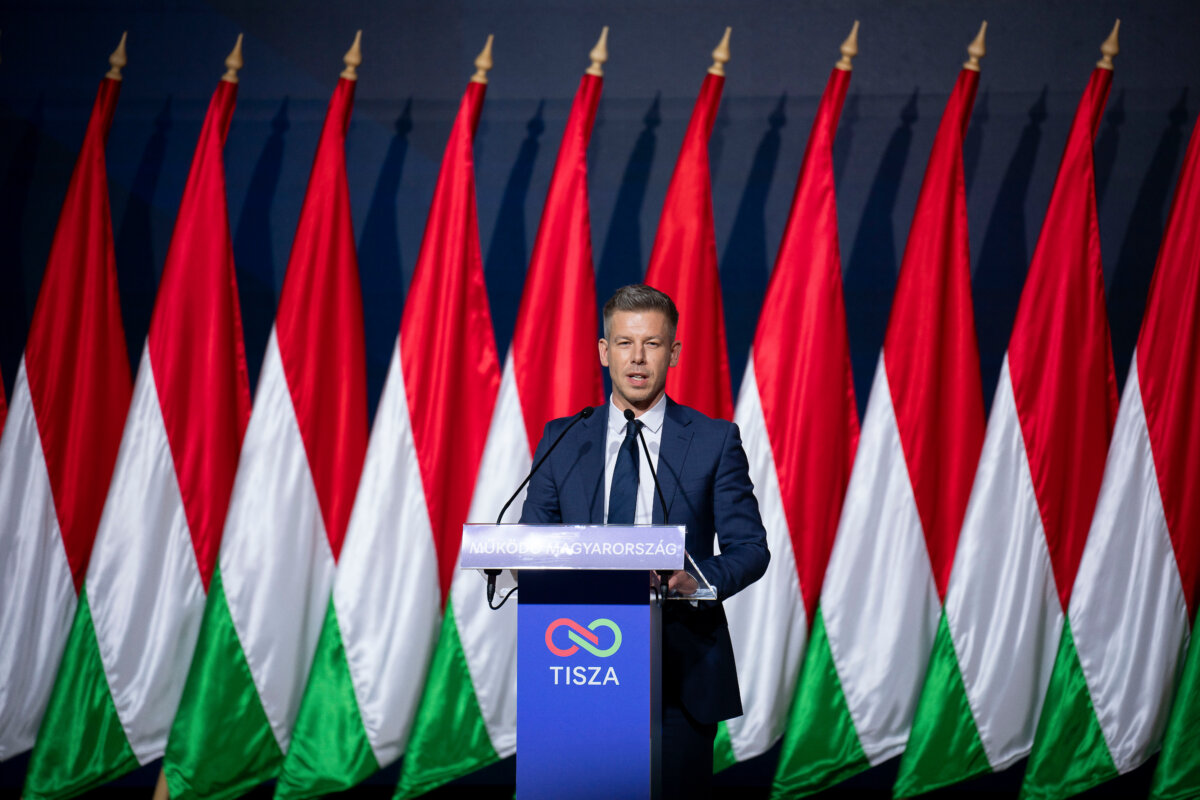

Hungarian opposition leader Peter Magyar launched his party’s election campaign in Budapest on Feb. 15, setting out plans to draw Hungary closer to European Union institutions ahead of the April 12 parliamentary election.
Magyar, a former member of Fidesz, the governing party led by Prime Minister Viktor Orban, founded the center-right Tisza party in 2024 after breaking with the government. Fidesz has been in power since 2010.
Speaking at the campaign launch on Sunday, Magyar said Hungary’s international standing had weakened under Orban and said he wanted to put an end to Hungary’s “drifting out of the European Union” under Orban.
“Hungary’s place is in Europe, not only because Hungary needs Europe, but also because Europe needs Hungary,” Magyar said.
U.S. Secretary of State Marco Rubio was in the Hungarian capital on Feb. 16 for meetings with Orban.
“President Trump is deeply committed to your success because your success is our success,” Rubio said, standing next to Orban.
“Because this relationship we have here in Central Europe through you is so essential and vital for our national interests.”
According to the PolitPro election trend as of Feb. 16, the opposition Tisza party holds a narrow lead over Orban’s governing Fidesz–KDNP coalition, with Tisza polling at about 46.5 percent and Fidesz at 41.7 percent.
Magyar said in a series of Feb.14 posts on X that he had meetings with around a dozen European leaders at last week’s Munich Security Conference in Germany, including Croatian Prime Minister Andrej Plenkovic, Polish Prime Minister Donald Tusk, Finnish President Alexander Stubb, and German Chancellor Friedrich Merz.
In another post on the same day, Magyar said, “In 57 days, Hungarians will drive out those who consider everyone a traitor who does not want them to remain in power, and we will begin building a new, peaceful, humane, and functioning Hungary.”
Magyar’s remarks came a day after Orban said the EU poses a greater threat to Hungary than Russia.
“We must come to terms with the idea that those who love freedom should not fear the East, but Brussels—and they should turn their anxious gaze towards Brussels,” Orban told supporters on Saturday.
“The ‘Putin, Putin, Putin’ mantra is crude and unserious, but Brussels is a tangible reality, and a direct source of danger. We would never have thought this twenty years ago! But this is the bitter truth, and we shall not tolerate it.”
Relations between Budapest and Brussels have deteriorated in recent years. The EU has frozen more than 6.3 billion euros (about $6.8 billion) in funding earmarked for Hungary, citing concerns about corruption and democratic standards.
The Tisza Party has pledged to introduce a wealth tax, join the euro, and end Russian energy imports by 2035.
Tisza’s recently released manifesto outlined measures to reclaim frozen EU funds.
It also said that it “will keep the southern border fence, reject the migration pact and migrant quotas, and we will not support Ukraine’s accelerated accession to the European Union.”
A Fidesz manifesto for the 2026 Hungarian parliamentary election has not yet been published, but in a Facebook post on Feb. 11, he cast the vote as a choice between peace and war.
The Orban government has also pursued conservative social policies, including a 2021 “child protection” law that restricts the public portrayal to minors of content depicting “divergence from sex at birth, sex reassignment, or homosexuality.”
Last year, U.S. President Donald Trump granted Hungary exemptions from sanctions affecting Russian gas delivered from the TurkStream pipeline and oil from the Druzhba pipeline.
Orban has previously criticised European leaders for imposing financial sanctions on Hungary for not letting migrants come into his country.
“In Hungary, the number of illegal immigrants is zero because we have a crystal clear system,” Orban said last November.
Last year, the EU’s top court ordered Hungary to pay a daily fine of 1 million euros (about $1.1 million) until it complies with EU refugee law.
Orban recently condemned an alleged EU plan to accelerate Ukraine’s accession to the bloc, warning that such a move would amount to an open confrontation.
In a post on X on Feb. 10, Orban said the EU has “decided that Ukraine will be admitted to the Union as early as 2027.”
“This new plan is an open declaration of war against Hungary,” Orban said.
Ukraine needs the backing of all 27 EU member states to join and faces a veto on EU entry from Hungary, which has said it opposes Kyiv’s membership.
Emel Akan, The Associated Press, and Reuters contributed to this report.
 Friends Read Free
Copy
Facebook
Tweet
Friends Read Free
Copy
Facebook
Tweet