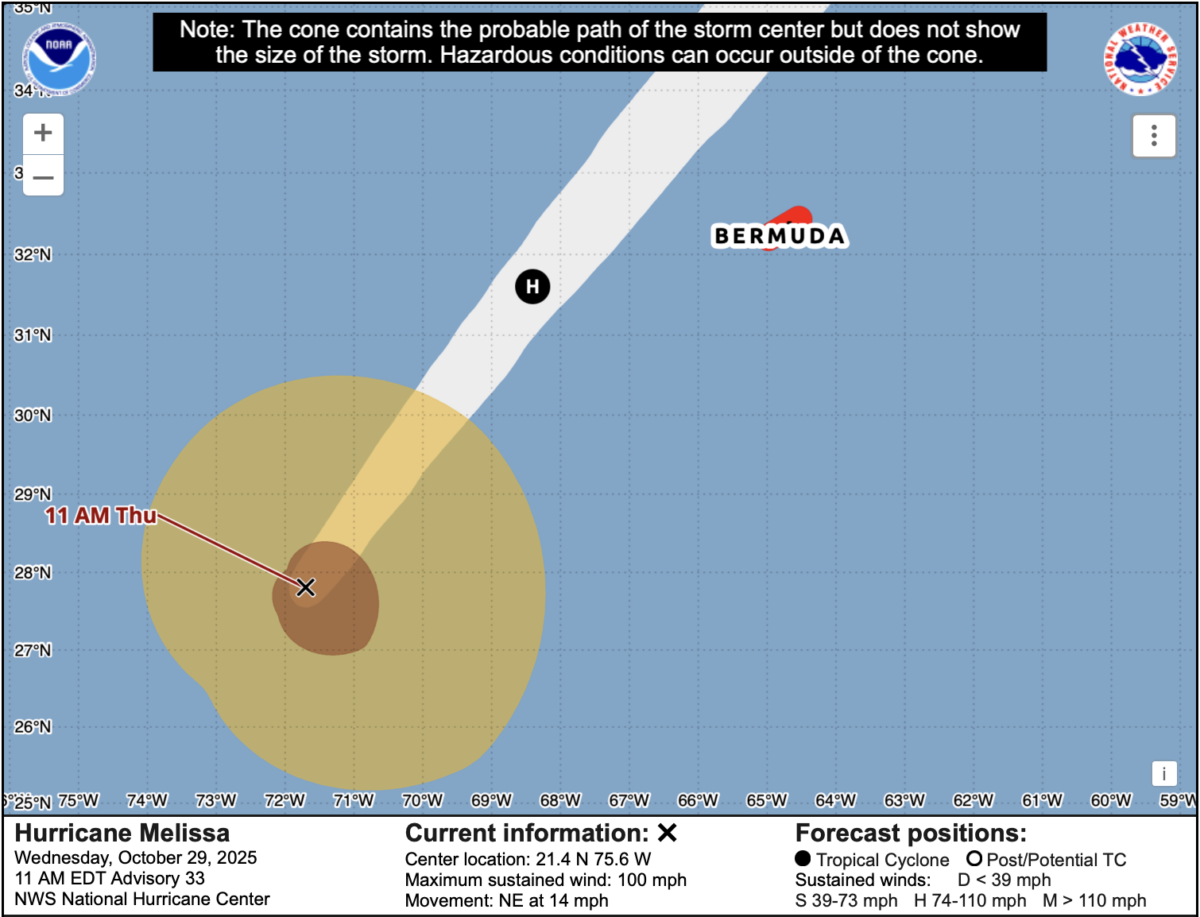

Hurricane Melissa left the Caribbean behind on Oct. 30 and, with renewed speed and strength, headed toward Bermuda in the mid-Atlantic Ocean.
After crossing Jamaica, Cuba, and the Bahamas, the storm retained hurricane status and regained some strength after weakening to a Category 1 hurricane.
The National Hurricane Center reported that Melissa was once again a Category 2 event with sustained winds of 105 mph.
“Hurricane conditions are expected in Bermuda tonight, with tropical storm conditions beginning late this afternoon,” the center warned in its Oct. 30 forecast.
“Preparations should be rushed to completion.”
The storm’s eye was tagged 515 miles southwest of Bermuda, moving north-northeast at 24 mph, and was expected to pass to the northwest of the British overseas territory by the night of Oct. 30.
Along with a slight reintensification, Melissa appeared to have expanded in overall size over the open ocean.
Tropical storm-force winds (39 mph to 73 mph) were recorded 220 miles out from its core, and hurricane-force winds (74 mph and greater) were recorded 75 miles out.
The hurricane center expected the storm to remain at its current intensity until Oct. 31, and then begin to weaken again, passing the southeastern tip of Newfoundland as a strong extratropical cyclone.
Jamaica, Cuba, Haiti, and the Bahamas are left to pick up the pieces from Melissa’s catastrophic impact.
Norman Manley International Airport reopened in Kingston, Jamaica, on Oct. 30, and road access to several devastated communities has been regained.
However, dozens of people are dead, hundreds of thousands are displaced and without power, and significant numbers of homes, landmarks, and pieces of infrastructure are destroyed.
Storm Timeline
Hurricane Melissa made landfall as a Category 5 near New Hope, Jamaica, just before 1 p.m. (EDT) on Oct. 28.
With maximum sustained winds of 185 mph and a core pressure of 892 millibars, it was the strongest landfall the island has had since recordkeeping began in 1851.
It was one of the most powerful ever recorded in the Atlantic basin.
Melissa’s core plowed through the western end of Jamaica, passing within 10 miles of Montego Bay, and emerged from the northern coast by 5 p.m. on Oct. 28.
It reentered Caribbean waters as a Category 4, as the mountainous terrain reduced its winds to 145 mph.
Hurricane Melissa made landfall near Chivirico, Cuba, on Oct. 29 as a Category 3 storm with sustained winds of 120 mph.
However, tropical storm conditions with intense rainfall and a deadly storm surge preceded its arrival.
Its passage over Cuba ended on Oct. 29, dropping to a Category 2 with winds of 100 mph.
As it made its way to the Bahamas, the National Hurricane Center noted that Melissa was decreasing in size, becoming a 90-mph Category 1 storm as it accelerated over the archipelago.
An expected reintensification occurred overnight, and Melissa sent heavy rains and a dangerous storm surge to the central and southern Bahamas, as well as the Turks and Caicos.
By 5 a.m. on Oct. 30, its winds maxed out at 105 mph.
Caribbean Aftermath
Affected islands have begun recovery efforts, as well as assessing the fatalities and destruction left in the storm’s wake.
Hurricane Melissa’s death toll was at least 34 as of Oct. 30, with 25 of the victims in Haiti, eight in Jamaica, and one in the Dominican Republic.
Haitian officials also reported that 10 more people were missing.
More than 25,000 people have taken refuge in shelters, Jamaican officials said, with nearly 90 percent of homes in St. Elizabeth Parish affected by the hurricane and 77 percent of the island’s population left without power.
A storm surge of 13 feet hit the southwestern shoreline, and catastrophic rainfall and winds uprooted trees, downed powerlines, and triggered life-threatening flash floods and landslides.
Santa Cruz, Jamaica, another town in the parish, suffered a landslide and devastating flooding that destroyed some of its streets.
Desmond McKenzie, deputy chairman of Jamaica’s Disaster Risk Management Council, said that St. Elizabeth had been “underwater” and suffered extensive damage.
Floyd Green, Jamaica’s Minister of Agriculture, Fisheries, and Mining, said on Oct. 29 that many communities remained cut off from roads and power, and efforts were underway to restore road access to many of those areas.
In Cuba, more than 735,000 people remained in shelters as authorities waited for conditions to improve enough to begin recovery efforts. As much as 15 inches of rainfall were recorded on the island.
In Haiti, more than 160 homes were damaged by the hurricane, and another 80 were destroyed in the town of Petit-Goave.
Officials said that 20 of the 25 deaths came from that town, and 10 of those were children.
Lawyer Charly Saint-Vil, 30, recalled seeing bodies down in the streets of the town among debris after the storm and hearing people screaming as they searched for their missing children.
Waves of international support have begun to be collected and deployed to the affected islands.
Those assisting include the United States and UK governments, the United Cajun Navy, and Sandals Resorts.
A free Starlink service has also been deployed to Jamaica and the Bahamas.
“Recovery will take time, but the government is fully mobilized,” Jamaican Prime Minister Andrew Holness said in a statement.
“Relief supplies are being prepared, and we are doing everything possible to restore normalcy quickly.”
The Associated Press contributed to this report.
 Friends Read Free
Copy
Facebook
Tweet
Friends Read Free
Copy
Facebook
Tweet