
A hurricane is about to become a typhoon for the first time in three years amid an intense Pacific storm season.
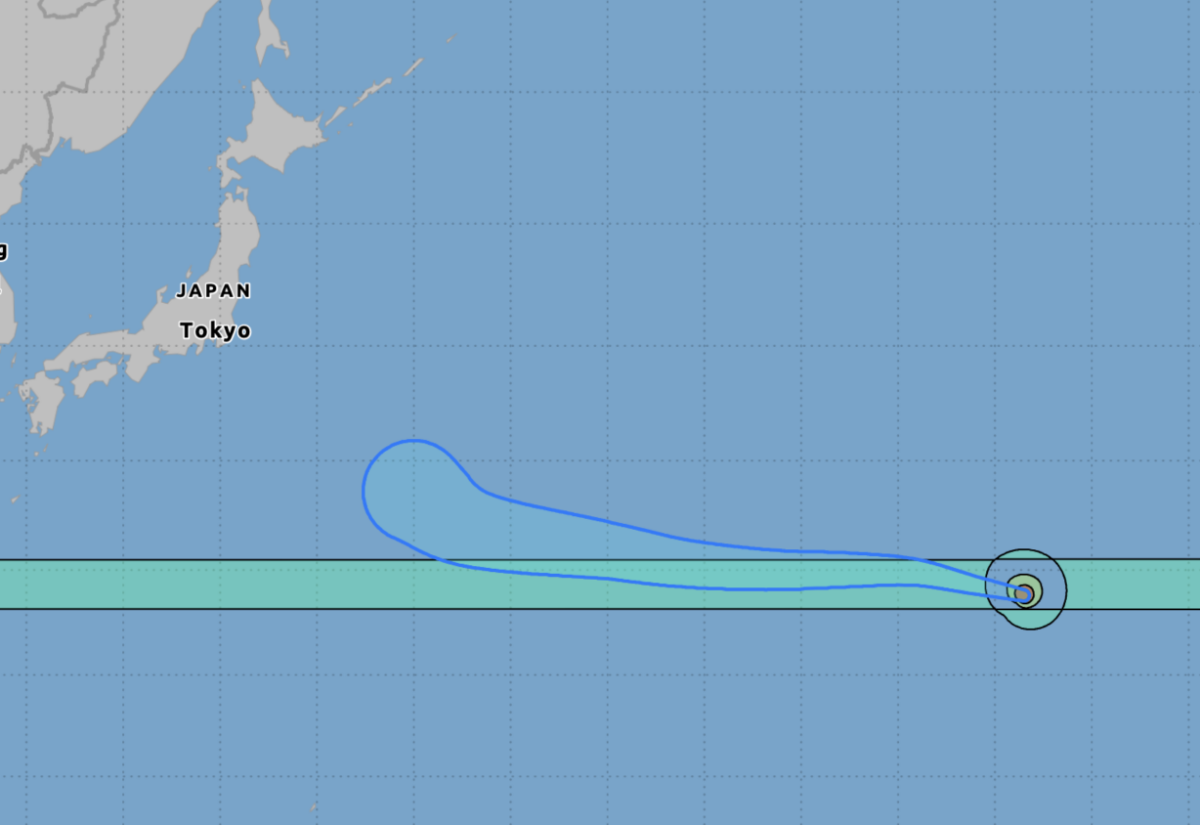
After scraping its way just south of the Hawaiian Islands, Hurricane Nolo regained strength and is continuing to move west across the Pacific, according to the National Hurricane Center.
As of 11 a.m. ET, Nolo was once again designated a major hurricane, moving west at about 18 mph. It is expected to cross the international date line within the next 12 hours. After that, Nolo will officially be in the Western Pacific and reclassified as a Typhoon.
Forecast maps show the storm moving in the general direction of Japan, but no watches or warnings have been issued.
The Joint Typhoon Warning Center forecast Nolo to gradually weaken but retain its Typhoon status for the next three days as it continues a westward push over open water. It is due to downgrade to a tropical storm on Oct. 7.
Hurricanes and Typhoons are both tropical cyclones with maximum sustained winds of at least 74 mph. However, cyclones that form in the Atlantic Ocean, including the Caribbean Sea and the Gulf of America; the Eastern Pacific off the coast of California, Mexico, and Central America; and the Central Pacific around Hawaii are classified as “hurricanes.” Cyclones that form in the Western Pacific and affect the Philippines, Japan, China, and the rest of the area generally known as the Far East are called Typhoons.
Nolo boasted maximum sustained winds of 115 mph, which made it a Category 3 hurricane on the morning of Oct. 4.
It earned the National Hurricane Center’s attention on Sept. 13 when it was in the Eastern Pacific about 615 miles southwest of the southern tip of Baja California, Mexico. It was designated “Tropical Depression 15-E,” and it remained a depression as it pushed west, falling to remnants in the final hours of Sept. 15. However, those remnants stayed together and moved into the Central Pacific. By Sept. 23, the storm reconstituted itself, earning the name Tropical Storm Nolo, and triggered a hurricane watch on Hawaii’s Big Island.
Nolo then became a hurricane on Sept. 24 as it turned north, threatening Hawaii. Ultimately, its eye and most destructive forces stayed south and away from the archipelago, and wind shear dethroned it of its hurricane status in the early morning hours of Sept. 30.
According to the National Hurricane Center, Nolo regained hurricane status around 5 p.m. on Oct. 2, and reintensified into a major hurricane by 2 p.m. on Oct. 3.
The Epoch Times has reached out to the Central Pacific Hurricane Center for comment about Hurricane Nolo, including its relationship to this year’s El Niño.
The last named storm to be classified as both was Hurricane/Typhoon Dora in 2023. It emerged in the Eastern Pacific as a tropical storm on Aug. 1 of that year, and was designated a Category 4 hurricane two days later. It retained its strength as it moved west into the Central Pacific, and became a Typhoon on Aug. 12, 2023.
Dora was the first cyclone since Hurricane John in 1994 to pass through all three Pacific Basins as a hurricane. In 2018, Hurricane Hector completed the trek as a major hurricane in the Eastern Pacific and through the Central Pacific, but crossed the international date line as a weakening Tropical Storm.
Before that, Hurricane Kilo formed in 2015, becoming one of a record-setting 15 Central Pacific tropical cyclones to form that season due to that year’s El Niño. It became a hurricane on Aug. 29 of that year, became a major hurricane the next day, and crossed the international date line on Sept. 1, 2015.
In 2014, Hurricane Genevieve appeared in the Central Pacific on Aug. 6 of that year, and rapidly intensified into a Category 3 hurricane on Aug. 7, 2014. It continued to intensify as it crossed the international date line later that same day, earning the designation Super Typhoon. Genevieve reached the equivalent strength of a Category 5 hurricane with maximum sustained winds exceeding 160 mph. It spent its life far from major population areas and dissipated on Aug. 13, 2014.
Nolo is the seventh named storm, the sixth hurricane, and the fourth major hurricane to appear in the Central Pacific this hurricane season as of Oct. 4. That makes this season’s count of five named storms, five hurricanes, and four major hurricanes above the Central Pacific’s recorded average between 1991 and 2020.
The hurricane season in the Eastern and Central Pacific ends on Nov. 30.
 Friends Read Free
Copy
Facebook
Tweet
Friends Read Free
Copy
Facebook
Tweet