
Australia’s 14th-largest trading partner and an important defence ally in the Indo-Pacific, Indonesia, has signed a strategic partnership with Russia, calling it a “key partner” in the region.
It comes after Indonesia became a full member of the Russian-inspired BRICS grouping in January this year.
Establishing BRICS as an alternative to the Western-dominated G7 had long been the ambition of the then-Russian Foreign Minister, Yevgeny Primakov, who in 2009 convened a meeting of the founding countries: Brazil, Russia, India, and China.
Over the years, it has added more members: South Africa, Egypt, Ethiopia, Indonesia, Iran, and the United Arab Emirates.
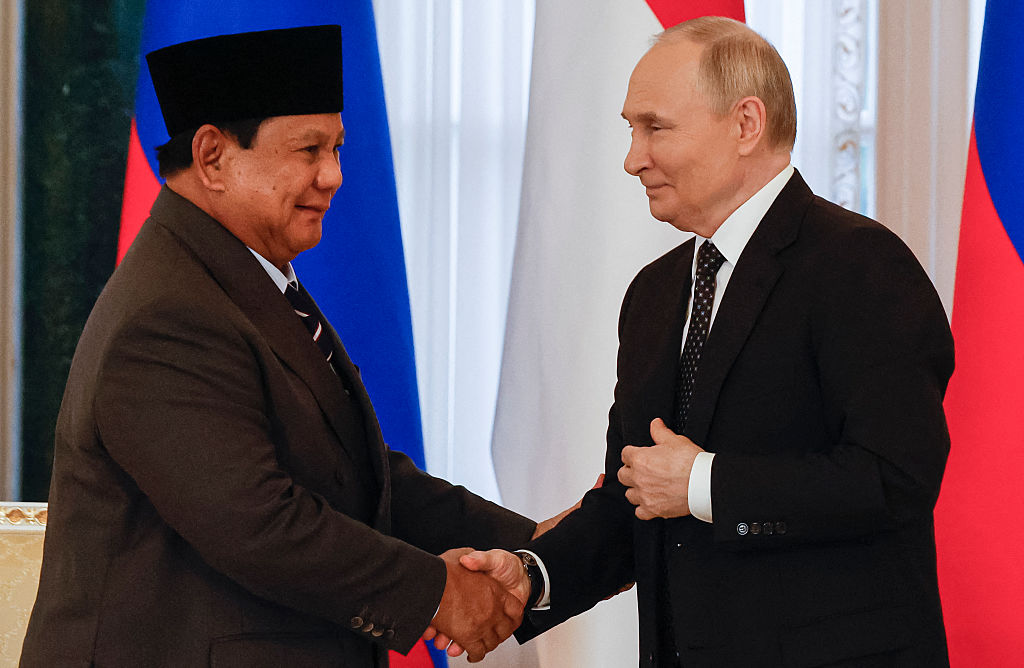
Following a meeting in St Petersburg on June 19 between Indonesian President Prabowo Subianto and his Russian counterpart, Vladimir Putin, the two countries announced an even closer relationship, deepening military, security and trade ties.
“Today we have met and our relationship is getting stronger again,” Prabowo said in a statement.
“My meeting with President Putin today was intense, warm and productive. In all fields of economics, technical cooperation, trade, investment, agriculture, they all have experienced significant improvements.”
Indonesian sovereign wealth fund Danantara and the Russian Direct Investment Fund also agreed to create an investment fund worth $2.29 billion.
It follows a major diplomatic effort by Canberra to woo Prabowo’s government, with Prime Minister Anthony Albanese making Jakarta the first bilateral visit of his second term just a month ago, accompanied by Foreign Affairs Minister Penny Wong and Home Affairs Minister Tony Burke.
It came just after reports alleged that Russia had asked to base long-range bombers in Papua, which Indonesia refused.
Albanese criticised Russia, saying that while it too will try to increase it influence in the region, “We make very clear our position when it comes to Russia around the world, be it the brutal invasion of Ukraine, its interference in cyber-security issues as well, its tolerance of criminal organisations that have been involved in that, are an anathema to our values.”
He said Australia would counter the effects of Indonesia joining BRICS by “investing in our capability and investing in our relationships,” such as continuing to provide military training.
Indonesia Non-Aligned: Analyst
The announcement of even closer ties between Jakarta and Moscow must be causing disquiet in Canberra, but aside from condemning Russia, there have been few other public moves from Albanese and Wong.
Gatra Priyandita, a senior analyst in the Australia Strategic Policy Institute’s (ASPI) Cyber, Technology, and Security programme, agreed with this approach.
“Australia should not foster an unrealistic sense that its partnership with Indonesia is akin to those it has with such close non-allied friends as Japan or Canada,” she said.
“For Australia, this means accepting that while bilateral ties have grown, particularly in defence and economic cooperation, they will continue to be shaped by divergent global outlooks.”
Indonesia has long pursued what it sees as a non-aligned foreign policy, and its views on world events differ from those of Australia.
“While Indonesia has condemned Russia’s invasion of Ukraine, it has not shown the same level of public concern for the plight of Ukrainians,” she said, “reflecting a degree of selective empathy in its own foreign policy. [Plus] the war in Gaza, Israel’s attack on Iran, and the strong support for Israel by many Western governments have eroded Indonesian public perceptions of Western credibility on human rights.”
Priyandita said Russia was a “safe choice” for Prabowo, as it doesn’t pose a direct challenge to Indonesia in the South China Sea or involve itself in Indonesia’s domestic affairs like Washington has in the past.
“Foreign policy has become more centralised in his presidency, with decisions increasingly shaped by the president’s personal preferences rather than institutional deliberation,” Priyandita said.
Australia and Indonesia have still managed to establish a “productive bilateral relationship despite their differing international perspectives.”
“Indonesia isn’t turning away from the West,” Priyandita said. “While it sometimes lacks coherence in execution of foreign policy, it is pursuing what it views as a balanced and independent approach.”
Closer Relationship With Russia Concerning
However, Michael Shoebridge, founder and director of Strategic Analysis Australia, was concerned about the implications of a stronger Russia-Indonesia relationship.
“There is an obvious and real pattern here which has Indonesia’s new leader working actively and quickly to deepen military cooperation with Russia, and of Putin welcoming this and working to the same end,” Shoebridge previously told The Epoch Times.
“Of course, there are limits to how much priority and attention Putin can give to this because of the overwhelming priority of his war in Ukraine, but Putin has been consistent in growing Russian military activities in our part of the world despite this.
“So, despite [Defence Minister Richard Marles] telling us that the security agreement he signed with Prabowo back in August last year was a historic deepening of the Australia-Indonesia defence relationship, Russia and Indonesia are getting closer and working together more. And Jakarta doesn’t see any need to give us details or consult about that.”
 Friends Read Free
Copy
Facebook
Tweet
Friends Read Free
Copy
Facebook
Tweet