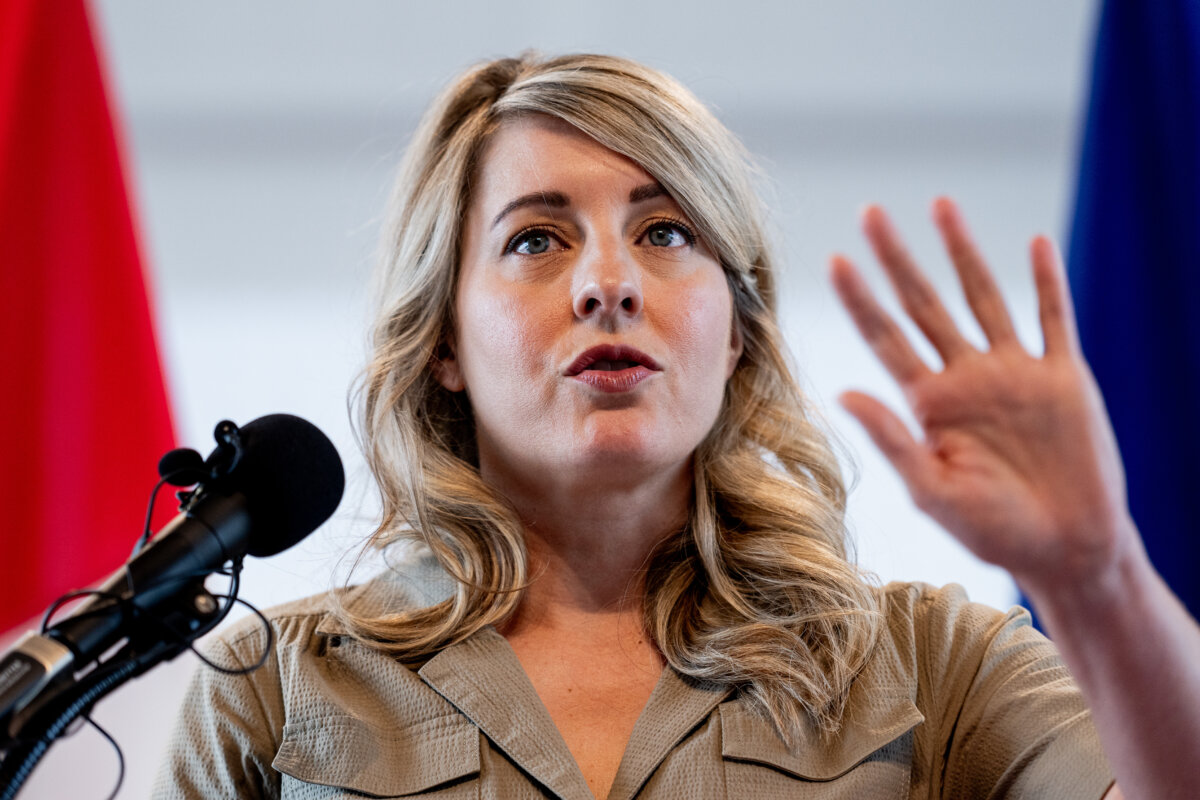

Industry Minister Mélanie Joly said she is working with Defence Minister David McGuinty on a new defence industrial strategy that would allow Canada to meet the new NATO target of 3.5 percent of GDP on core defence spending.
Joly said during an Aug. 20 press conference that as Canada is the world’s ninth-largest economy, Ottawa will be making “an enormous amount of investment in our Canadian Armed Forces” to meet the defence alliance’s GDP target.
“At the same time, we’ll be able to invest in our industrial capacity, and that’s why I’m working on a new defence industrial strategy in concert with my colleague, the minister of defence,” she said.
At their annual summit in June, NATO members agreed to raise their military spending targets to 5 percent of GDP from 2 percent by 2035. The new goal includes 3.5 percent for core defence spending and 1.5 percent for related items like critical infrastructure, civil preparedness, cyber defence, and bolstering the industrial base.
According to the latest NATO estimates, Canada spent 1.45 percent of its GDP on defence in 2024. It has been criticized for years by the United States for failing to meet the 2 percent NATO target.
Prime Minister Mark Carney announced in early June that Ottawa would increase defence spending by $9 billion by the end of the fiscal year to bring Canada to 2 percent.
Carney said Canada would meet the target by:
- Putting the Canadian Coast Guard under the defence department instead of fisheries
- Establishing a Bureau of Research Engineering and Advanced Leadership in Innovation and Science
- Participating in ReArm Europe to boost collective defence capabilities
- Increasing military salaries
Ottawa also announced $2.1 billion to strengthen the government’s relationship with the defence industry to “lay the groundwork” for a defence industrial strategy. The government said it would focus on reducing obstacles that “currently limit industry’s ability to provide critical equipment and support to the CAF,” while also working with allies to procure defence equipment.
Carney has linked Canada’s critical minerals to defence, allowing mining of minerals like lithium, cobalt, nickel, and rare earth minerals to be considered part of defence spending.
In August, Carney announced higher pay for all Canadian Armed Forces members, including a 20 percent increase for privates in the regular forces, a 13 percent raise for lieutenant colonels and lower ranks, and an 8 percent raise for those at the rank of colonel, captain, and above.
 Friends Read Free
Copy
Facebook
Tweet
Friends Read Free
Copy
Facebook
Tweet