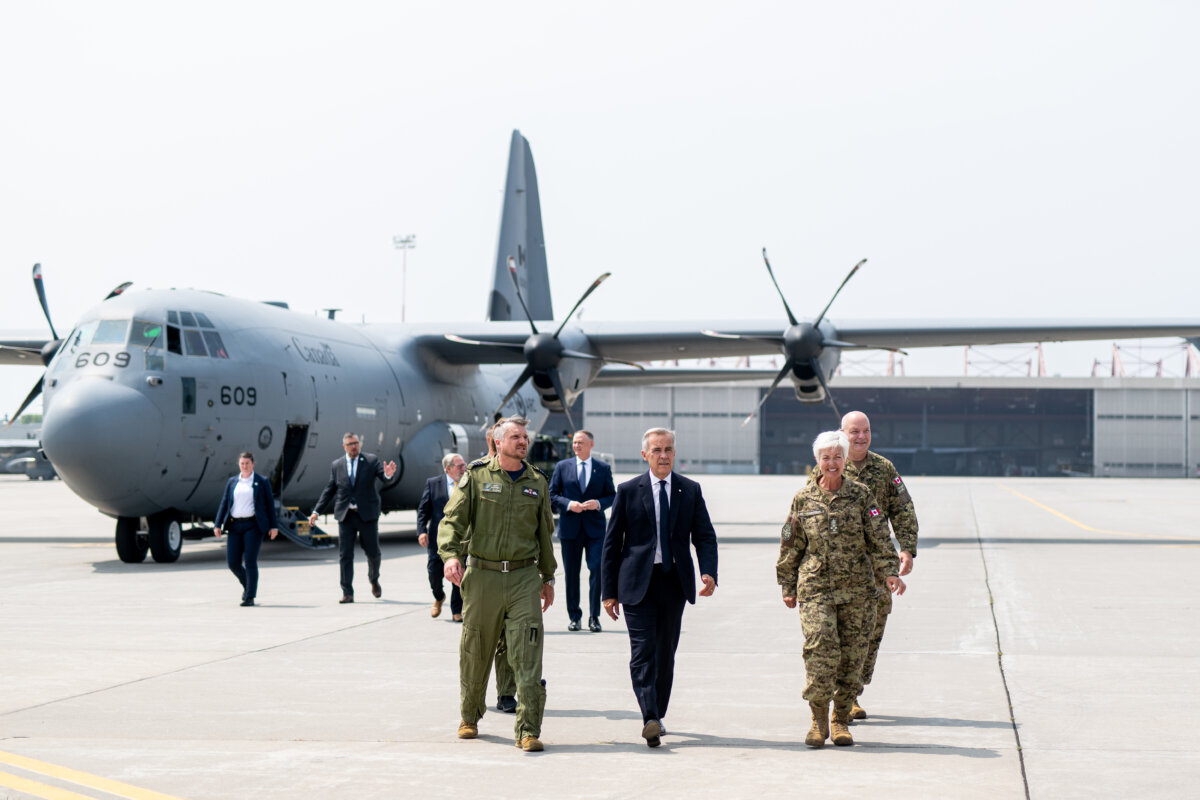

Prime Minister Mark Carney has announced higher pay for all members of the Canadian Armed Forces (CAF), saying salaries have not kept pace with the demands put on those serving their country.
Starting pay for privates in the regular forces will see a 20 percent increase, while lieutenant colonels and lower ranks will receive a 13 percent raise, and those at the rank of colonel or captain and above, will receive an 8 percent raise, Carney said during an Aug. 8 announcement at Canadian Forces Base Trenton in Trenton, Ont.
“All members of the Canadian Armed Forces will receive a pay raise,” Carney said. “As the demands on our Canadian Armed Forces have increased their resources and their salaries have not kept pace, and these are the men and women we trust to wear the maple leaf, the Canadian flag, and to risk their lives for it.”
Carney was joined for the announcement by Minister of National Defence David McGuinty, local Liberal MP Chris Malette, and Chief of the Defence Staff Gen. Jennie Carignan.
McGuinty said in June there would be an approximate 20 percent pay raise for CAF members, but Carney said that amount isn’t across the board because its a “generation change.” The new pay raises will also include pay benefits based on years of service “so that paycheques honour years in uniform,” he said.
Under previous rates, entry-level CAF recruits on active duty earned $3,614 per month, rising to $5,900 to $7,500 per month for corporals, $6,900 to $10,200 per month for sergeant, to chief warrant officer and upward depending on officer rank. The new raises will bring a regular force CAF private up from $3,614 per month to $4,337 per month.
Carney added there will be additional financial support for those preparing to deploy to combat and high-risk training, funding for those required to relocate, and financial support for those posted far away from their families. CAF members who are deployed for emergencies and natural disasters within Canada will also receive an additional pay benefit, along with more funding going to support critical trades in the military.
Canada has fallen well below NATO’s previous 2006 target that member countries spend a minimum of 2 percent of GDP on defence, with defence spending in Canada in 2024-2025 sitting at 1.37 percent. Ottawa set out a path last April to reach 2 percent of GDP spending by 2032, bolstered by $8.1 billion in additional spending over five years and $73 billion over 20 years.
That target was bumped up on June 9, when Carney said Canada would reach 2 percent of defence spending in this fiscal year, seven years ahead of schedule, with a $9.3 billion investment in the military and its partners.
“We’re building up our own defence and security industries and diversifying those international defence partnerships,” Carney said, adding that “our total spending on defensive security will quadruple by the end of this decade, relative to 2023-24.”
Canada joined NATO member states in pledging to raise defence spending to 5 percent of GDP by 2035 during a NATO summit held in the Hague, Netherlands, on June 25. This spending specifically includes 3.5 percent in core defence spending such as equipment and personnel and 1.5 percent for national security and defence-related investments such as expanding the nation’s industrial base and cybersecurity.
“Canada’s new government recognizes that our military infrastructure and equipment have aged, hindering our military preparedness,” Carney said Aug. 8. “We recognize that only one of our four submarines is seaworthy, but less than half our maritime fleet and land vehicles are operational. So we’re modernizing our military equipment. We’re building up our own defence and security industries.”
Carney said Canada’s promised $2 billion in military support to Ukraine earlier in the month at the G7 summit in Kananaskis, Alta., would count toward meeting the NATO spending goal as well.
Ottawa is slated to provide a roadmap midway through next year on meeting the 5 percent goal, along with a full review by 2029. Carney has said Canada’s defence budget will rise to roughly $150 billion per year by 2035 to meet the NATO target.
 Friends Read Free
Copy
Facebook
Tweet
Friends Read Free
Copy
Facebook
Tweet