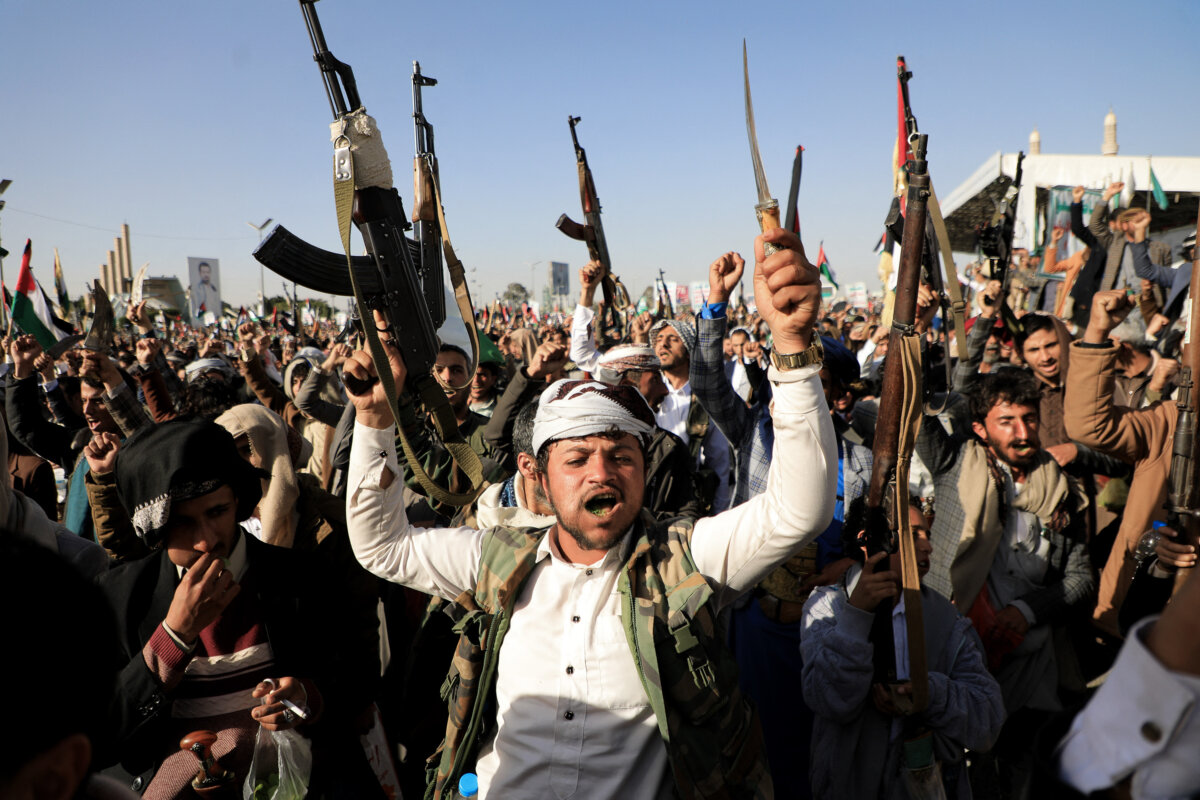

The Houthis, a Yemen-based terrorist group aligned with Iran, have threatened to block the Bab el-Mandeb Strait—a strategic waterway in the Red Sea—and target U.S. vessels in the region, raising the possibility of their involvement in a broader conflict alongside Iran.
The Bab el-Mandeb Strait connects the Red Sea to the Gulf of Aden and is a vital route for global trade, particularly for oil and gas shipments moving between Europe and Asia. Any disruption there could have significant economic consequences worldwide.
In a statement on March 20, the Houthis warned regional countries, including Jordan, Saudi Arabia, and the United Arab Emirates, against intercepting missiles launched by Iran, Yemen, or allied groups. They cautioned that any such actions would be treated as direct alignment with their adversaries.
Iran has long projected influence across the Middle East through a network of allied groups operating in Gaza, Syria, Lebanon, Iraq, and Yemen. Some of these allies have already escalated their activities.
Hezbollah resumed strikes on Israel shortly after attacks on Iran, while militias tied to the Islamic Resistance in Iraq have claimed responsibility for drone attacks on U.S. bases in Irbil.
In contrast, the Houthis have so far limited their response to public demonstrations and statements condemning the conflict. This marks a shift from their actions following the Oct. 7, 2023, Hamas terrorist attack on Israel, when they launched missiles and drones at both Israeli targets and commercial shipping in the Red Sea.
The Houthis, who are armed and supported by Iran, took control of much of northern Yemen, including the capital Sanaa, in 2014. This forced the internationally recognized government into exile and triggered a Saudi-led military intervention the following year. Since then, Yemen has been locked in a prolonged and largely stalemated civil war.
Although the Houthis share political and religious connections with Iran, they maintain a degree of independence. They follow a distinct branch of Shiite Islam and are not directly subordinate to Iran’s supreme leader, unlike Hezbollah and some Iraqi militias.
Houthi leader Abdulmalik al-Houthi has repeatedly stated that the group is prepared to intervene in regional conflicts, saying their “hands are on the trigger,” though he has not specified what form such involvement might take.
Previous Houthi attacks during the Israel–Hamas war significantly disrupted Red Sea shipping, a corridor that typically carries around $1 trillion in goods annually. The group also launched drones toward Israel during that period.
The Associated Press contributed to this report.
 Friends Read Free
Copy
Facebook
Tweet
Friends Read Free
Copy
Facebook
Tweet