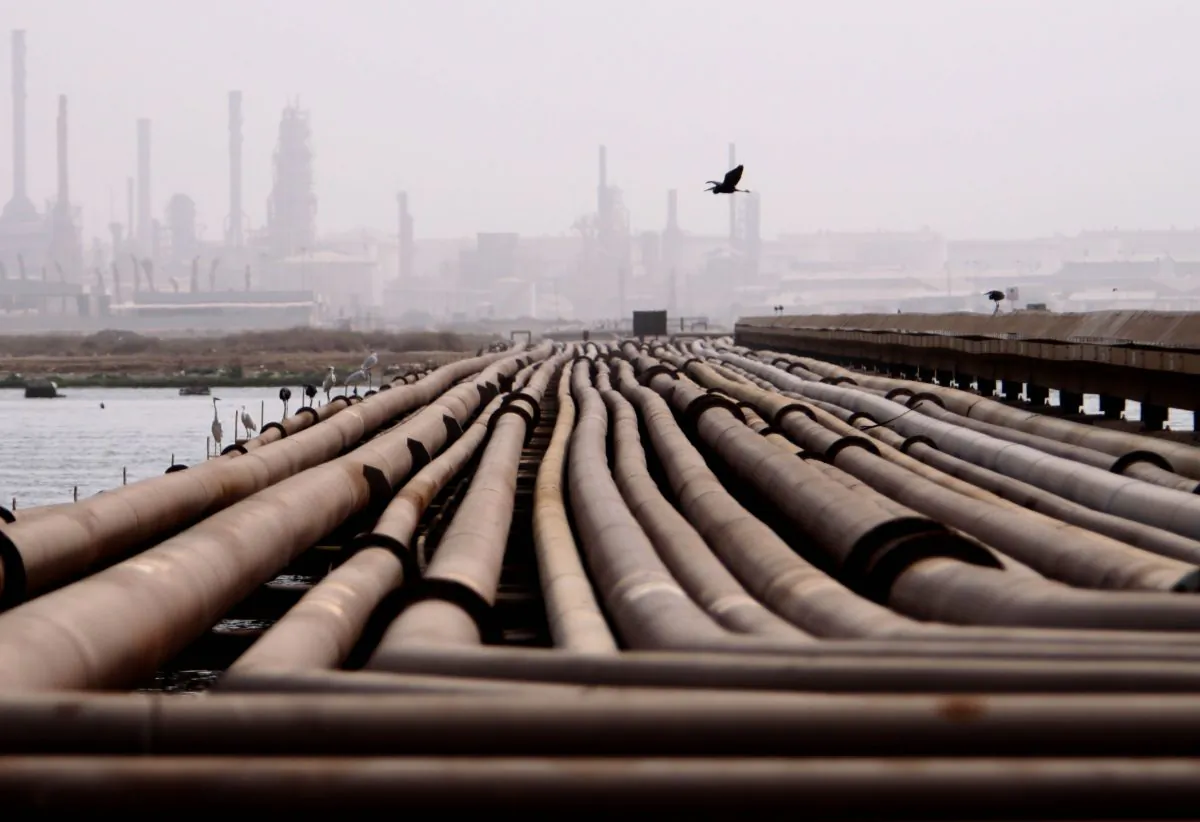

Bapco Energies, Bahrain’s state-owned energy company, declared force majeure on its group operations on March 9 following an Iranian attack on its Sitra refinery complex, according to the company.
Force majeure is a legal term meaning an unexpected event beyond someone’s control, such as war, natural disaster, or government action, that prevents them from fulfilling a contract.
The Sitra refinery is the largest refinery on Bahrain’s island of Sitra, according to the trade publication Offshore Technology.
The Bahrainian Ministry of Interior stated in a March 9 post on X that a “fire that broke out in a facility in the Ma’ameer area, as a result of Iranian aggression, has been brought under control.”
The ministry noted that no injuries or deaths were reported.
Bahrain also accused Iran of striking a desalination plant on March 8.
Desalination plants supply water to millions of residents in desert regions by removing salts and other minerals, making it suitable for human consumption, irrigation, and industrial use.
Oil prices increased by around 25 percent on March 9 to their highest since mid-2022.
Brent crude futures climbed to a high of $119.50 per barrel and U.S. West Texas Intermediate (WTI) to $119.48 per barrel.
“The plan is to get oil and natural gas and fertilizer and all of the products from the Gulf flowing through the straits,” Energy Secretary Chris Wright told Fox News on March 8.
“One large tanker has already gone through the straits with no issues at all … energy will flow soon,” he said in a March 8 post on X, shared by the White House’s Rapid Response 47 account.
“Short-term oil prices, which will drop rapidly when the destruction of the Iran nuclear threat is over, is a very small price to pay for U.S.A., and world safety and peace,” President Donald Trump said in a March 8 post on Truth Social. “Only fools would think differently!”
The war has blocked the world’s most important oil artery, the Strait of Hormuz, which accounts for 20 percent of global oil and LNG supply, triggering force majeure across Gulf energy markets.
On March 7, Kuwait Petroleum Corp. (KPC) implemented a reduction in crude oil production and refining throughput because of “ongoing aggression by the Islamic Republic of Iran against the State of Kuwait.”
The national oil company did not say by how much it would reduce output.
“KPC emphasizes that this adjustment is strictly precautionary and will be reviewed as the situation develops. It remains fully prepared to restore production levels once conditions allow. KPC stresses that all domestic market needs remain fully secured in accordance with established plans,” the company said in a March 7 post on X.
QatarEnergy, a state-owned energy company and the world’s largest single liquefied natural gas (LNG) producer, stated in a March 4 post on X that it had declared force majeure, meaning that it can’t guarantee deliveries amid the Iran War.
If the halt applies across its 14 LNG trains, the shutdown could affect close to 20 percent of global LNG supply.
Last week, Qatari Energy Minister Saad Al-Kaabi said that the conflict in the Middle East could “bring down the economies of the world.”
Al-Kaabi, who is also the CEO of QatarEnergy, told the Financial Times on March 6 that oil prices could soar to $150 per barrel within two to three weeks if tankers and other merchant vessels are unable to pass through the Strait of Hormuz.
“Everybody that has not called for force majeure we expect will do so in the next few days that this continues. All exporters in the Gulf region will have to call force majeure,” Al-Kaabi said.
“If they don’t, they are at some point going to pay the liability for that legally, and that’s their choice.”
Reuters contributed to this report.
 Friends Read Free
Copy
Facebook
Tweet
Friends Read Free
Copy
Facebook
Tweet