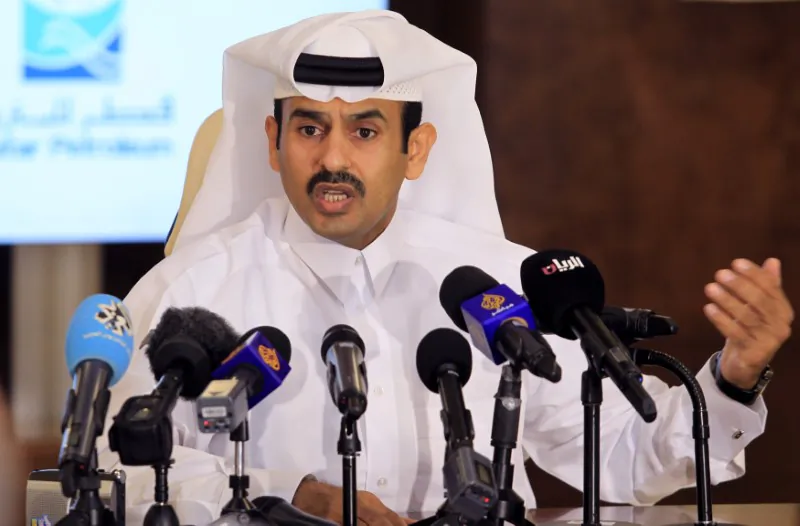

Qatari Energy Minister Saad Al-Kaabi has said that the conflict in the Middle East could “bring down the economies of the world.”
Al-Kaabi, who is also the CEO of QatarEnergy, told the Financial Times on March 6 that oil prices could soar to $150 a barrel within two to three weeks if tankers and other merchant vessels are unable to pass through the Strait of Hormuz.
“Everybody that has not called for force majeure we expect will do so in the next few days that this continues. All exporters in the Gulf region will have to call force majeure,” Al-Kaabi said.
“If they don’t, they are at some point going to pay the liability for that legally, and that’s their choice.
“This will bring down the economies of the world.”
He said that everybody’s energy prices will go up.
“There will be shortages of some products, and there will be a chain reaction of factories that cannot supply,” he said.
QatarEnergy, the state-owned energy company and the world’s largest single liquefied natural gas (LNG) producer, said in a March 4 post on X that it had declared “Force Majeure,” meaning it can’t guarantee deliveries amid the Iran War.
Force Majeure is a legal term meaning an unexpected event beyond someone’s control, such as war, natural disaster, or government action, that prevents them from fulfilling a contract.
If the halt applies across its 14 LNG trains, the shutdown could affect close to 20 percent of global LNG supply.
“We don’t think anybody would dare to come to us and say we are not reliable because you were being bombed and you did not deliver,” Al-Kaabi said.
“Let’s assume you want to buy 77 million and deliver it to customers; there is no 77 million tonnes lying around for you to buy.”
Vessel-tracking platform MarineTraffic said tanker traffic had fallen by about 90 percent, according to a March 4 post on X.
The Atlantic Council said in a March 5 report that while China would suffer from oil disruptions, a crisis resulting in major LNG outages would not cause significant harm to Beijing because natural gas plays a smaller role in its energy mix.
They said that the Chinese Communist Party (CCP) has “the largest onshore crude stockpiles in the world, with inventory levels estimated at 1.2 billion barrels as of January 2026, with builds amounting to 100 million barrels over the previous year, per Kpler data.”
The European Union, Japan, South Korea, and Taiwan rely far more heavily on LNG imports.
It added that LNG outages in Qatar would benefit the U.S. LNG industry.
On March 4, Russian President Vladimir Putin said that Russia could halt gas supplies to Europe.
When asked on Russian state television about European plans to impose a total ban on Russian pipeline gas imports by late 2027 and to ban new short-term Russian LNG contracts from late April 2026, Putin said it might be more beneficial for Russia to stop selling the gas right now.
“Now other markets are opening up. And perhaps it would be more profitable for us to stop supplying the European market right now. To move into those markets that are opening up and establish ourselves there,” Putin said.
“This is not a decision; it is, in this case, what is called thinking out loud. I will definitely instruct the government to work on this issue together with our companies.”
According to the International Energy Agency, Russia holds the world’s largest proven natural gas reserves and is the world’s second-largest producer of natural gas.
Reuters contributed to this report.
 Friends Read Free
Copy
Facebook
Tweet
Friends Read Free
Copy
Facebook
Tweet