
The European Union has agreed to stop Russian natural gas imports by late 2027 and has committed to phasing out Russian oil, the bloc announced on Dec. 2.
The Council of the EU, which is composed of national ministers from each of the 27 member states, and the European Parliament agreed on a provisional roadmap to introduce a ban on liquefied natural gas (LNG) by Dec. 31, 2026, and pipeline gas by Sept. 30, 2027.
The European Commission, the EU’s executive branch, said in a statement that the full phaseout of Russian fossil fuels set out in the REPowerEU Roadmap will “guarantee Europe’s energy independence, competitiveness, resilience and market stability.”
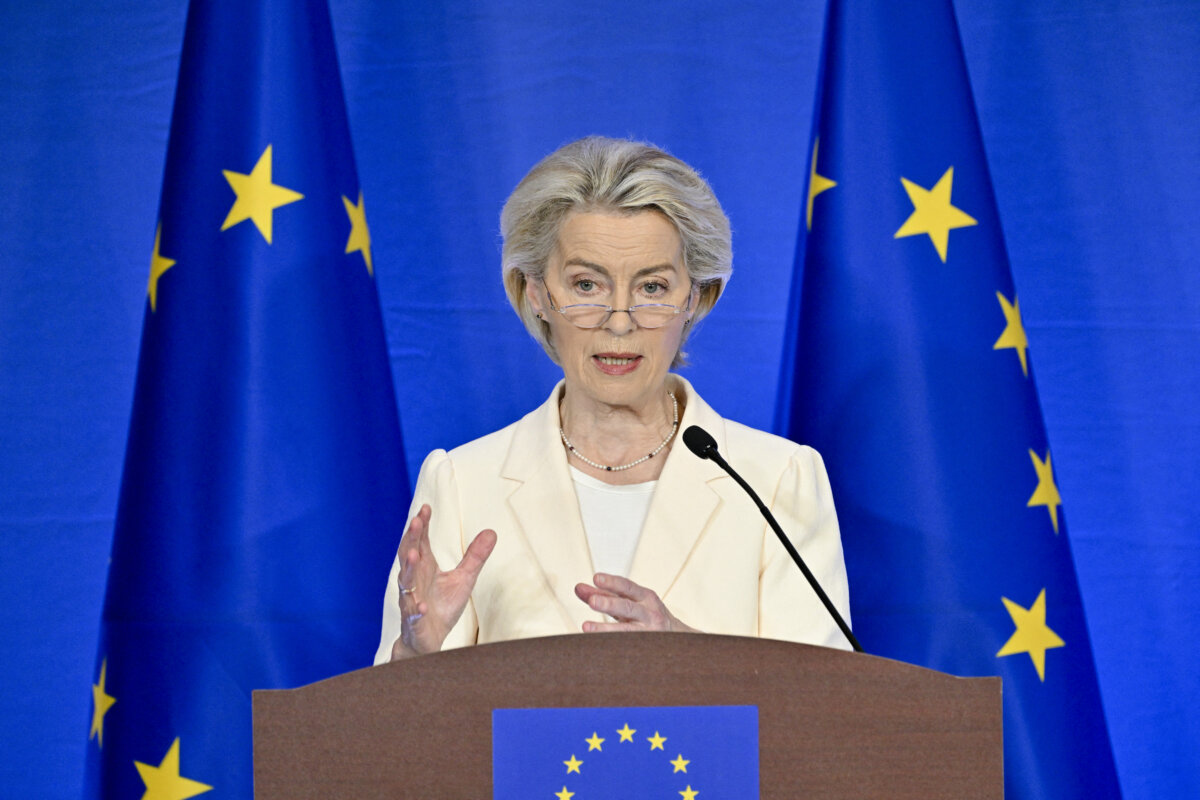
European Commission President Ursula von der Leyen said in a statement: “Today, we are stopping these imports permanently. By depleting Putin’s war chest, we stand in solidarity with Ukraine and set our sights on new energy partnerships and opportunities for the sector.”
The EU’s executive branch also stated that it remains committed to phasing out all remaining oil imports by the end of 2027, with plans to propose bloc-wide legislation to ban Russian oil imports early next year.
The text of the political agreement will now need to be formally approved by the European Parliament, which is made up of 720 lawmakers directly elected by citizens of individual EU member states and by the Council of the EU.
Following the 2022 Russian invasion of Ukraine, the EU has sought to reduce its dependence on energy from Russia. According to an explainer on the European Council’s website, “Russia’s share of EU imports of pipeline gas dropped from over 40% in 2021 to about 11% in 2024.”
In 2024, Russia accounted for less than 19 percent of the EU’s combined imports of gas and LNG.
November 2027 Deadline
The bloc stated that for short-term supply contracts concluded before June 17, 2025, the ban on imports will apply from April 25, 2026, for LNG and from June 17, 2026, for pipeline gas.
For long-term LNG contracts concluded before June 17, 2025, the cut-off date will be Jan. 1, 2027. This aligns with the ban on imports of LNG adopted by the Council of the EU on Oct. 23 as part of the bloc’s 19th round of sanctions against Russia.
For long-term contracts for pipeline gas imports, the deadline is Sept. 30, 2027. However, the commission said that if an EU member state importing pipeline gas cannot fill its required storage levels by the deadline, the import ban for pipelines will apply from Nov. 1, 2027.
“Therefore, by November 2027 [at] the latest, the EU will have phased out, once and for all, Russian gas imports,” the commission stated.
Under the terms of the political agreement, member states will have to submit plans on how they intend to diversify their oil and gas supplies by March 1, 2026.
European Commissioner for Energy and Housing Dan Jorgensen said: “Finally, and for good, we are turning off the tap on Russian gas. Europe has chosen energy security and independence. We will never go back to our dangerous dependence on Russia.
“We will never go back to volatile supplies and market manipulation. We will never go back to energy blackmail and economic exposure. And we stand stronger than ever with Ukraine in its quest for freedom.”
Hungary to Challenge EU Decision
However, the bloc’s decision poses a challenge for some of Europe’s landlocked countries that rely on Russian fuel. Hungary and Slovakia, in particular, receive Russian supplies via the Druzhba oil pipeline.
Budapest and Bratislava maintain closer ties with Moscow than the rest of the bloc and have defended their continued purchase of Russian energy, saying alternatives are too expensive.
Hungarian Foreign Minister Peter Szijjarto said in a post on X on Dec. 3 that “as soon as the RePowerEU [Roadmap] is formally adopted, we will immediately challenge it before the [Court of Justice of the European Union].”
“Legal proceedings will start without delay. Preparatory work is already underway. We will do everything necessary to defend Hungary’s energy security,” Szijjarto said.
Moscow has also criticized the plans, saying Europe will become more dependent on much more expensive imported gas by phasing out Russian fuel.
“Europe is thus condemning itself to much more expensive energy sources, which will inevitably have consequences for the European economy and a decrease in Europe’s competitiveness,” Kremlin spokesman Dmitry Peskov said, as quoted by Russian state-owned news agency TASS.
“This will only accelerate the process that has emerged in recent years of the European economy losing its leading potential.”
 Friends Read Free
Copy
Facebook
Tweet
Friends Read Free
Copy
Facebook
Tweet