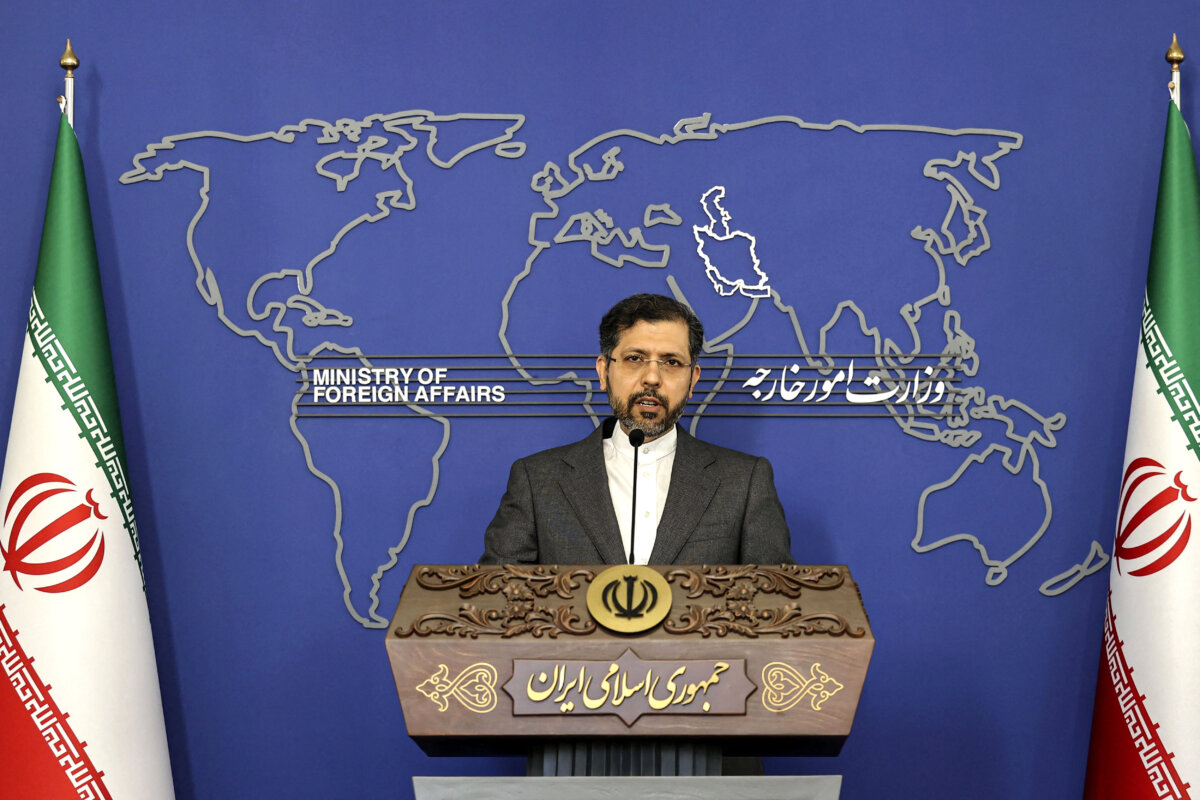

Iran is not ready to hold another set of peace talks with U.S. representatives until President Donald Trump backs off from his “maximalist” stance on Iran’s nuclear activity, Iranian Deputy Foreign Minister Saeed Khatibzadeh said on April 18.
During a visit to Turkey on Saturday, Khatibzadeh told reporters that there needs to be a clear “framework of understanding” for peace talks to proceed. The Iranian official offered the comment with just days left on a two-week ceasefire that began on April 7.
Vice President JD Vance had led a U.S. delegation in a 21-hour round of talks with Iranian representatives on April 11, but the talks ended without a deal. At the time, Vance said the sticking point had been Iran’s refusal to clearly swear off the pursuit of nuclear weapons.
Tehran has denied it’s pursuing nuclear weapons, however, the International Atomic Energy Agency (IAEA) said Iran has about 970 pounds of uranium enriched to 60 percent purity—a short, technical step from weapons-grade levels of 90 percent.
As he spoke with reporters on Saturday, Khatibzadeh said Iran would not agree to stricter limits on nuclear activity than those expected of other countries under existing international standards.
“The other side should abandon its maximalist position and should respect international law, within which we can then secure diplomacy,” Khatibzadeh said. “I have to be very crystal clear that Iran would not accept to be an exception from the international law.”
Earlier this week, Trump raised the prospect of a second round of weekend peace talks. As he spoke with reporters on Saturday, Khatibzadeh said no date would be set for such talks until there is a baseline agreement between Washington and Tehran.
U.S. forces bombed three Iranian nuclear facilities in June 2025. Since then, there has been speculation about whether stockpiles of highly enriched uranium may still be trapped under the rubble at these damaged nuclear facilities.
Speaking with Reuters on April 17, Trump said the United States would be able to enter Iran at a “leisurely pace” to locate and remove Iran’s uranium stockpiles.
In an interview with The Associated Press on Saturday, Khatibzadeh dismissed the idea that Iran would willingly relinquish its nuclear fuel.
“I can tell you that no enriched material is going to be shipped to United States,” the Iranian official said, and referred to the idea as a “nonstarter.”
Tehran has also chafed at a U.S. blockade of Iranian ports, which went into effect on April 13.
The Strait of Hormuz and its adjoining waterways—which run along Iran’s shoreline and act as a key artery for global energy flows—have faced disruptions over the past month and a half. After U.S. and Israeli forces commenced attacks on Iran on Feb. 28, Iranian forces began threatening ships transiting the Strait of Hormuz as a way to inflict retaliatory economic disruption.
Tehran agreed to cease attacks on shipping in the Strait of Hormuz when it entered into the current two-week ceasefire.
On Saturday, Iran’s military announced it would again restrict transit through the Strait of Hormuz, in response to the ongoing U.S. blockade of Iranian ports. The UK Maritime Trade Operations Centre has since reported that a pair of Iranian gunboats fired on a tanker ship, and an unknown projectile struck a container ship, both northeast of Oman.
 Friends Read Free
Copy
Facebook
Tweet
Friends Read Free
Copy
Facebook
Tweet