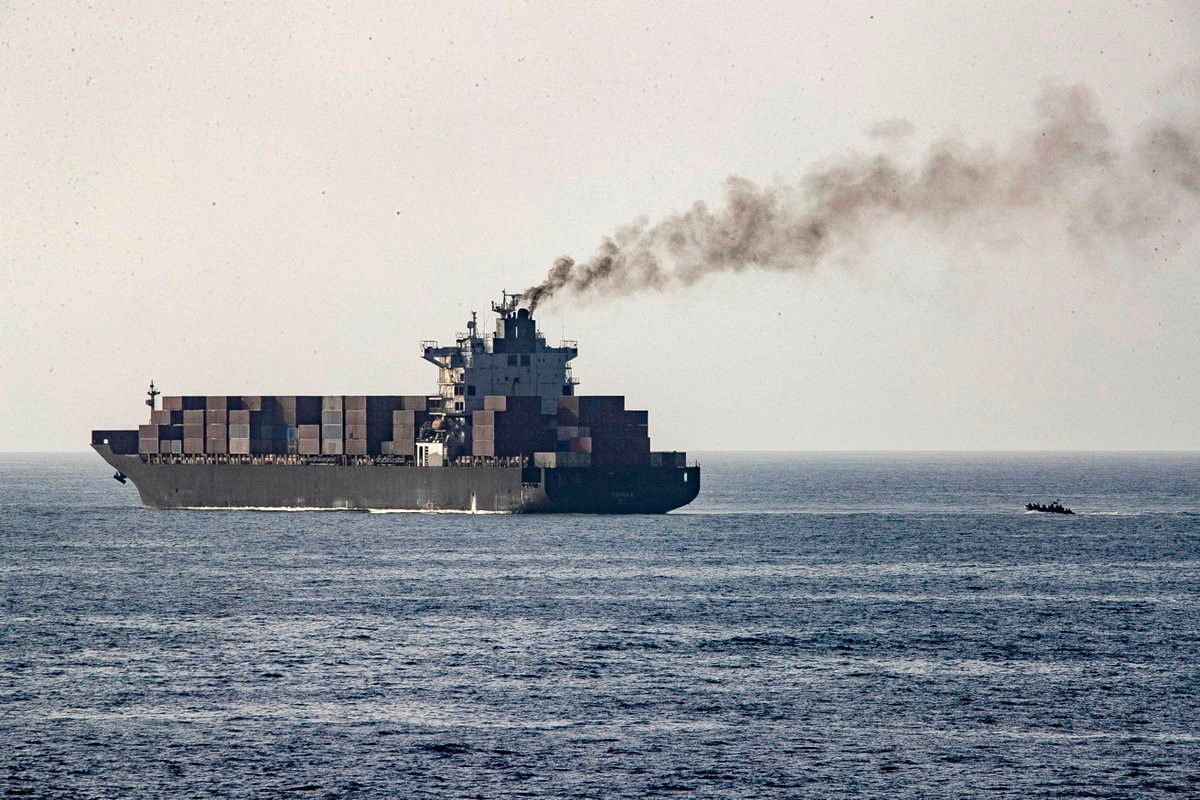

Iran is nearing forced oil production stoppages as storage tanks fill rapidly, with usable capacity potentially falling to as little as 12 days, according to an April 27 update from Kpler, a commodities data firm that tracks global oil, gas, and shipping flows.
The firm said the U.S. blockade is beginning to “materially disrupt Iran’s oil flows,” with loadings collapsing and storage filling rapidly.
Homayoun Falakshahi, who leads Kpler’s crude oil analysis team, said Iran’s usable oil storage is estimated at about 26 million barrels, equal to roughly 14 days of capacity. But assuming not all storage tanks can be used, he said, “usable storage drops to just around 12 days, including floating storage.”
Since the United States and Israel began strikes on Iran on Feb. 28, and Iran’s response targeting its Gulf neighbors and commercial shipping, traffic through the Strait of Hormuz has slowed sharply. U.S. Central Command said on April 13 it began enforcing a naval blockade on vessels entering or leaving Iranian ports.
Falakshahi disputed Iranian claims that 34 vessels have escaped the zone since the blockade was imposed.
“We have not observed any vessels successfully transiting it,” Falakshahi said.
“So far, the US blockade appears very efficient.”
According to the update, since the blockade, Iran’s oil inventories have risen by about 4.6 million barrels, bringing total onshore storage to roughly 49 million barrels.
Iran’s total storage capacity is estimated at 90 million–95 million barrels, leaving about 41 million barrels available, roughly 22 days of production.
However, Falakshahi said that not all storage can be used.
Tanks at Sirri and Lavan, holding about 4.7 million barrels, are not accessible for onshore crude. Around 8.6 million barrels at Assaluyeh are reserved for condensate from the South Pars gas field.
And roughly 1.6 million barrels at Bandar Abbas are tied to a condensate refinery and are not usable for crude storage.
In practice, this leaves about 26 million barrels, or 14 days of capacity, though usable storage may be closer to just 12 days of normal export levels.
In a separate update on April 27, Kpler said imports of Iranian crude into China’s Dalian Changxing Island, home to the Hengli refinery, averaged 202,000 barrels per day in 2025 and 253,000 barrels per day so far in 2026.
On April 24, the U.S. Department of the Treasury’s Office of Foreign Assets Control (OFAC) announced sanctions against Hengli Petrochemical (Dalian) Refinery, one of China’s largest independent refiners, for its involvement in purchasing Iranian oil.
The move was shared with The Epoch Times ahead of the announcement.
The 400,000-barrel-per-day refinery in Dalian was designated as one of Iran’s largest customers for crude oil.
“China’s independent oil refineries, colloquially known as ‘teapots,’ purchase the majority of Iran’s crude oil, providing a vital source of revenue to the Iranian regime and its armed forces,” OFAC said in a statement.
“Economic Fury is imposing a financial stranglehold on the Iranian regime, hampering its aggression in the Middle East, and helping to curtail its nuclear ambitions,” said Treasury Secretary Scott Bessent.
“At President Trump’s direction, Treasury will continue to constrict the network of vessels, intermediaries, and buyers Iran relies on to move its oil to global markets. Any person or vessel facilitating these flows—through covert trade and finance—risks exposure to U.S. sanctions.”
Iranian Foreign Minister Abbas Araghchi traveled to Russia on April 27 for talks with Russian President Vladimir Putin.
Araghchi shuttled between mediators, Pakistan and Oman, on April 26 before flying to Russia on April 27, after leaving Islamabad on April 25 without meeting U.S. negotiators.
Russia released a video on April 27 showing Araghchi’s arrival in St. Petersburg.
Russian Defense Minister Andrei Belousov held talks in Kyrgyzstan on Monday with Iranian Deputy Defense Minister Reza Talaei-Nik, state-run TASS news agency reported on April 27.
“We are in favor of resolving the conflict exclusively diplomatically. We support the sovereignty and territorial integrity of Iran,” he said.
“I wish the fraternal Iranian people, their armed forces, steadfastness and courage in overcoming all threats facing the country. We are ready to do everything possible to resolve this situation.”
Eva Fu contributed to this report.
 Friends Read Free
Copy
Facebook
Tweet
Friends Read Free
Copy
Facebook
Tweet