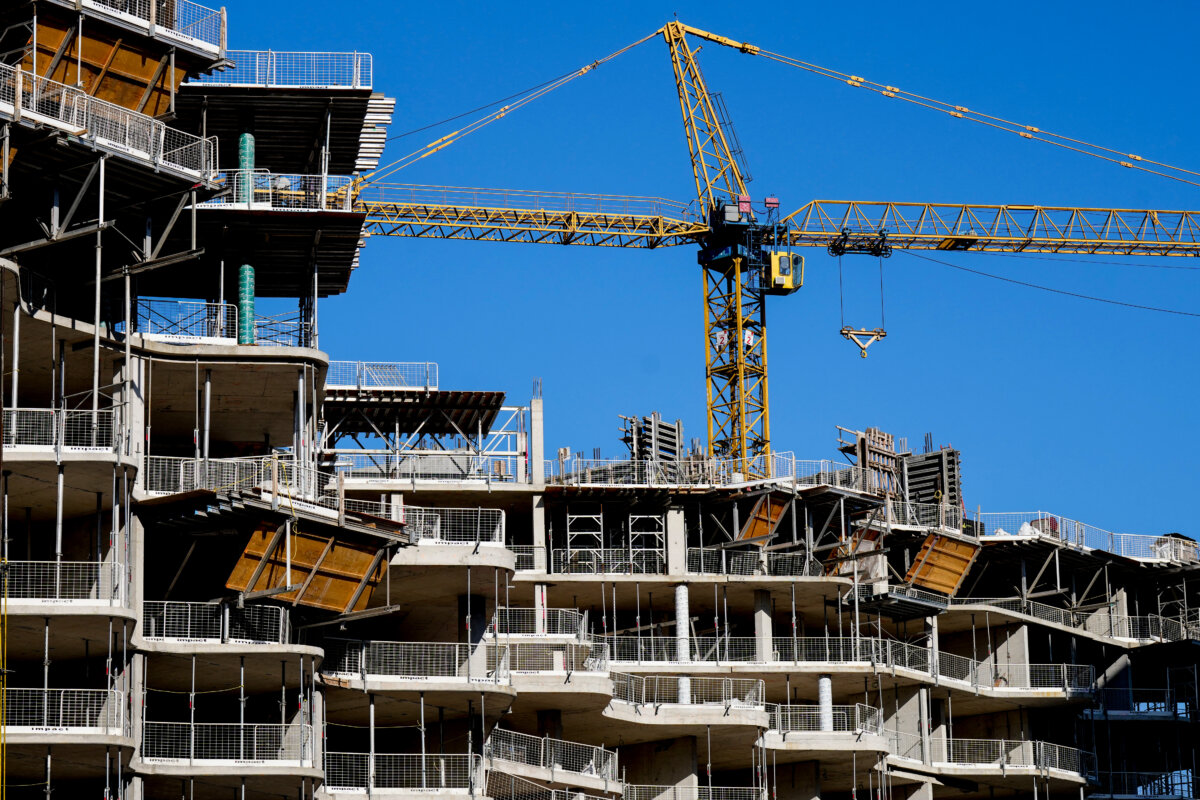

The C.D. Howe Institute says it’s too soon to conclude that Canada has entered a recession, after the latest data from Statistics Canada showed the economy contracted for two consecutive quarters, meeting the common definition of a technical recession.
The institute’s Business Cycle Council, widely seen as the authority on recessions in Canada, said on June 5 that it doesn’t accept the definition of a recession as two straight quarters of declining GDP. Instead, it defines a recession as a “pronounced, persistent and pervasive decline in real economic activity.”
“It is too early to conclude that the Canadian economy is in recession,” the council said in a report on the institute’s website.
Statistics Canada announced on May 29 that Canada’s economy contracted by 0.1 percent in the first quarter of 2026 on an annualized basis after shrinking 1 percent in the fourth quarter of 2025. But the Business Cycle Council said this decline was of “very low amplitude” compared with earlier recessions.
The council said a quarterly decline in economic activity, especially a small one, must be accompanied by weakness in surrounding quarters to demonstrate a general economic contraction. It also said that GDP figures are often revised and “future revisions could easily overturn the slight downturn in the first quarter.”
The Statistics Canada report said that on a quarterly basis, Canada’s GDP saw zero growth in the first quarter of 2026 after falling by just 0.2 percent in the final quarter of 2025.
C.D. Howe said that there was a cumulative GDP decrease of 5.3 percent in the 1981 recession, 3.4 percent in the 1990 recession, 4.4 percent in 2008, and 12.7 percent in 2020. The latest two-quarter GDP drop, meanwhile, was of just 0.28 percent.
“With GDP in the third quarter of 2025 growing by 0.47 percent, the criterion of accompanying weakness in contiguous quarters is not satisfied,” the council said.
The council also said Canada’s average unemployment rate improved from 7 percent in the third quarter of 2025 to 6.6 percent in the first quarter of 2026, which is atypical in a recession.
“For all these reasons, the Council judges that it is too early to conclude that the Canadian economy is in recession,” it said.
Still, the council said the upcoming review of the Canada-United States-Mexico Agreement (CUSMA) “continues to be a cause for concern for economic growth in the next few quarters.”
Prime Minister Mark Carney told reporters on June 2 that Canada’s economy was seeing “weakness” due to lower population growth and reduced government spending. He framed the news of a technical recession as part of his government building the “foundations” for a “stronger, more resilient economy.”
Conservative Leader Pierre Poilievre has argued that Canada is the only G7 country currently in recession despite all member nations facing U.S. tariffs, and has blamed Carney’s government for the downturn. He also noted that Mexico, which shares a border with the United States, has so far avoided a recession.
 Friends Read Free
Copy
Facebook
Tweet
Friends Read Free
Copy
Facebook
Tweet