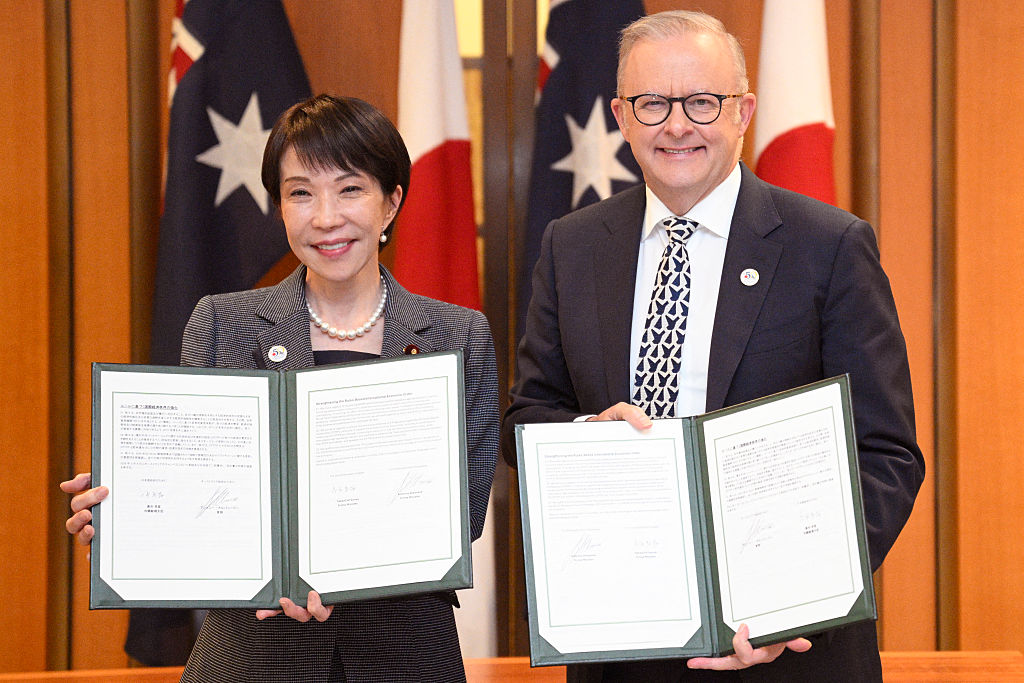

Australia and Japan have signed an upgraded defence pact aimed at strengthening the two nations’ defence capabilities.
The joint agreement focuses on closer integration between the Australia’s and Japan’s defence forces, including greater intelligence sharing, joint development and maintenance of defence technology, expanded training exercises and cooperation on supply chains and maritime security.
The announcement was made on May 4, as Prime Minister Sanae Takaichi met her Australian counterpart, Anthony Albanese, in Canberra.
It builds on recent agreements between the two nations as well as Australia’s decision to acquire upgraded Mogami-class frigates from Japan.
The Australian government said the agreement will enhance defence and security cooperation with Japan, while support regional stability.
“In a complex strategic environment, cooperation between Australia and Japan is essential to maintaining a peaceful, stable and prosperous region,” Albanese said.
“Enhanced defence and security cooperation between Australia and Japan increases interoperability between our defence forces, ensuring Australia and Japan can work closely together to support regional peace and security.”
Deputy Prime Minister and Defence Minister Richard Marles said the alliance between the two nations was “more important than ever.”
“Our enhanced defence cooperation with Japan means our forces can train, plan and operate together with greater sophistication— strengthening our combined capability and supporting deterrence,” he said.
According to the Joint Statement on Enhanced Defence and Security Cooperation, the two nations will prioritise co-developing and co-producing defence capabilities, the testing of advanced weapons and emerging technologies and helping each other collectively to deal with “future challenges.”
Albanese and Takaichi also agreed on a number of other combined initiatives including the Joint Declaration on Economic Security Cooperation which will see greater development of AI, quantum and biotechnology, a firmer agreement on critical minerals and open trade flows of liquid fuels and gas.
“Our two countries have never been more strategically aligned,” Albanese said.
Takaichi called the renewed pact with Australia a “historic milestone,” noting that her strategic talks with Albanese covered a wide range of issues, including regional security challenges involving China, North Korea and the Middle East.
She also reaffirmed the importance of working closely with international groupings such as the Quad, a partnership between Australia, Japan, India and the United States.
“Japan and Australia now have a firm intention to contribute together to peace and stability of the region and the international community,” Takaichi said.
“The two countries have built a relationship as frontrunners in cooperation among like-minded countries by advancing pioneering security cooperation at a level that could be described as Quasi-allies.
“I am convinced that the next step, 50 years of Japan-Australia relations, will be even more robust and dynamic than the past 50 years.”
The Epoch Times has reached out to shadow defence spokesman James Paterson for comment.
 Friends Read Free
Copy
Facebook
Tweet
Friends Read Free
Copy
Facebook
Tweet