
Japan and the United States will work to codevelop rare earth mining around the waters of Japan’s Minamitori Island, also known as Marcus Island, in the western Pacific, Japanese Prime Minister Sanae Takaichi told a parliamentary session on Nov. 6.
“We will consider specific ways to promote cooperation between Japan and the United States on rare earth development … around Minamitori Island,” Takaichi said.
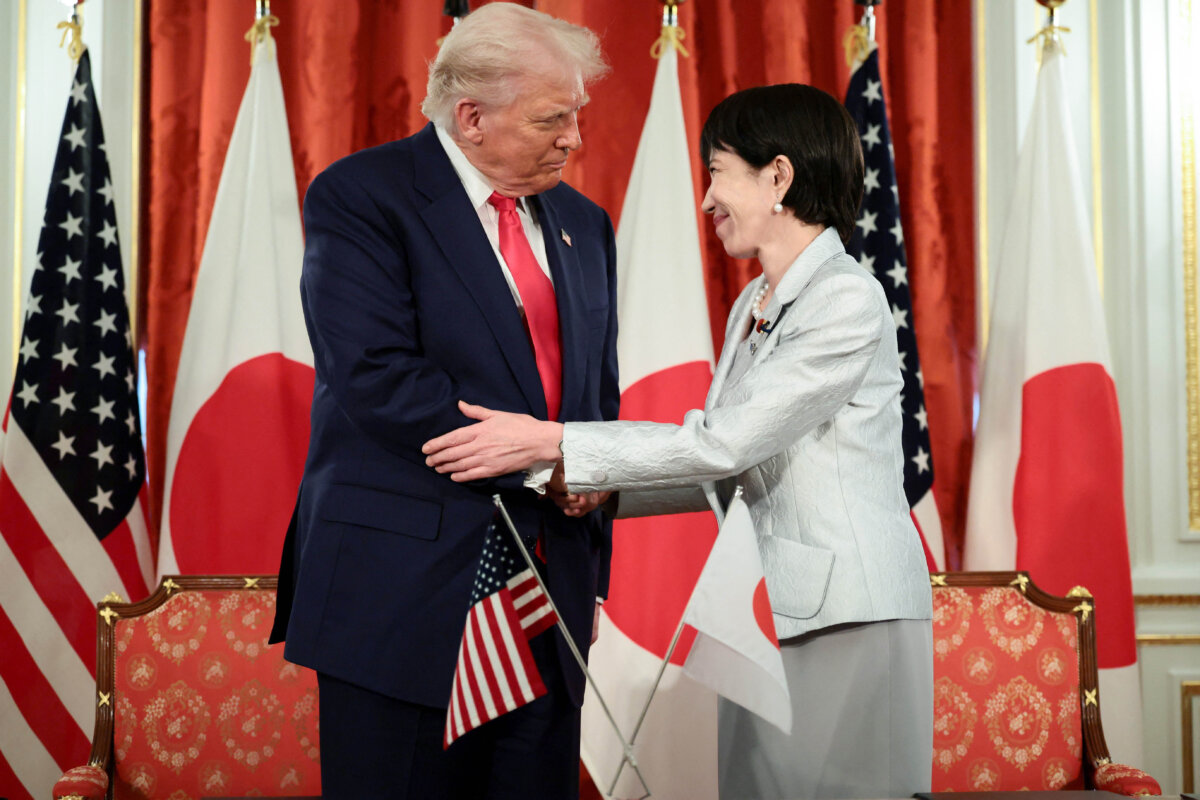
The prime minister said the rare earth partnership with the United States was a core issue discussed during her Tokyo meeting with President Donald Trump last week.
During Trump’s visit, the two nations signed a framework agreement for securing rare earth supplies to counter communist China’s dominance in the supply chain for minerals that are crucial for manufacturing modern technologies, in everything from cars to fighter jets.
Tokyo wants to secure its own supply chain of critical minerals and rare earths as part of efforts to strengthen maritime and economic security.
Takaichi noted the abundance of mud that potentially holds rare earths around Japan’s easternmost territory, situated in the Pacific Ocean some 1,180 miles southeast of Tokyo.
In April 2018, a Japanese research team discovered an estimated 16 million tons’ worth of rare earth oxides in the mud within Japan’s exclusive economic zone near Minamitori Island, which scientists said could provide centuries’ worth of several rare earth minerals, such as yttrium and europium.
“The research area was estimated to be able to supply [yttrium], [europium], [terbium], and [dysprosium] for 780, 620, 420, and 730 years, respectively, and has the potential to supply these metals on a semi-infinite basis to the world,” the study, published in Nature’s Scientific Reports, found.
The finding was noted as significant because the metals, if they’re minable, could reduce global reliance on China, which currently dominates rare earth production and processing.
If successful, the project would become the world’s first for extracting rare earth materials from deep-sea mud.
The Japanese government confirmed in July that it plans to test the feasibility of raising rare earth mud from 6,000 meters below the ocean surface in January 2026.
If the exploratory mining goes to plan, the project will launch trial operations of a system capable of recovering 350 metric tons of mud per day from January 2027. Supply of processed rare earths could begin as early as 2028.
With the project led by Shoichi Ishii of the Cabinet Office’s national platform for innovative ocean developments, mud will be collected daily through pipes attached to a Japan Agency for Marine-Earth Science and Technology vessel.
“The goal is to secure a domestic supply to enhance national security, rather than to enable private companies to profit from selling rare earths,” Ishii said in July.
Reuters contributed to this report.
 Friends Read Free
Copy
Facebook
Tweet
Friends Read Free
Copy
Facebook
Tweet