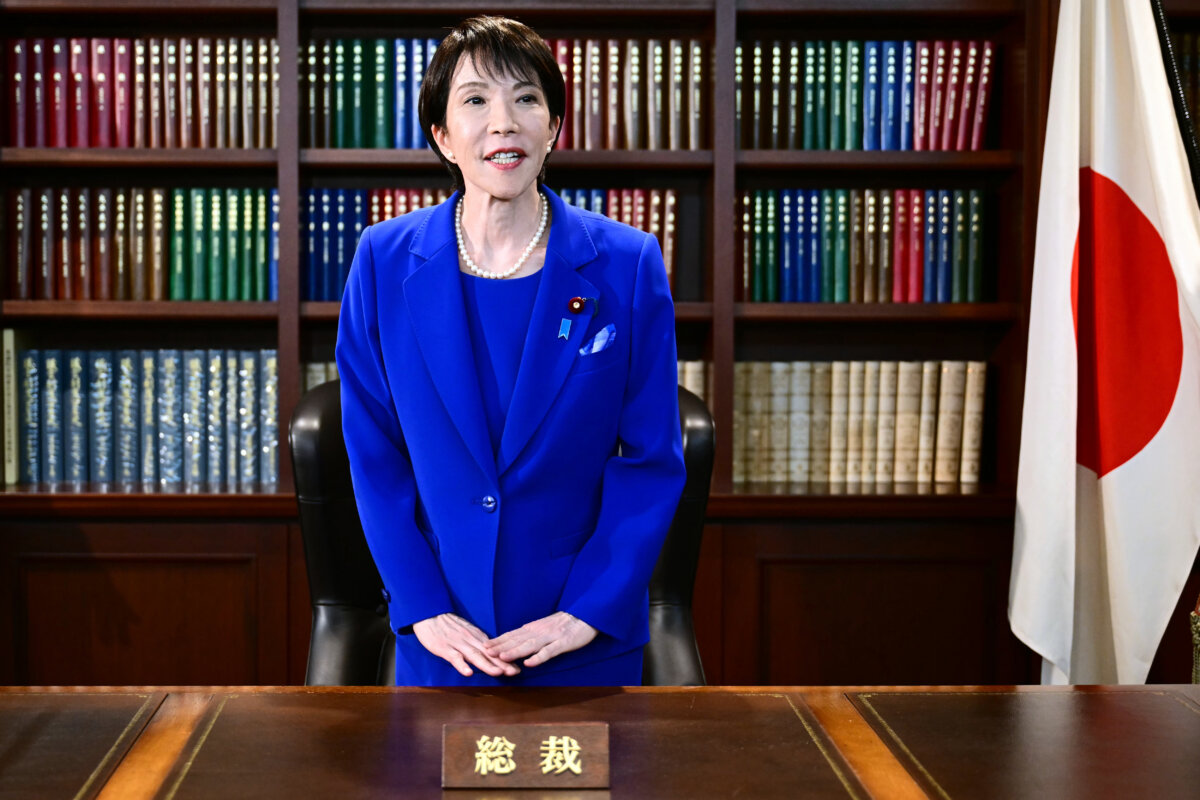

Japanese Prime Minister Sanae Takaichi said her government wants a summit with North Korean leader Kim Jong Un to break the deadlock over the issue of Japanese citizens abducted by North Korea decades ago.
If realized, the meeting would be the first summit between leaders of the two nations in more than 20 years. Former Japanese Prime Minister Junichiro Koizumi visited Pyongyang in 2002 when North Korea admitted to abducting Japanese nationals and allowed five to return home.
“The abduction issue is one of the highest priorities of my Cabinet,” Takaichi said at a rally in Tokyo on Nov. 3 to demand the return of abductees. “To this end, I intend to face Chairman Kim directly in person, and as prime minister, I will take the lead in pursuing all possible actions according to circumstances to achieve concrete results.”
Japan has said that at least 17 citizens, including the five returned in 2022, were kidnapped by North Korean agents during the 1970s and 1980s, part of what a 2014 United Nations report described as the “enforced disappearances” of other countries’ nationals by Pyongyang.
After acknowledging the abductions in 2002, North Korea claimed that some had died and the rest had returned home. Tokyo disputes that account and has stated its belief that some victims are living in North Korea.
Takaichi, who took office earlier this year, has placed the abduction issue at the center of her administration’s agenda.
Speaking to families of the abductees, she said there is “no time to lose.”
“We must achieve a resolution while the families of the abductees are still alive to witness it,” she said.
Support From Washington, Allies
In a Nov. 3 post on X, Takaichi said she had met repeatedly with the families of the abductees, first at the prime minister’s office, then in a meeting with U.S. President Donald Trump, and at the rally.
She added that each meeting filled her with “a heart-wrenching sense of anguish” that renewed her determination “to achieve the swift return of all abductees as soon as possible.”
During his visit to Japan last month, Trump met with the families of abductees. Trump, who was first introduced to the families by the late former Prime Minister Shinzo Abe—Takaichi’s political mentor—said he would raise the issue again with the North Korean leader.
“We’ll be discussing it,” Trump said. “We always have this in mind. It started with Shinzo Abe.”
Takaichi has also sought support from other world leaders. During the recent ASEAN and APEC summits, she urged her counterparts to back Japan’s calls for a resolution, arguing that the issue’s settlement would serve regional stability.
“Doing so is indispensable for building a future in which both Japan and North Korea can share peace and prosperity,” she said.
The National Council for the Rescue of Japanese Nationals Abducted by North Korea (NARKN) has long pressed the Japanese government and international organizations to increase pressure on Pyongyang.
On Nov.3, NARKN reiterated its demand that Tokyo ensure “the immediate and simultaneous repatriation of all abduction victims while their parent generation families are still alive.”
Takaichi signaled that she is prepared to take bold steps.
“This matter concerns both the lives of Japanese citizens and our national sovereignty,” she said. “I have no intention of limiting the means by which we seek a solution.”
Koizumi’s 2002 meeting with then-North Korean leader Kim Jong Il was the first direct meeting between Japanese and North Korean leaders. The encounter briefly raised hopes for normalization, and five abductees returned home in October 2002.
Talks later stalled amid disputes over the fate of the remaining abductees and Pyongyang’s pursuit of nuclear weapons.
The two leaders met again in 2004, when Pyongyang agreed to allow some family members of the abductees who had returned to Japan in 2002 to leave North Korea for Japan, according to the Japanese government.
Those two meetings remain the only direct talks between Japanese and North Korean leaders.
During his visit to Asia, Trump said he is willing to meet with Kim Jong Un if Pyongyang takes the initiative to seek talks.
 Friends Read Free
Copy
Facebook
Tweet
Friends Read Free
Copy
Facebook
Tweet