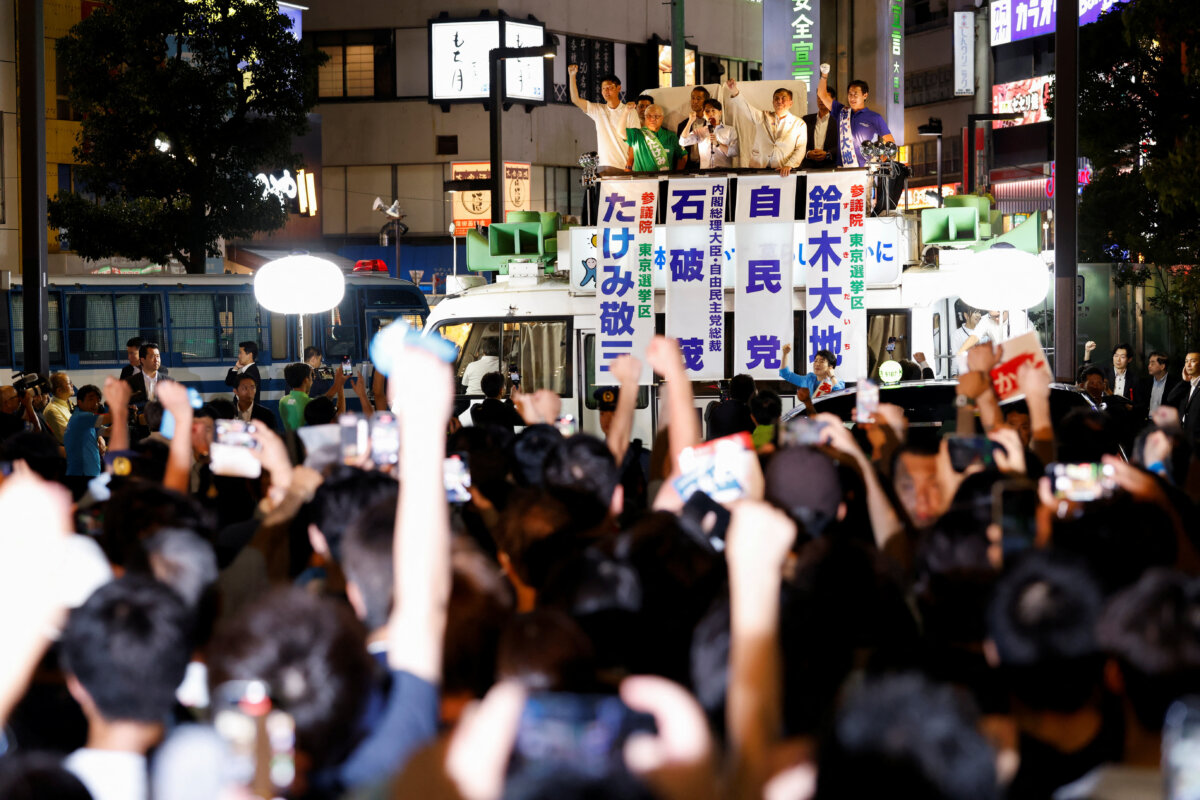


Japan’s ruling coalition is certain to lose its majority in the upper house, public broadcaster NHK announced on Monday after exit poll returns.
It’s a tough blow for Prime Minister Shigeru Ishiba, whose party lost control of the more powerful lower house in October 2024. With the loss of the upper house, Ishiba faces an uncertain future.
Nevertheless, the center-right Liberal Democratic Party (LDP) leader said that while he “solemnly” accepted the “harsh result,” he has no intention to step down.
“We are engaged in extremely critical tariff negotiations with the United States … we must never ruin these negotiations. It is only natural to devote our complete dedication and energy to realizing our national interests,” he told TV Tokyo in an interview, referencing the imminent Aug. 1 trade negotiation deadline with the United States.
Asked whether he intended to remain the prime minister and leader of his party, Ishiba said, “That’s right.”
Noda Yoshihiko, leader of the opposition center-left Constitutional Democratic Party (CDP), told NHK that Ishiba would need to explain his decision if he chose to remain in power, describing the outcome as a rejection of the LDP-led government. The CDP is on track to finish in second place.
It’s unclear what’s next for the politically-split government.
To secure the 248-seat upper chamber, the LDP and its center-right coalition partner Komeito needed to win at least 50 of the 124 seats up for grabs. They were officially projected to fall short of that threshold by NHK early Monday morning after returns made it impossible for the ruling coalition to keep control of the upper house.
It marks the first time since the party’s formation in 1955 that the LDP has been out of the majority in both houses.
The coalition had its worst performance in 15 years in the October 2024 lower house election, leaving Ishiba’s administration open to motions of no confidence and calls for leadership change within his party.
Exit polls showed opposition parties that advocated for tax cuts and stricter immigration policies on course to make gains, particularly as increasing prices, especially on staples such as rice, became a critical issue for voters.
“The LDP was largely playing defense in this election, being on the wrong side of a key voter issue,” David Boling, a director at consulting firm Eurasia Group, said.
“Polls show that most households want a cut to the consumption tax to address inflation, something that the LDP opposes. Opposition parties seized on it and hammered that message home.”
The party has been championing fiscal restraint, especially with a shaky bond market that worries investors about Japan’s ability to refinance the highest government debt, as a percentage of gross domestic product, among developed countries.
Japan, the world’s fourth-largest economy, also faces a looming deadline in almost two weeks to strike a trade deal with the United States or see steep tariffs on its exports to the United States, its largest export market.
U.S. President Donald Trump sent a letter to Ishiba on July 7, notifying the prime minister that Japan would face 25 percent tariffs on its imports into the United States if he did not strike a deal with Washington.
“Starting on August 1, 2025, we will charge Japan a Tariff of only 25 [percent] on any and all Japanese products sent into the United States, separate from all Sectoral Tariffs,” Trump wrote, later adding, “If you wish to open your heretofore closed Trading Markets to the United States, and eliminate your Tariff, Non-Tariff, Policies, and Trade Barriers, we will, perhaps, consider an adjustment to this letter.”
Trump said the tariffs could be “modified, upward or downward, depending on our relationship with your Country.”
Opposition Party Makes Considerable Gains
The populist Sanseito party was forecast to make serious gains in the election, with polls expecting it to secure 10 to 15 seats in the chamber, up from one seat.
Advocating for a “Japanese First” agenda and using rhetoric about a “silent invasion” of foreigners, Sanseito grew its appeal in the election.
“I am attending graduate school, but there are no Japanese around me. All of them are foreigners,” said Yu Nagai, a 25-year-old student who voted for the party early on July 20.
“When I look at the way compensation and money are spent on foreigners, I think that Japanese people are a bit disrespected,” Nagai said after casting his ballot at a polling station in Tokyo’s Shinjuku ward.
Tom Ozimek and Reuters contributed to this report.
 Friends Read Free
Copy
Facebook
Tweet
Friends Read Free
Copy
Facebook
Tweet