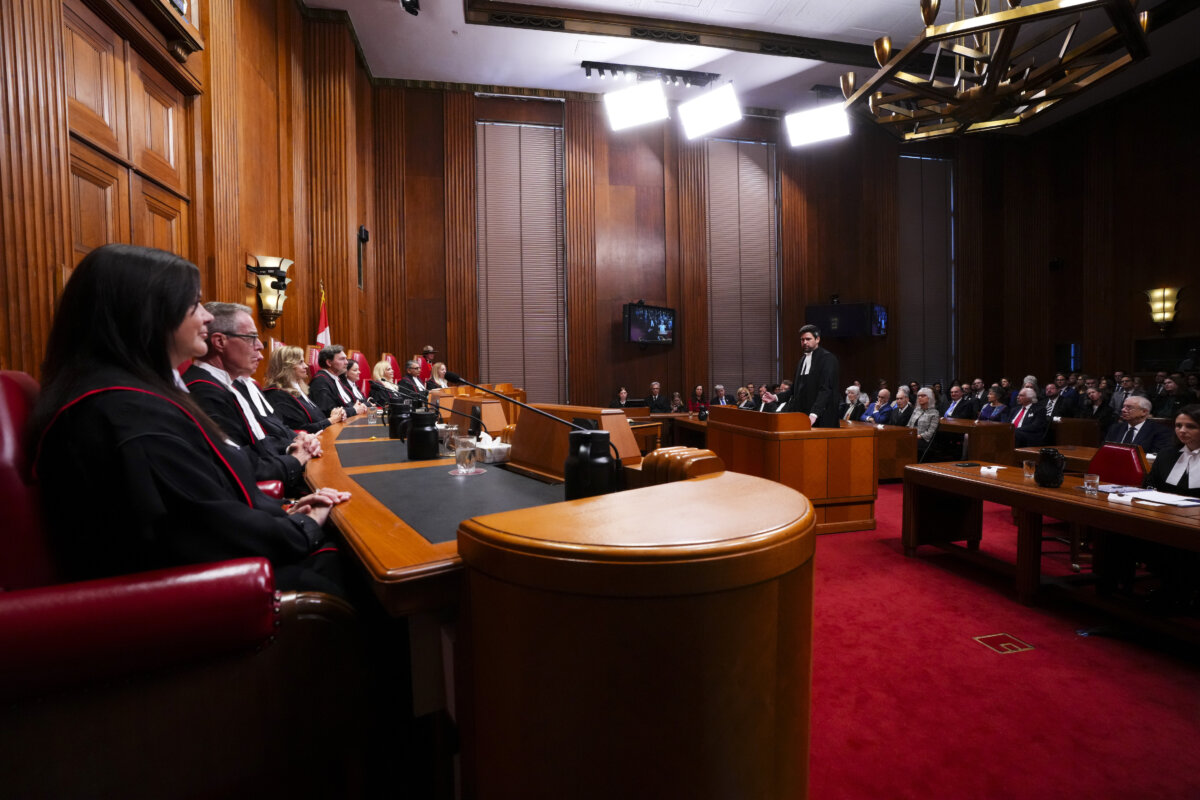

The Supreme Court of Canada has ruled that judges must “meaningfully consider” traditional indigenous community approaches to justice when sentencing indigenous offenders and said that not doing so can constitute a legal error.
The Supreme Court judges were split on the decision, with four dissenting and five in the majority.
The ruling came in the context of an appeal in the case of Harry Arthur Cope, an indigenous man convicted of severely assaulting his indigenous girlfriend in 2021. Cope’s five-year prison sentence was reduced to three years by the Nova Scotia Court of Appeal in 2024.
Sentencing Circles
The Supreme Court upheld the reduced sentence in a 5–4 decision on Oct. 9, holding that the original sentencing judge hadn’t properly taken into account the recommendations by an indigenous sentencing circle or the mental illness of the man in issuing the sentence.
“What is required is that a sentencing judge reasonably engage with the perspectives expressed in the sentencing circle in crafting a fit and appropriate sentence on the facts of each case,” Justice Michelle O’Bonsawin wrote for the majority.
“A sentencing judge’s failure to meaningfully consider the sentencing circle’s recommendations is not a freestanding error in principle, but can amount to a failure to properly conduct the second part of the s. 718.2(e) analysis,” she added.
Section 718.2(e) of the Criminal Code requires judges to consider reasonable alternatives to imprisonment, particularly in cases of indigenous offenders.
Indigenous sentencing circles include offenders, victims, elders, and other indigenous community members who take part alongside justice officials in determining an appropriate sentence for a crime, including possible alternatives to incarceration, according to the Department of Justice.
‘Braiding’
O’Bonsawin went on to endorse using indigenous traditions in tandem with conventional Canadian sentencing law, in a process the majority calls “braiding.”
She referred to a 2024 Supreme Court decision implementing the United Nations Declaration on the Rights of Indigenous Peoples (UNDRIP) in the fields of indigenous child and family services and stated that “sentencing circles provide an opportunity for this braiding.”
She added that reconciliation between indigenous and non-indigenous people can be advanced by “braiding together” the two legal traditions to form a “single, strong rope.”
O’Bonsawin stated that “these provisions do not create a parallel regime for Indigenous offenders.” She said judges must still continue with “the fundamental sentencing principle of proportionality” and “the ultimate objective of protecting society.”
The four dissenting justices disagreed with the majority, particularly in the majority’s reliance on legal principles linked to UNDRIP.
Justices Malcolm Rowe and Mahmud Jamal, writing for the dissent, said they don’t agree that indigenous law and legal practices can be “braided” into criminal sentencing law.
They argued that the majority incorrectly drew on a previous Supreme Court ruling about implementing UNDRIP in line with legislation recognizing indigenous jurisdiction on child welfare, whereas Parliament has not put in any comparable changes in Canada’s laws in line with the majority’s decision.
“Parliament has done nothing comparable in the Criminal Code; it has not conferred jurisdiction on Indigenous communities over sentencing decisions, nor has it directed sentencing judges to defer to Indigenous legal traditions,” Rowe and Jamal wrote, adding that the Criminal Code must guide a judge’s authority and that the view of the majority could limit a judge’s discretion.
While the dissenting judges said they agreed indigenous sentencing factors could form part of judicial decisions, they said that such factors should not override Canadian law as established by Parliament.
The four dissenting judges had called for restoring Cope’s original five-year sentence, saying the reduced sentence he’d received by the appeal court didn’t adequately take into account the severity of the violence he committed, the vulnerability of the victim, or the danger Cope posed to the community.
Cope’s Case
The Oct. 9 Supreme Court ruling providing guidance on how judges must consider indigenous perspectives and legal traditions when sentencing indigenous offenders came in the case of Harry Arthur Cope, a Mi’kmaw man who pleaded guilty to aggravated assault for attacking his indigenous girlfriend in Halifax in 2021.
According to the judgment, Cope punched the woman a number of times and threw her on the ground, causing her to suffer severe injuries to her upper body and face.
Cope pleaded guilty to aggravated assault in April 2022, and a sentencing circle with members of his indigenous community was held in October 2022 recommending to the court that he get treatment for mental health challenges and addiction problems instead of more time in pretrial custody.
Nova Scotia Provincial Court Judge Christine Driscoll sentenced Cope in February 2023, stating that she had taken into account that Cope had been formally diagnosed with schizoaffective disorder as well as substance use disorder and also considered his indigenous background and long criminal history, including violent offences.
Driscoll concluded that a six-year sentence for Cope’s crime would be appropriate, but reduced it to five years citing his indigenous background, addiction issues, and mental health problems. She declined to issue a community-based sentence to Cope, stating that he still posed a danger to society.
Cope appealed his sentence and had it reduced to three years, less 18 months of credit for time served as well as two years of probation after release in a 2–1 ruling by the Nova Scotia Court of Appeal in June 2024.
The majority found that Cope’s sentence was disproportionate to his culpability due to his addictions, mental illness, and indigenous background, despite Driscoll already having cited these factors in handing Cope a reduced sentence in 2023.
In upholding the Nova Scotia Court of Appeal’s sentence reduction, the Supreme Court agreed that Driscoll hadn’t adequately considered the mitigating factors in Cope’s case including his mental illness, addictions, and indigenous background as well as the recommendations of the 2022 sentencing circle.
The Supreme Court’s Oct. 9 ruling builds on what are known as the Gladue principles, which emerged from a 1996 amendment to the Criminal Code.
The Supreme Court ruled in its 1999 R. v. Gladue decision that judges are required to consider unique systemic and background factors that may have contributed to an indigenous offender being before the courts, and to consider alternative sentencing procedures and sanctions appropriate to their circumstances.
Other Reduced Sentences for Indigenous Offenders
The Supreme Courts’s Oct. 9 ruling and upholding of Cope’s reduced sentence comes in the wake of a number of reduced sentences given to indigenous offenders citing their indigenous background as a contributing factor in granting lighter sentences than otherwise would have been imposed.
In September this year, Ontario Court of Justice judge Gethin Edward sentenced 31-year-old indigenous man Darris James Wilson to two years of house arrest after a dangerous-driving crash in which he killed a 12-year-old girl and severely injured the child’s mother. Edward said he considered the effects of “colonization” in the sentence as well as the offender’s desire to reconnect with his indigenous heritage.
In January 2026, André Chamberlain of the Ontario Court of Justice sentenced convicted cocaine trafficker Lloyd Williams to four and a half years in prison with credit for 22 months served after saying he had taken into account his difficult upbringing, indigenous ancestry, responsibilities as a father, and health problems. Williams did not provide documented proof of his indigenous ancestry.
In a counter-example where indigenous ancestry did not contribute to a lighter sentence, Justice Paul Bychok of the Nunavut Court of Justice sentenced an indigenous man referred to as T.T. to eight years in prison in June 2025 for sexually and physically assaulting his daughters.
Bychok declined the defence’s proposed punishment of two to five years, saying indigenous ancestry should not be an automatic grounds for a lighter sentence and saying it risked turning the Gladue principles into a “heritage-based discount.”
Bychok emphasized the courage it takes for victims to come forward, particularly in remote communities.
“Nunavut’s hundreds of victims of domestic and sexual violence are living a nightmare,” Bychok said, adding that it takes “tremendous courage” to testify, often in front of family members of the accused.
 Friends Read Free
Copy
Facebook
Tweet
Friends Read Free
Copy
Facebook
Tweet