News Analysis
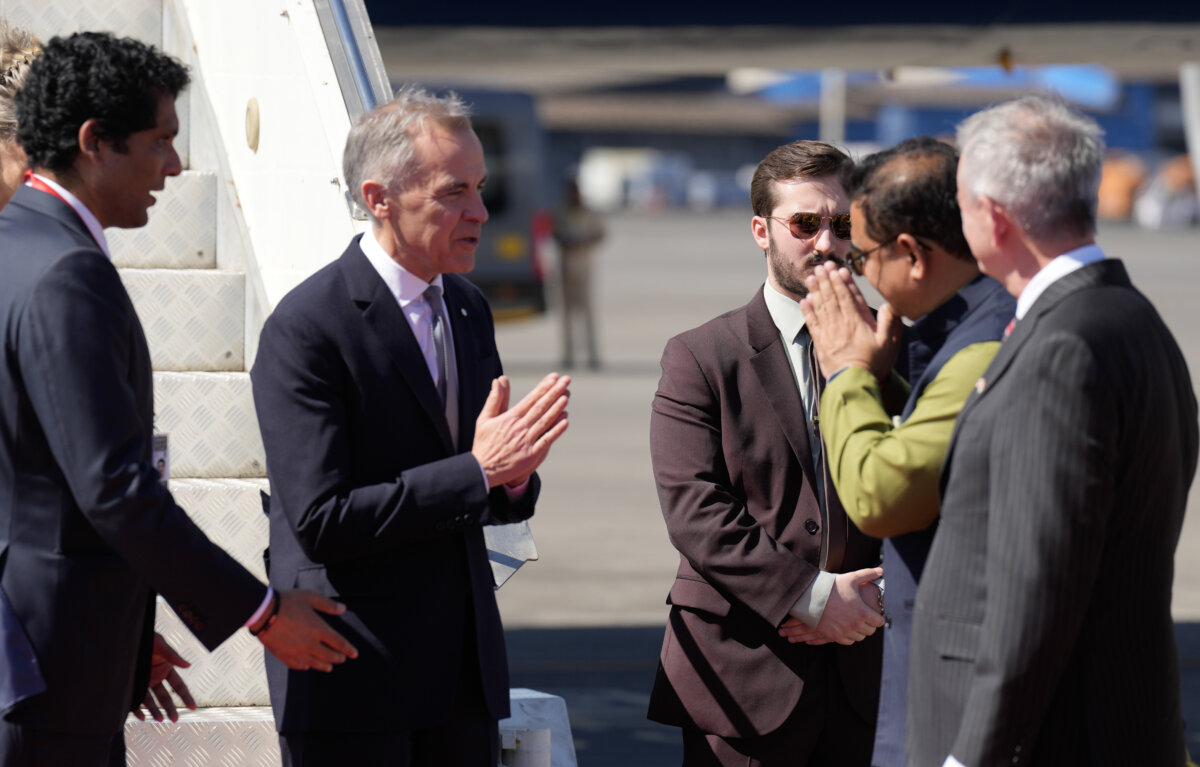
Prime Minister Mark Carney concluded an official visit to India this week, a key event as Ottawa and New Delhi pursue closer ties.
The two sides issued a long wish list of areas for closer cooperation, and reached some concrete agreements on energy, trade, and higher education exchanges.
The key to taking the bilateral relationship to the next level will be concluding a comprehensive trade deal, which has been pursued for years without success. The two nations have set a timeline to conclude those talks.
Carney has worked to repair ties with India after the acrimony of relations under the previous Liberal government, with serious accusations levelled and diplomats expelled. The prime minister took questions from reporters on this aspect of the relationship, but not until he left India.
Trade Deal
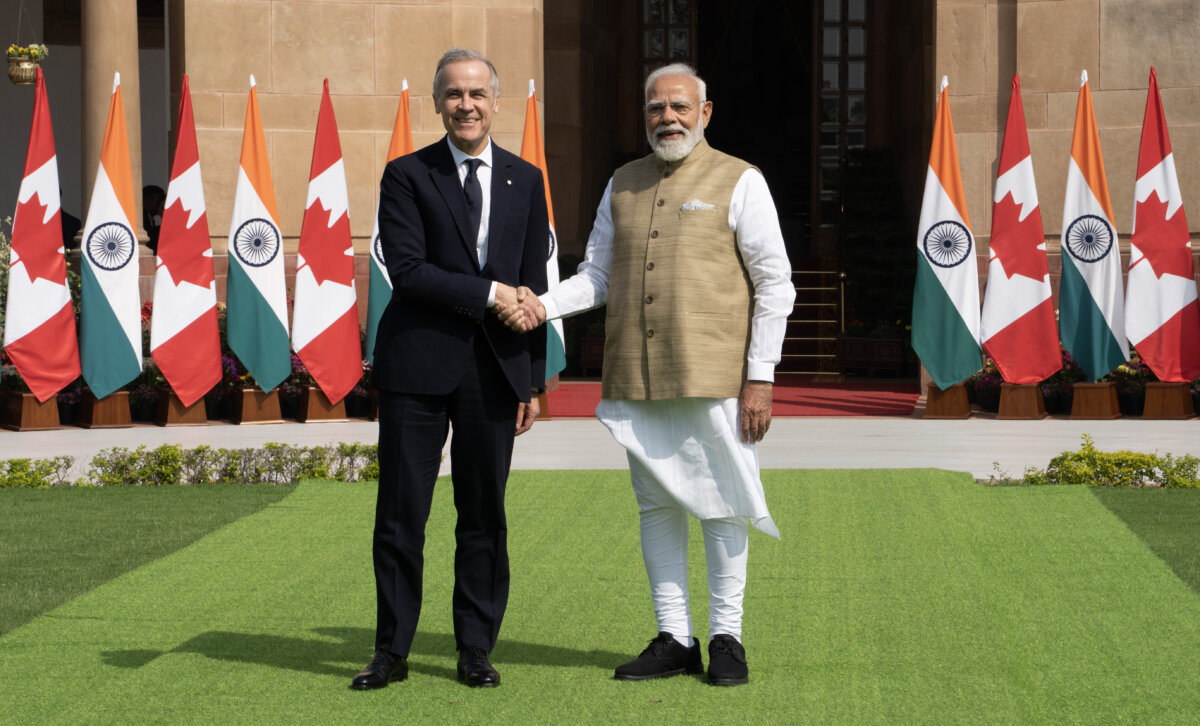
Carney met with Indian Prime Minister Narendra Modi in New Delhi on March 2 and the two agreed to press forward in reaching a Comprehensive Economic Partnership Agreement, a type of free trade deal. It was the first visit to India by a Canadian prime minister since 2018.
Both sides have signed the terms of reference to guide the negotiations and the two leaders set a deadline of the end of 2026 to finalize the deal.
Canada and India are both seeking to diversify trade amid a shifting geopolitical context, U.S. protectionist policies, and major armed conflicts.
Ottawa says it expects the agreement with New Delhi to double two-way trade between the two countries to $70 billion by 2030. Two-way merchandise trade between Canada and India amounted to $13.3 billion in 2024, according to Global Affairs Canada.
Carney has called the trade agreement “foundational” to Canada’s partnership with India.
Ottawa had put trade talks with New Delhi on ice in the summer of 2023. This was shortly before then-Prime Minister Justin Trudeau rose in the House of Commons to accuse India of having a hand in the assassination of pro-Khalistan activist Hardeep Singh Nijjar in British Columbia.
India has long accused Canada of sheltering Sikh separatists, who seek to carve an independent Khalistan state out of India’s Punjab region, but has denied involvement in the Nijjar case.
Agreements and MOUs
During Carney’s visit, Canada and India signed a number of memorandums of understanding (MOUs) and agreements, some more concrete than others.
The Prime Minister’s Office (PMO) announced 54 deals, covering everything from energy to higher learning.
Energy Minister Tim Hodgson had visited India in January and agreed with his counterpart to deepen energy cooperation. Some aspects of that cooperation were formalized during Carney’s visit.
This includes a $2.6 billion uranium deal, with Canadian company Cameco agreeing to supply India’s department of atomic energy for the country’s civilian nuclear program.
The deal is part of a new “strategic energy partnership” between the two countries, which covers renewables, hydrocarbons, and critical minerals.
No specific details were announced on oil and gas, but the PMO said there will be increased engagement to reach a first long-term arrangement with India to supply liquified petroleum gas (LPG).
Canada currently has two operational LPG export terminals on the West Coast, with two more in construction.
The PMO noted other private business deals, including a commitment by Indian company Jubilant Pharmova to invest $155 million in its facility in Kirkland, Que., which produces sterile injectables.
Meanwhile, Canadian mining company Elk Valley Resources has signed MOUs with four Indian companies discussing the sale of 1.2 million tonnes of metallurgical coal—a deal worth about $285 million.
Carney has also highlighted the deals reached to deepen educational partnerships under the Canada-India Talent and Innovation Strategy. This involves 13 new partnerships between Canadian and Indian universities.
Among the measures, the University of Toronto will provide up to $25 million for over 220 scholarships for Indian students. Meanwhile, Canada will provide $10 million for scholarships under its Indo-Pacific Strategy to support collaboration of over 85 Canadian graduate students and researchers with Indian academics.
Defence and Security
Aside from boosting trade and people-to-people ties, Ottawa and New Delhi are seeking closer cooperation in the fields of defence and security, although the two countries made no major announcements in those fields.
The joint statement from Carney and Modi says the two leaders welcome opportunities for joint training and professional military exchanges.
In a concrete step toward military cooperation, the two countries agreed to launch an India-Canada Defence Dialogue at the joint secretary or assistant deputy minister level. An assistant deputy minister is the third-highest rank in Canadian government departments.
The leaders’ joint statement also noted the appointment of a Canadian defence attaché to India, whereas India’s defence attaché in the United States is accredited to fill the role in Canada.
On security, the two sides have been holding dialogues to iron out issues around the Nijjar case and other concerns related to Indian government activities in Canada.
The Carney-Modi statement says the two leaders agreed to cooperate more closely to tackle issues such as “violent extremism, terrorism, organized crime, including the illegal flow of narcotics and fentanyl precursors, cybercrime, extortion, financial fraud, trafficking and related criminal networks.”
The PMO statement about the visit mentions some issues discussed between leaders but not written in the joint statement, such as “transnational organised criminal networks.” It also says Carney underscored that Canada will continue to tackle transnational repression.
Transnational repression is a form of foreign interference where a foreign state threatens or takes actions against members of the diaspora or dissidents living in Canada.
China is considered by security bodies to be the top foreign interference threat in Canada. The Canadian Security Intelligence Service (CSIS) says India is also involved in meddling, according to the Canadian Security Intelligence Service (CSIS), in large part to counter the pro-Khalistan separatist movement.
“Links between the Government of India and the Nijjar murder signals a significant escalation in India’s repression efforts against the Khalistan movement and a clear intent to target individuals in North America,” CSIS wrote in its latest annual report.
Diplomatic Row
The Canadian government during the Trudeau years had taken further consequential actions on the Nijjar case and other crimes it says linked back to the Indian government.
On Oct. 14, 2024, the RCMP said serious crimes committed in Canada, including extortion and homicides, had links to Indian government agents. The same day, Ottawa had expelled six Indian diplomats, including its high commissioner, saying the RCMP had gathered evidence making them “persons of interest” in the Nijjar case.
India had responded with tit-for-tat expulsions of Canadian diplomats and said it “strongly rejects these preposterous imputations and ascribes them to the political agenda of the Trudeau Government that is centered around vote bank politics.”
Carney’s government has had to deal with these issues as it sought to repair the relationship. Discussions around this issue have been spearheaded by the national security advisers of Carney and Modi.
Before Carney left for India, Ottawa messaged that New Delhi was no longer involved in plotting violent acts in Canada.
“We have a very robust diplomatic engagement, including between national security advisers, and I think we can say we’re confident that that activity is not continuing,” a senior government official told reporters on background.
This prompted a rebuke by separatist activists in Canada, who said they still face threats, and Carney was pressed on the issue when speaking with reporters. However, he did not have to address this thorny issue while in India, having cancelled his media availability. The Conservatives raised concern about this issue, with MP and foreign affairs critic Michael Chong saying Carney is, “Running away from accountability and refusing to answer questions.”
Carney spoke to reporters on the issue in Australia on March 3, disputing what his senior official had told reporters before his trip regarding Indian activities in Canada. “We can debate whether you had a discussion that was not for quotation,” he said, adding he “would not use those words” the senior official had transmitted.
Carney said progress has been made with India on the file, while Canada remains “vigilant,” tightening laws and ensuring an appropriate level of security resources.
“I will tell you that there is progress on these issues, and that progress is a product […] of the resources we’re putting in,” he said. “It’s a product of the clarity of our position. We will not tolerate foreign interference, transnational repression, by anyone.”
The prime minister also said the issues was raised during his meetings with Modi.
“To engage, you have to be able to talk to countries, countries where there have been issues, and to raise issues, including at the highest level, to ensure that the cooperation is there, whether it’s extortion or some other form of cross-border, criminal activity or security risk,” he said. “That is what we have done.”
Carney refused to comment on the Nijjar case, saying judicial procedures are under way. Four men have been charged in the case, all of them Indian nationals who were in Canada on temporary visas.
 Friends Read Free
Copy
Facebook
Tweet
Friends Read Free
Copy
Facebook
Tweet