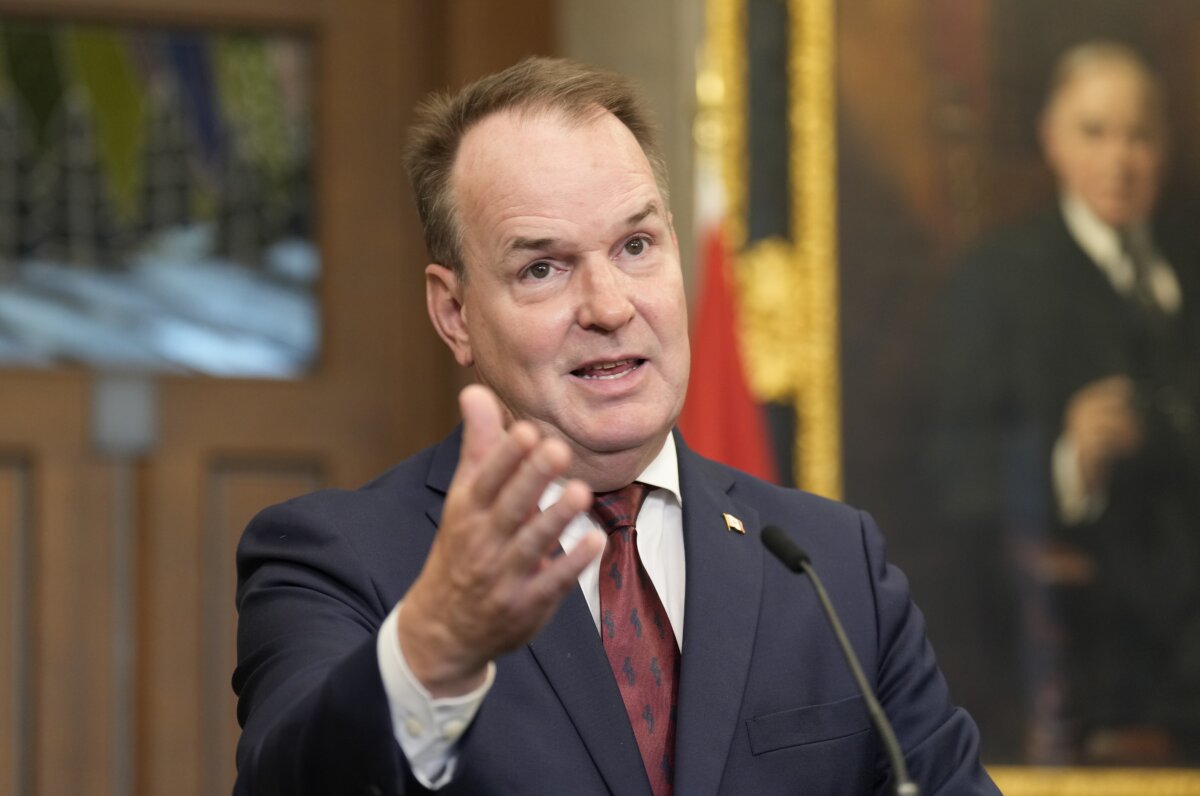

As Parliament reconvenes for the fall sitting, Government House Leader Steven MacKinnon said he hopes opposition parties will cooperate, while noting a “substantial” budget deficit will be presented to the House in the coming weeks.
MacKinnon, who manages the government’s agenda in the House of Commons, made comments about the budget and outlined the Liberals’ priorities on Sept. 15, shortly before MPs returned to their seats the same day.
The tabling of the budget will be a key and unusual moment of the fall sitting, with Prime Minister Mark Carney having opted not to present one last spring, as is customary.
Carney’s election platform had projected a deficit of $62.3 billion in financial year 2025-2026, more than $20 billion over the last official projection in the Fall Economic Statement of 2024.
Increased spending, including on defence, has led to estimates pinning the projected deficit at near or over $70 billion.
The deficit is “substantial and needs to be dealt with, and is being dealt with with incredible seriousness by the entire government,” MacKinnon told reporters, while declining to provide additional details.
“The pandemic I think saw very, very large deficits,” he said. “Some of the issues we’re experiencing today, represent, of course, the unwinding of some of the measures that were proposed and accomplished during the pandemic.”
Along with increasing spending on defence in a bid to reach the original NATO guideline of 2 percent of GDP, Carney also announced on Sept. 14 an initial spending of $13 billion to fund his new agency, Build Canada Homes. The initiative will involve the federal government in building affordable housing.
Meanwhile, ministers have been told to look for savings in their departments to help offset the increased spending. Finance Minister François-Philippe Champagne requested this summer “ambitious savings proposals” to reduce operational spending by 7.5 percent in fiscal 2026-27, which would be followed by 10 percent cuts in the following year and 15 percent in 2028-29.
MacKinnon said Carney has made it “very, very clear” that his ministers have to find ways to make the government more efficient. “At the same time, we have to invest in our military, we have to invest in housing, we have to invest in the kinds of things that are very important to keep our economy growing and to make sure that all Canadians have a place in to prosper in this economy,” he said.
The vote on the budget will be a major test for the minority Liberals, which are three seats shy of a majority. MacKinnon said he hasn’t been part of any discussions to poach MPs from other parties to achieve majority status.
Legislative Agenda
Aside from the upcoming budget, MacKinnon said the Liberal government’s legislative agenda will be focused on passing several bills. Bill C-3, which would amend the Citizenship Act to grand citizenship by descent to people born outside Canada to a parent who is a citizen, is undergoing second reading on Sept. 15.
MacKinnon also mentioned Bill C-2, also known as the Strong Borders Act, which would reinforce border security, tighten immigration, and also give additional powers to security agencies to obtain currently protected private subscriber data. Liberals will also seek to move forward Bill C-4, which relates to tax cuts, having already come into force through the adoption of a ways and means motion last spring.
As for new legislation, MacKinnon said the government will table bills to increase community safety and tackle crime. Justice Minister Sean Fraser is expected to introduce legislation to reform the bail system amid a wave of violent crime in the country.
MacKinnon said Liberals will “put politics aside” and listen to “constructive criticism” when “responsible alternative policies” are proposed. At the same time, he also made comments critical of Tory Leader Pierre Poilievre, who is returning to the Commons after winning a byelection in Alberta last month.
“I am under no illusions about what we face with the Conservatives under the leadership of Pierre Poilievre,” he said, accusing him of using “three-words slogans” and “a lot of angry rhetoric.”
Meanwhile Poilievre told his caucus on Sept. 14 that his party had helped Liberals move some initiatives along last spring, but he called those measures “often too small, and too late.” Tories supported the fast-tracking of the One Canadian Economy Act, also known as Bill C-5, to take down federal barriers to interprovincial trade and fast track major projects.
The Tory leader proposed a similar approach for the fall. “We will oppose things we’re against and support things we’re for, but we will also propose solutions to the problems Liberals have created,” he said.
Poilievre said the Liberals have not delivered so far on an array of promises, whether to grow the economy or stand up to U.S. President Donald Trump.
“Sadly, everything is worse: Unemployment is worse, the cost of living is worse, home building is worse, divisions are worse, the tariffs are worse, crime is worse, immigration is worse,” he said.
 Friends Read Free
Copy
Facebook
Tweet
Friends Read Free
Copy
Facebook
Tweet