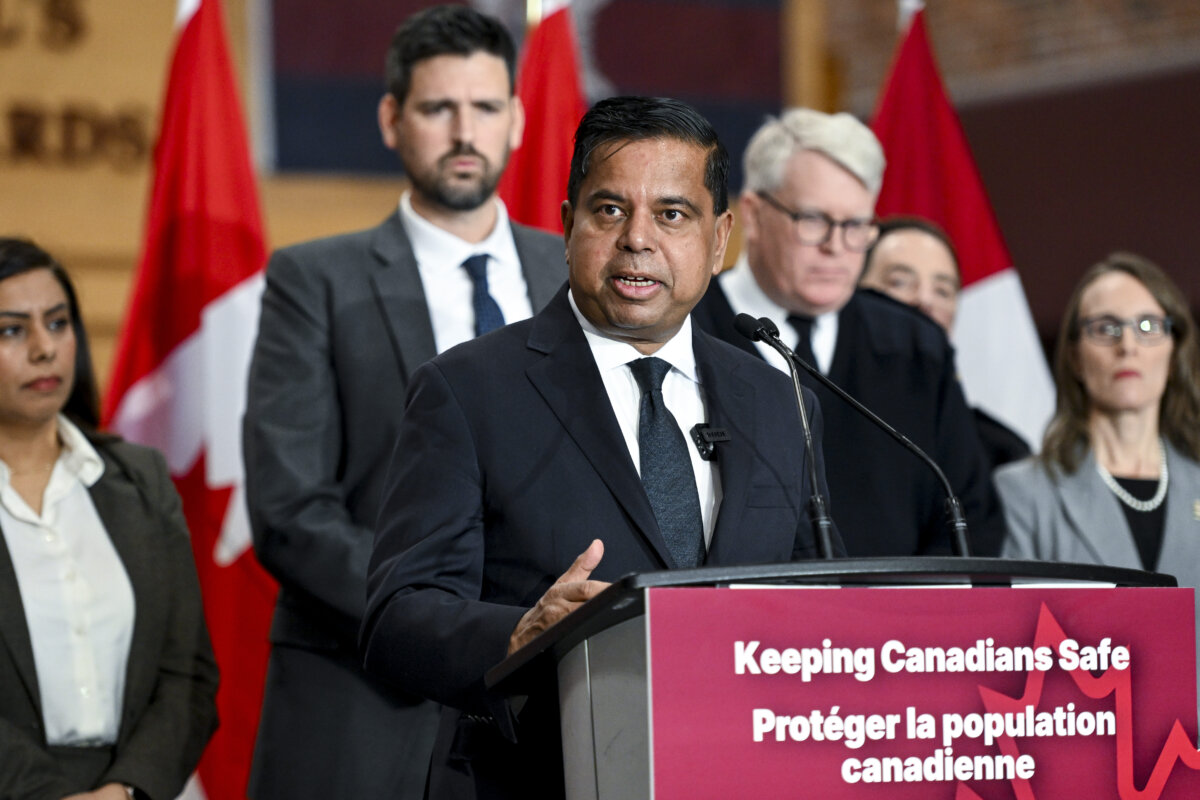

The Liberal government has introduced a new “lawful access” bill that would give police expanded powers to access certain data from electronic service providers during criminal investigations.
The government introduced Bill C-22, also known as the Lawful Access Act, in the House of Commons on March 12. The bill contains elements of Bill C-2, the Strong Borders Act that was introduced last June, but aims to address some of the privacy concerns raised by opposition parties and civil liberties groups.
Bill C-22 creates a legal framework for a lawful access regime in Canada and has been informed by the views of stakeholders and parliamentarians who had voiced “serious concerns” with Bill C-2, Public Safety Minister Gary Anandasangaree said at a March 12 press conference announcing the new proposed legislation.
“We listened to what they had to say, and this new legislation, Bill C-22, balances the needs of law enforcement with the privacy and civil rights that Canadians demand,” Anandasangaree said.
“It is not about surveillance of Canadians going on about their daily lives. It is about keeping Canadians safe in the online space.”
The bill would require electronic service providers to establish and maintain lawful access capabilities, ensuring law enforcement can obtain “timely, lawfully authorized communications or information” when they need it, Anandasangaree said.
On the grounds of “reasonable suspicion,” police will be able to ask electronic service providers whether a specific individual is a customer and issue a production order to obtain “basic subscriber information,” such as identification and location data. Law enforcement will need judicial authorization to obtain additional information about individuals.
The bill would also require telecommunications companies to be capable of tracking users’ location information. Anandasangaree said this information would be accessed in instances where it is deemed to be necessary for “immediate safety and security needs,” such as cases of human trafficking, but otherwise would be in line with the information telecommunications companies are already collecting.
He said individuals’ medical information will be excluded from the lawful access powers, and the legislation would be reviewed by parliamentarians in three years.
In addition, the bill would allow a judge to authorize law enforcement to request information from foreign telecommunications providers, including social media companies and artificial intelligence firms. However, the process would not force such companies to share identifying information about their users.
Justice Minister Sean Fraser also spoke at the press conference, saying that a lawful access regime would better equip police forces to investigate and prevent human trafficking, smuggling, extortion, and a number of other serious crimes, by allowing police to obtain identifying information on individuals from telecommunications companies should there be “reasonable suspicion” that a crime has been committed.
“These processes are designed to protect people’s privacy rights, but ensure that we have the modern tools that are necessary to address crimes that are taking place in the modern world,” Fraser said.
Also speaking at the press conference, Ontario Provincial Police Commissioner Thomas Carrique said Bill C-22 will allow law enforcement to advance its investigations “where previously there was no pathway forward.”
Ahead of the government’s announcement of the bill, University of Ottawa law professor Michael Geist said on March 12 that the bill would be “likely to revive constitutionally dubious warrantless access provisions.”
Bill C-2
The new bill comes after the Liberal government introduced Bill C-2, the Strong Borders Act, last June, following Ottawa’s $1.3 billion border security plan released in late 2024. Bill C-2 came after pressure from the U.S. administration citing concerns about illegal drugs and migrants crossing the shared borders as a reason to impose tariffs on Canada and Mexico.
Anandasangaree said at the time that the the bill aimed to keep Canada’s border secure, combat transnational organized crime, stop the flow of fentanyl, and combat money laundering, and that it was needed to modernize legislation around lawful access to information.
Bill C-2 proposed to amend more than a dozen pieces of legislation to allow border officials to cancel asylum applications, give law enforcement expanded powers to search mail and access communications, and crack down on money laundering and fentanyl precursors.
Opposition parties and civil liberties groups criticized the bill, saying it went too far in granting new powers to security agencies, which could endanger Canadians’ liberties and privacy.
Bill C-2 proposed to allow law enforcement to access internet subscriber information without a warrant and authorized Canada Post to open mail. The expanded powers for Canada Post are not included in Bill C-22.
Geist had said last year that Bill C-2 included measures on internet subscriber data that “have nothing to do with border safety or security.”
Anandasangaree insisted at the time that the bill would not infringe on privacy rights and that there would be judicial oversight.
After Bill C-2 failed to pass second reading in the House of Commons, the Liberal government split it up into separate tracks, including Bill C-12 and now Bill C-22.
Bill C-12
Anandasangaree introduced Bill C-12 last October, drawing on elements of Bill C-2, such as expanding the Coast Guard’s role, tightening the immigration and refugee system, enhancing information sharing on sex offenders, and improving the control of precursor chemicals used to make illicit drugs. The minister said Bill C-2 would continue to move through Parliament on a separate track.
Bill C-12 gives expanded powers to the border agency, including to inspect goods destined for export, and grants more powers to the immigration minister in matters of information sharing or to intervene on refugee claims.
Meanwhile, it doesn’t contain the most controversial clauses of Bill C-2, such as expanding law enforcement’s access to data, private communications, and mail. It also omits provisions that would make it a criminal offence for “certain entities” to accept cash donations, deposits, or payments of $10,000 or more, and provisions that would give Canada Post expanded authority to open private mail during inspections.
The Conservatives had proposed a number of amendments to C-12 while reviewing the bill in committee, and some were ultimately adopted on Dec. 11, 2025, in the House of Commons, such as one that says the government in power does not have the authority to grant permanent resident status or to “grant or extend study permits or work permits.”
Bill C-12 cleared the House of Commons in December and is currently undergoing third reading in the Senate.
Noé Chartier contributed to this report.
 Friends Read Free
Copy
Facebook
Tweet
Friends Read Free
Copy
Facebook
Tweet