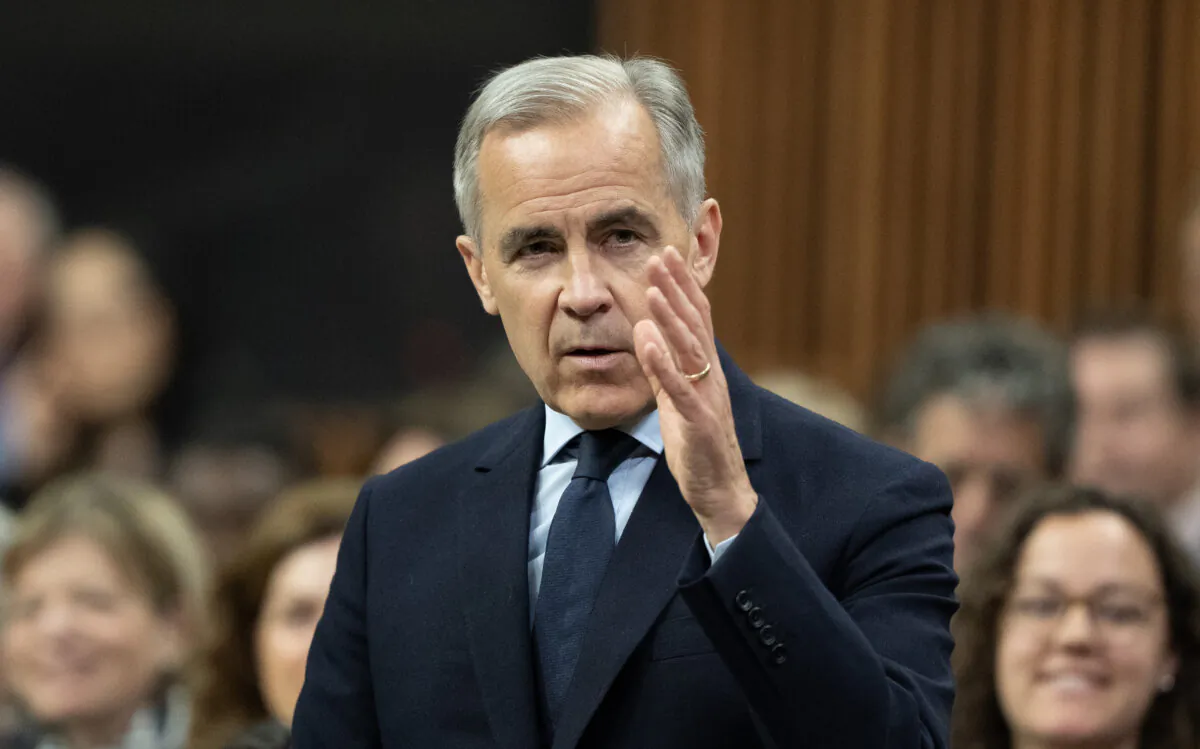

The Liberal government has introduced legislation aiming to bring down trade barriers within Canada and expedite the process for identifying and approving nation-building projects.
The One Canadian Economy Act (Bill C-5) would allow Canada to meet “this hinge moment with the urgency and determination it requires,” Prime Minister Mark Carney said during a June 6 press conference.
The first part of the legislation would create “one Canadian economy out of 13,” which has been a priority for the provincial and territories in the face of steep tariffs by the United States, the prime minister said.
The legislation stipulates that when a federal trade barrier exists, a good or service that complies with “comparable provincial or territorial rules” will be deemed to satisfy the federal trade requirements in Canada. Businesses that follow comparable provincial and territorial rules will also see costs and delays reduced.
The bill also provides a new framework to recognize provincial and territorial licences and certifications for workers, allowing them to more easily work in the same occupation under federal jurisdiction.
“It will allow Canadian workers to do their jobs wherever they want in this great country,” Carney said. “The provinces and territories have already announced seven similar initiatives this year. More are in the works.”
The first part of the the bill would enact the Free Trade and Labour Mobility in Canada Act and the second part the Building Canada Act.
The second part of the bill is designed to support the development of major projects that align with national interests, contingent upon discussions with the provinces, territories, and indigenous peoples. The bill aims to allow the assessment of projects based on their potential to strengthen Canada’s autonomy and security, deliver economic benefits, advance the interests of indigenous peoples, and support clean growth while assisting the nation in achieving its climate change goals.
The legislation is a part of the Liberal government’s commitment to a “one project, one review” process, which involves a single assessment for projects and improved coordination of permitting alongside the provinces and territories. The review process aims to reduce approval times from five years to two.
Carney said while Canada “used to build big things” in short amounts of time, such as the 1967 World’s Fair in a span of four and a half years and the St. Lawrence Seaway over the course of five years, it has become “too difficult to build in this country.” He said the current approval process involves multiple reviews and assessments that happen sequentially as opposed to at the same time.
“That process is arduous, it takes too long, and it’s holding our country back,” Carney said. “When federal agencies have examined a new project, their immediate question has been, ‘why?’ With this bill, we will instead ask ourselves, ‘how?’”
Carney said an indigenous advisory council would be created to provide “guidance” for the approval processes, and the government will provide funding for indigenous participation in the process while also doubling the Indigenous Loan Guarantee Program to $10 billion to enable “more indigenous communities to become owners of major projects.”
Carney told reporters the recent first ministers meeting on infrastructure and energy projects had been “encouraging” because many provinces had come together in support of projects stretching across provincial boundaries.
One example of that is the premiers from both Nova Scotia and New Brunswick saying they are in support of the Energy East partnership that would see energy from eastern Canada transmitted to other markets, Carney said, but added that “much more, of course, needs to be done.”
Carney also told reporters he would like to see the bill passed before Parliament breaks for the summer. “We’re in an economic crisis. We sometimes glide over that,” Carney said, referencing the U.S. tariffs.
“We have a tremendous opportunity to build strength at home. This bill helps to unlock that. So, yes, it is a top priority for this government, and we will do everything to get it passed before the summer.”
Opposition Reaction
Conservative Leader Pierre Poilievre has pushed for removing legislation impeding economic growth. Speaking to reporters about the government’s new bill on June 6, he welcomed first steps in this direction while advocating for broader changes.
He said the Liberal legislation would have “almost no impact” on increasing interprovincial trade. Poilievre said his party is proposing the implementation of bonuses for provincial and municipal governments for every interprovincial trade barrier they dismantle.
Poilievre also said the One Canadian Economy Act would allow “certain politically favoured projects” to circumvent federal laws and said Ottawa should “just get rid of” those laws altogether.
The Tory leader said he is also concerned about Carney promising provinces “veto” power over resource projects and pipelines. While Alberta has been pushing for a pipeline running from northwest B.C. to the port of Churchill, Man., the B.C. government has expressed opposition to the project.
“So is the prime minister effectively saying we’re not going to get any pipelines built, and if so, is he ceding to Donald Trump that the Americans will continue to get 80 to 90 percent of our energy projects at enormous price discounts? It would appear to be the case,” Poilievre said.
Poilievre said his party would be in favour of passing a “real national sovereignty law” that would repeal legislation on impact assessment and the West Coast tanker ban, repeal the industrial carbon tax, and “unlock our resources with shovel-ready zones that provide pre-permitting.”
When asked about voting in favour of the One Canadian Economy legislation, Poilievre said his caucus would discuss it. He noted that the party’s test for legislation is not whether it is perfect, “but whether it is better than the way things are.”
 Friends Read Free
Copy
Facebook
Tweet
Friends Read Free
Copy
Facebook
Tweet