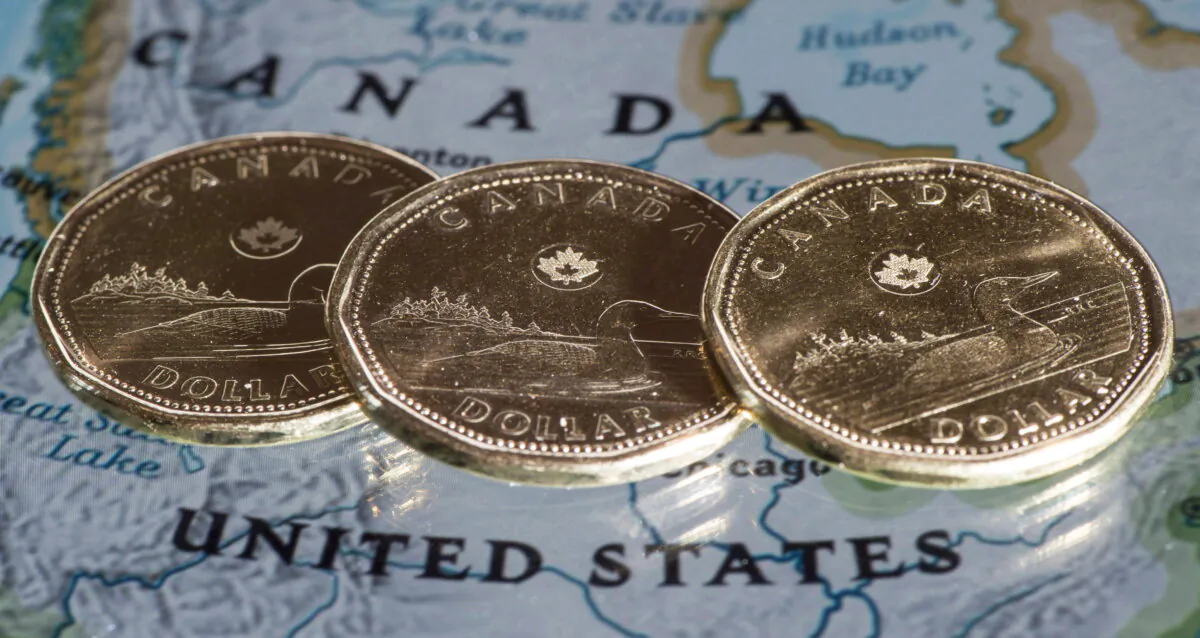

The Canadian dollar is falling further against the U.S. dollar as the collapse of Canada–U.S. trade talks results in further tariffs and trade tensions.
After the two countries failed to reach an agreement on Aug. 21, the United States imposed 50 percent tariffs on roughly $28 billion of Canadian goods the next day, covering products including dairy, wine, wood, furniture, and cement.
In response, Canadian Prime Minister Mark Carney said Canada would respond with its own tariffs starting on Sept. 8, targeting U.S. steel, dairy, agricultural equipment, paper, and electronics.
As of 2:10 p.m. EDT on Monday, Aug. 24, the Canadian dollar was trading at 72.16 cents U.S. compared to 72.67 cents U.S. on Aug. 21, representing a decline of 0.7 percent.
Meanwhile, the S&P 500 was down 14.46 points to 7,659.13, while the TSX Composite Index was up 13.96 points to 36,634.19.
While it’s unlikely that there will be a large sell-off of the Canadian dollar in response to the breakdown of trade talks, the loonie “is the clear underperformer” in the Group of 10 (G10) currencies on Aug. 24, Derek Halpenny, head of research of Global Markets for EMEA and International Securities at global financial group MUFG, said in his FX Daily Snapshot.
Halpenny highlighted Carney’s comments on Aug. 21 about matching the U.S. tariffs “dollar for dollar” and his statement the next day that “you’re at war when you get attacked. We got attacked.” Carney also criticized the United States’ failure to adhere to the Canada–United States–Mexico Agreement and said America “sometimes signs deals in pencil.”
“By promising to match dollar for dollar that risk of spiral is real,” Halpenny wrote, noting that the undermining of the Canadian dollar is understandable given that the market had recently begun pricing in a positive outcome.
Three days after Carney spoke about imposing retaliatory tariffs “dollar for dollar” against the United States, on Aug. 24 the prime minister said this may not be practical given that the U.S. economy is much larger than Canada’s and that Ottawa may therefore take a more targeted approach with its tariffs.
U.S. President Donald Trump said on the same day that he will be imposing new 50 percent tariffs on Canadian autos.
Despite the Canadian dollar’s poor performance on Aug. 24, Halpenny said it had been the third-best-performing G10 currency in August, helped by higher crude oil prices and investors’ optimism that a deal was likely.
The goods impacted by the new tariffs account for 5 percent of all Canadian exports to America, and while the initial size appears manageable, Carney’s response opens up “a round of retaliatory tit-for-tat actions that could see a quick spiral,” said Halpenny.
While crude oil prices remain supportive, that support could fade if energy price increases undermine global growth prospects, he added. Canada’s retaliatory response could also affect investor confidence, while dollar-related downside risks could intensify the longer the trade war continues.
Derek Holt, vice-president and head of Capital Markets Economics with Scotiabank, wrote in an Aug. 24 daily note that “only mild market reactions” to the news have emerged so far.
While the Canadian dollar is weaker compared to the U.S. dollar—but only by half a penny since Aug. 21—some weakness is due to lower oil prices and a decline in futures, Holt said. Some of the weakness is also due to a “slightly firmer overall” U.S. dollar and a decline in Canadian government bond yields.
“It’s clearly disappointing that all signs were pointing to a deal being consummated as late as well into Friday evening only to fall apart minutes before the midnight deadline when additional US tariffs kicked in,” Holt stated in a note on Aug. 23.
“There are no winners in trade wars, only losers, including the United States and its consumers and businesses,” he added.
In a separate note on Aug. 23, Holt said the 50 percent tariffs on $28 billion worth of imports from Canada raised the effective tariff rate on U.S. goods imports to 11.5 percent and on goods and services to 9.6 percent. The additional American tariffs also raise the effective tariff rate on total Canadian exports of goods and services to 4.6 percent—still the lowest imposed on any of America’s trading partners, Holt said.
 Friends Read Free
Copy
Facebook
Tweet
Friends Read Free
Copy
Facebook
Tweet