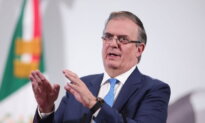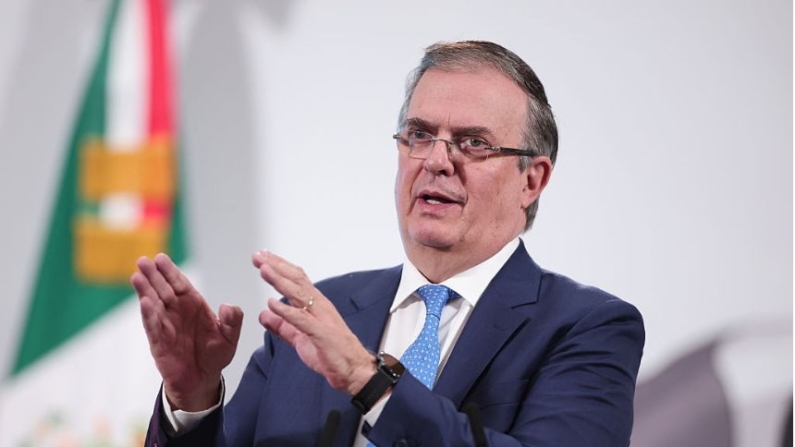
The Mexican government will raise tariffs on Chinese cars from 20 percent to 50 percent, Economy Secretary Marcelo Ebrard said during an event at Felipe Ángeles International Airport.
“I was asked if we are going to apply tariffs on vehicles from Asia, particularly China,” Ebrard said on Sept. 10. “I said yes. They already have a tariff. The tariff is 20 percent. Now, what are we going to do? We are going to raise it higher, which is allowed by the World Trade Organization, up to 50 percent.”
He said only 23 percent of the automotive industry in Mexico is domestically manufactured.
“We have to protect it,” Ebrard said. “One way to protect it is to increase the tariffs paid on those light cars that are currently imported at such low prices, below the reference price.
“Why? Because the prices at which they are arriving in Mexico are below what we call reference prices.
“I’ll explain that a little bit. You have a reference price for each product. When a product arrives in your country below the reference price, if it is a single product, you conduct an anti-dumping investigation. A single product.
“But if there are many, what do you do? You modify your tariff. Because if you don’t, the domestic industry is at a disadvantage. So, for that reason, we are taking that measure.”
Dumping is an unfair international trade practice in which goods are introduced into a country at a price lower than their normal price in the country of origin, the Ministry of Economy states on its website.
The new measure will take effect once the Mexican Congress approves the Ministry of Finance’s revenue package, which includes measures to increase tariffs and protect 320,000 jobs, according to Ebrard. If approved by Congress, it will be published as a decree and the tariffs will take effect 30 calendar days after its publication in the Official Journal of the Federation.
One day after Ebrard’s announcement to raise tariffs to 50 percent on various imports from Asian countries, Mexican President Claudia Sheinbaum said her government was talking to its various ambassadors to ensure that there is “no conflict with any country.”
“So we are talking to them, to the Chinese ambassador in Mexico, to South Korea,” the president said.
“We are explaining to them that this is a measure that has to do with strengthening our economy.”
The Chinese Ministry of Commerce criticized the Mexican government’s decision to increase tariffs, stating that the measure would undermine investor confidence.
On Sept. 4, Sheinbaum announced that her government is considering imposing tariffs on countries with which it does not have a trade agreement, including China, as part of the broader national strategy of Plan México presented on Jan. 13.
Plan México includes measures to reduce the country’s dependence on cheap imports from China by maintaining the U.S.–Mexico–Canada Agreement.
Reuters contributed to this report.
 Friends Read Free
Copy
Facebook
Tweet
Friends Read Free
Copy
Facebook
Tweet