
A Native Title claim in Central Queensland has been allowed to restart a year after a judge issued a rare order not only dismissing the action, but blocking any further claims.
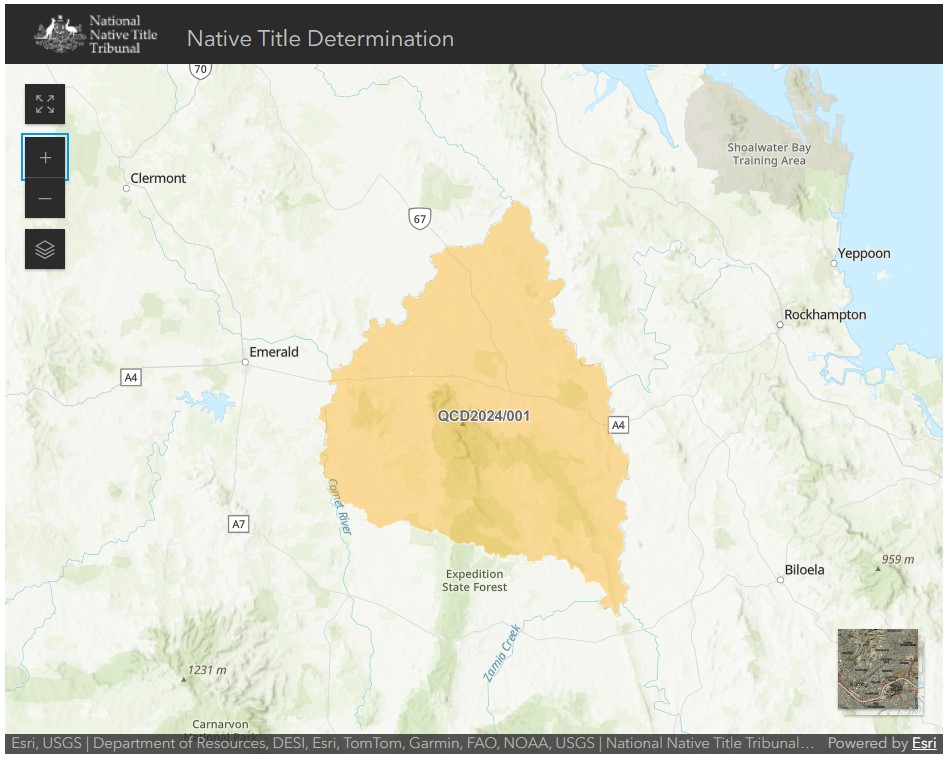
In April 2024, the Gaangalu people applied for exclusive and non-exclusive Native Title over more than 25,000 kilometres of land and waters west and south-west of Rockhampton.
The area, between Rockhampton and Emerald, encompasses the Dawson Range State Forest, the Blackdown Tableland National Park and Duaringa State Forest.
In 2024, Judge Darryl Rangiah found that Native Title did not exist for several reasons including a lack of proof the Indigenous Gaangalu people had sufficient interests in the area, that there was an ongoing connection to the land, and that a “regional society” continues to exist.
The Aboriginal group’s claim was opposed by the state of Queensland, Banana Shire Council, and the Central Highlands Regional Council, who argued there was insufficient evidence of a continued connection to the land.
The court found that on the date of Australia’s sovereignty, the Gaangalu people did have rights and interest in the area but it was not maintained—a key requirement of Native Title.
The decision was ultimately appealed, and on Dec. 5 the Federal Court of Australia found that the previous judge did not properly analyse how the connection between the people and the land had evolved.
“His Honour erroneously failed to identify that the shift in inheritance rights from being patrilineally biased to cognatic, was an adaptation of the traditional system and that the shift from clan estates to language groups was also an adaptation,” the Federal Court found.
Biographies of several Indigenous people with connections to the land were included as part of the appeal, as well as cultural explanations and the opinions of anthropologists.
“In my opinion, based on the available material, it can be inferred that the Gaangalu Nation People have continued to hold country according to laws and customs of their regional society that are rooted in tradition,” University of Sydney consultant anthropologist Katherine Kenny noted.
At the outcome of the appeal, it was ordered that the negative determination be set aside and that parties now have until Feb. 13, 2026, to submit their next action.
 Friends Read Free
Copy
Facebook
Tweet
Friends Read Free
Copy
Facebook
Tweet