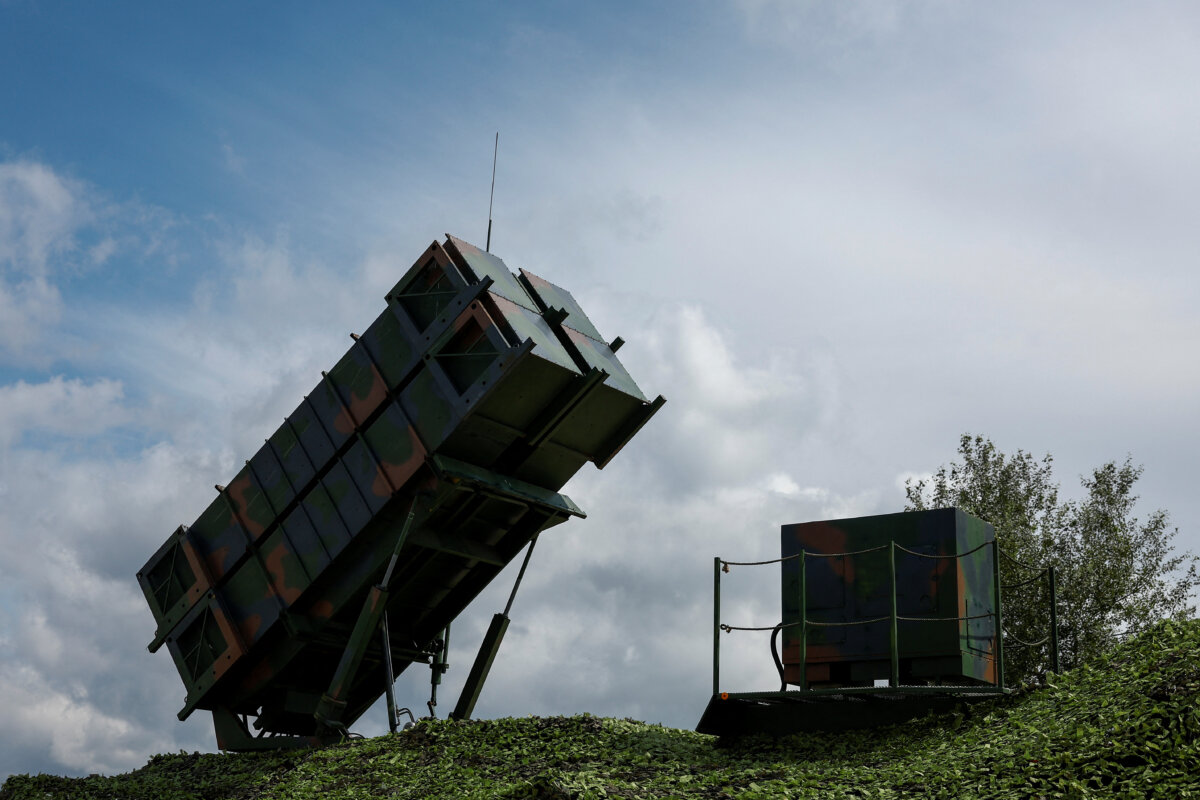

Arrangements are being made to transfer additional Patriot air defense systems to Ukraine, NATO’s top military commander said on July 17.
“Preparations are underway, we are working very closely with the Germans on the Patriot transfer,” NATO Supreme Allied Commander Europe Gen. Alexus Grynkewich told a conference in the German city of Wiesbaden.
“The guidance that I have been given has been to move out as quickly as possible.”
Grynkewich, of the U.S. Air Force, was nominated for the post of supreme allied commander Europe on June 5 and assumed the duties of the role on July 4.
His comments come just days after U.S. President Donald Trump said on July 13 that the United States will deliver Patriot air defense missiles to Ukraine, with the European Union covering the cost.
Speaking to reporters at Joint Base Andrews, Trump said the United States will not bear any cost of the weapons for Ukraine.
“We basically are going to send them various pieces of very sophisticated military equipment,” he said. “I haven’t agreed on the number yet, but they’re going to have some because they do need protection, but the European Union is paying for it. … We will send them Patriots, which they desperately need.”
Trump later said on July 15 that some Patriots, which are coming from Germany, were already on their way to Ukraine.
“Secretary [of State Marco] Rubio just talked about capabilities that are in Europe [that] can be moved more quickly than something coming off the production line,” he said. “But the production line can then be used to backfill the capabilities that others donate.”
Grynkewich said that he did not currently know how many Patriots might be freed up and sent to Kyiv.
“We’re going to move as quickly as we can on this,” he said.
Following a meeting between U.S. Secretary of Defense Pete Hegseth and German Defense Minister Boris Pistorius in Washington on July 14, Germany said a decision on supplying two U.S.-made Patriot systems to Kyiv could be reached within days or weeks.
However, he added that actual delivery of those systems could take months.
Germany has already donated three of its own Patriot units to Kyiv, retaining nine systems, which is significantly fewer than the 36 Patriot units it held during the height of the Cold War.
Berlin has also offered to buy U.S. Patriot units to then supply to Ukraine.
Germany is also in the process of acquiring the Arrow 3 missile defense shield from Israel as the country looks to bolster its own defenses in the event of a Russian attack on Europe. Berlin is set to take delivery of the first units of the new system before the end of 2025, after agreeing to the deal with Jerusalem almost two years ago.
Ukraine views the Patriot system, built by Raytheon, as its most valuable means to intercept ballistic and hypersonic missiles fired by Russia.
The news of the fresh supplies will be welcomed by Kyiv, which has seen a marked increase in Russian bombardment in recent weeks.
Ukrainian President Volodymyr Zelenskyy said on July 13 that Russian forces fired more than 1,800 drones, more than 1,200 guided aerial bombs, and 83 missiles of various types on Ukrainian cities over the past week.
Zelenskyy said his nation’s interceptor drones have shot down hundreds of the drones used by Russian forces.
“The Russians are intensifying terror against cities and communities to increasingly intimidate our people,” the Ukrainian leader stated on X on July 13.
Zelenskyy said he has been in talks with international partners to scale up the use of interceptor drones to respond.
“We must neutralize this threat in order to bring diplomacy into motion sooner,” he said. “We count on strong decisions from the United States, Europe, the G7, and all our partners.”
Talks between Moscow and Kyiv remain stalled.
On July 16, Russian Security Council Secretary Sergey Shoigu told Kommersant that Russia “should not forget that NATO still remains a key threat to Russia’s national security.”
Aldgra Fredly contributed to this report.
 Friends Read Free
Copy
Facebook
Tweet
Friends Read Free
Copy
Facebook
Tweet