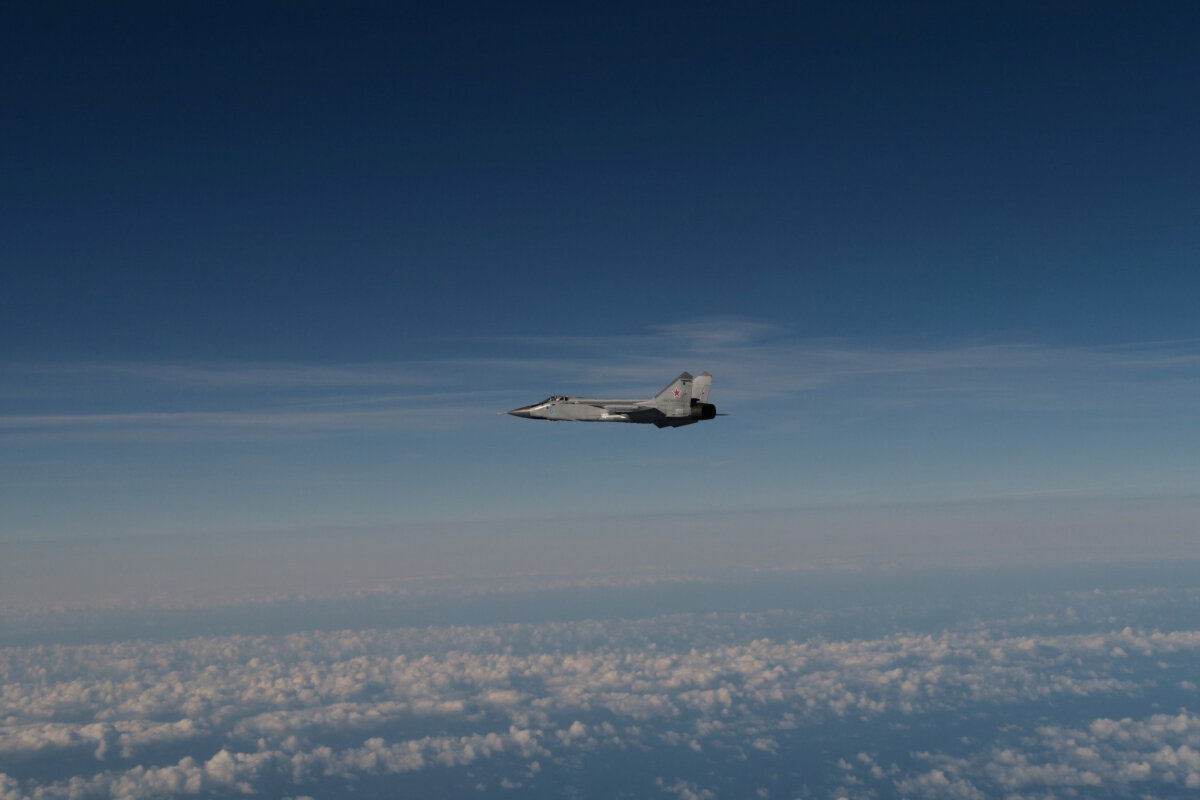

NATO fighter jets intercepted three Russian MiG-31 warplanes that crossed into Estonian airspace on Sept. 19, prompting the Baltic nation to request urgent alliance consultations under Article 4 of the NATO treaty over what Estonian officials said was a “brazen” and “totally unacceptable” incursion.
Estonia’s Foreign Ministry said the jets entered its airspace near Vaindloo Island in the Gulf of Finland without permission and remained there for 12 minutes. Their transponders were switched off, no flight plans were filed, and they were not in contact with air traffic controllers, officials said.
“This is an unprecedented and brazen intrusion—clear proof of Russia’s growing aggression,” Estonia’s Foreign Minister Margus Tsahkna said. “Such actions cannot be tolerated and must be met with swift political and economic pressure.”
Col. Martin O’Donnell, a spokesperson at NATO’s Supreme Headquarters Allied Powers Europe, said Italian F-35s deployed to Estonia under NATO’s Baltic Air Policing Mission scrambled to intercept the intruders, while Sweden and Finland also launched quick-reaction aircraft.
“This is not the type of behavior one would expect from a professional air force,” O’Donnell said in a statement, with NATO spokesperson Allison Hart calling the incident another example of “reckless Russian behavior.” NATO Secretary-General Mark Rutte said the alliance’s response under its Eastern Sentry system was “quick and decisive.”
The Russian Defense Ministry did not immediately comment.
Article 4 Move
Estonia’s Prime Minister Kristen Michal said the NATO-allied country had decided to trigger Article 4 of the NATO treaty, which obliges the alliance’s 32 members to consult when a member’s security or territorial integrity is threatened.
“Such violation is totally unacceptable,” he said in a social media post.
“This was no accident,” EU foreign policy chief Kaja Kallas said while visiting Brazil. Calling the incursion “an extremely dangerous provocation” in a post on social media, she urged the West to respond with pressure. “Putin is testing our resolve. We must not show weakness,” she wrote.
Estonia summoned Russia’s chargé d’affaires in Tallinn to lodge a formal protest over the incursion.
Friday’s violation followed a string of recent incidents involving Russian military activity in NATO airspace. Last week, Poland said it shot down multiple Russian drones that strayed across its border, while Romania reported detecting a Russian drone during strikes on Ukrainian targets near the Danube River.
Polish border guards said two Russian fighter jets also violated the safety zone of the Petrobaltic oil platform in the Baltic Sea on Sept. 19, performing a low pass over the installation.
The airspace breach coincided with the European Union’s announcement of a sweeping 19th sanctions package against Moscow. The measures accelerate the bloc’s planned ban on Russian liquefied natural gas imports to January 2027, tighten restrictions on banks and technology exports, and—for the first time—target cryptocurrency platforms accused of helping Russia evade sanctions.
“Again and again, President Putin has escalated. And in response, Europe is increasing its pressure,” European Commission President Ursula von der Leyen said in Brussels. “It is time to turn off the tap.”
The incursion also highlights rising tensions on NATO’s eastern flank more than three years into Russia’s war with Ukraine, to which President Donald Trump has been trying to broker an end.
Western intelligence chiefs said this week there is “no evidence” that Russian President Vladimir Putin seeks peace. Richard Moore, head of Britain’s MI6, said in Istanbul that the Kremlin leader was “stringing us along.”
Trump, on a state visit to the United Kingdom, said Putin had “let me down” by refusing to heed calls for a ceasefire. Kremlin spokesman Dmitry Peskov said that Moscow remained ready for talks but accused Ukraine and Western nations of blocking diplomacy.
 Friends Read Free
Copy
Facebook
Tweet
Friends Read Free
Copy
Facebook
Tweet