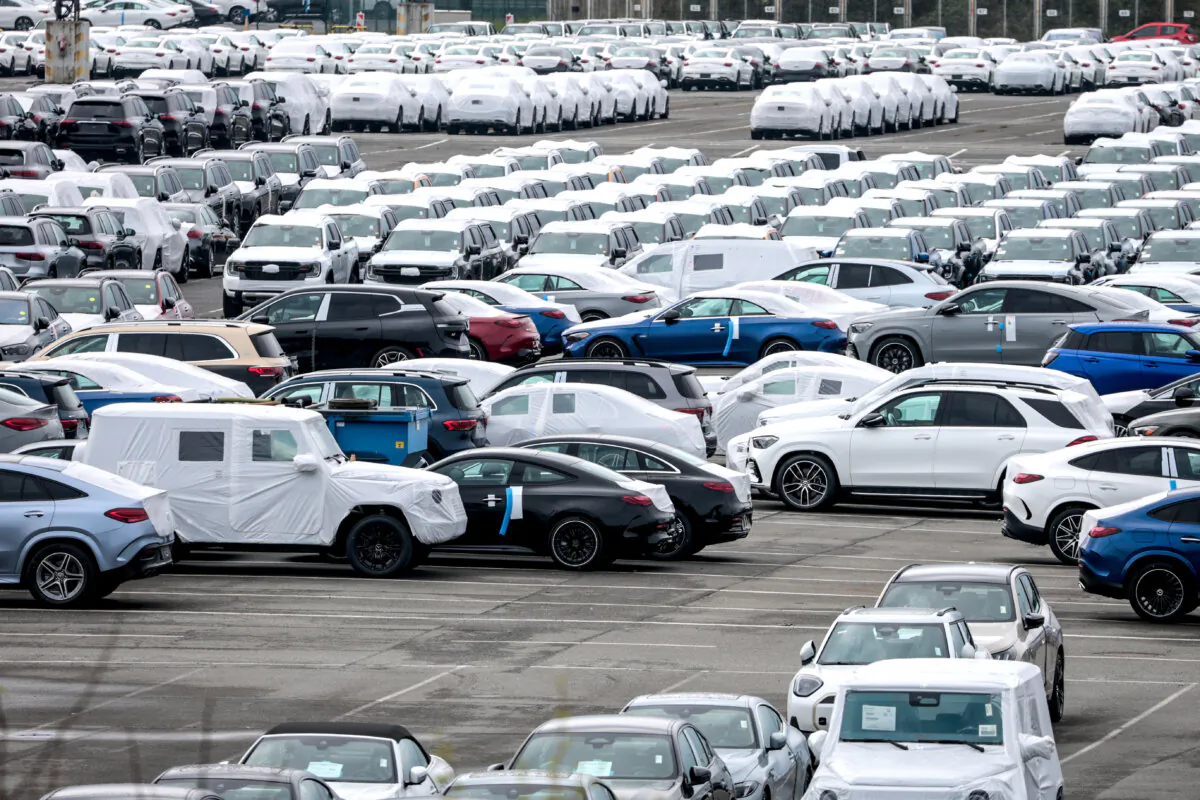

Germany’s car industry has said that the new EU–U.S. trade deal will “burden” automakers with billions in extra costs.
The 15 percent U.S. tariff on European car imports will hit hard, warned Hildegard Mueller, president of Germany’s main auto industry group, the VDA, adding to the woes of Europe’s industrial powerhouse, which is already creaking under serious strain.
“One thing is also clear: the U.S. tariff of 15 percent, including for automotive products, will cost the German automotive industry billions annually, and will burden them in the midst of the transformation,” Mueller said in a July 27 statement.
“It is of great importance that the automotive supply chains, which have been distorted and restricted by the tariff dispute, will work smoothly again,” she added.
The deal between the European Commission (EC) and the United States was struck days before the Aug. 1 deadline, after which nearly all EU imports would have been hit with 30 percent levies.
The 27-member bloc will buy $750 billion worth of energy from the United States, and tariffs on EU imports, including automobiles, will be set to 15 percent.
German Chancellor Friedrich Merz said in a statement on July 27 that he welcomed the deal, and that the two trading partners would now avoid an “unnecessary escalation in transatlantic trade relations.”
Merz said his country’s export-oriented economy, with its large automotive sector, would have been hit hard without this agreement.
“We have thus been able to safeguard our core interests, even if I would have certainly welcomed further easing of transatlantic trade,” he said.
He recently, however, also said the tariffs will be a “burden.”
“But I am fully aware that the tariffs that remain in place, in particular the 15 percent versus zero percent for imports into the European Union, represent a considerable burden on the export-oriented economy of the Federal Republic of Germany,” he told a press conference in Berlin on July 28.
“I am not satisfied with this outcome in the sense that it is now good, but I am simply saying that more was obviously not achievable given the starting position we had with the United States of America. In plain language, this means that the German economy will suffer considerable damage as a result of these tariffs,” he said.
Germany, Europe’s largest economy, is known for its skilled labor force and high-end exports.
According to a recent EC economic forecast for Germany, after slightly contracting for two years in a row, economic activity is expected to broadly stagnate in 2025.
The country has also been struggling with the loss of affordable Russian gas and Chinese carmakers expanding their presence in Europe, creating competitive pressures for German manufacturers.
According to a March report by the London-based Centre for European Reform (CER), German firms are struggling to compete with China.
EU law stipulates that from 2035, all new cars that come on the market cannot emit any carbon dioxide, making it illegal to sell new fossil fuel-powered internal combustion engine vehicles in the bloc.
Volkswagen stated last year that it is considering factory closures in Germany for the first time amid growing pressure from cheaper Chinese electric vehicles (EVs).
In April, for the first time ever, Chinese automaker BYD sold more EVs in Europe than Tesla, according to a report released by UK-based JATO Dynamics on May 22.
“Bound by the logic of capitalism to deliver returns, not just pour out products, and without profits to fuel new investment, they risk falling behind in the technological race,” said CER of European companies.
“Chinese firms that do not need to show a financial return, thanks to state backing, will also deprive German firms of the profits needed to invest in the next generation of machines and production methods,” it added.
Victoria Friedman contributed to this report.
 Friends Read Free
Copy
Facebook
Tweet
Friends Read Free
Copy
Facebook
Tweet