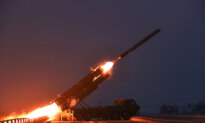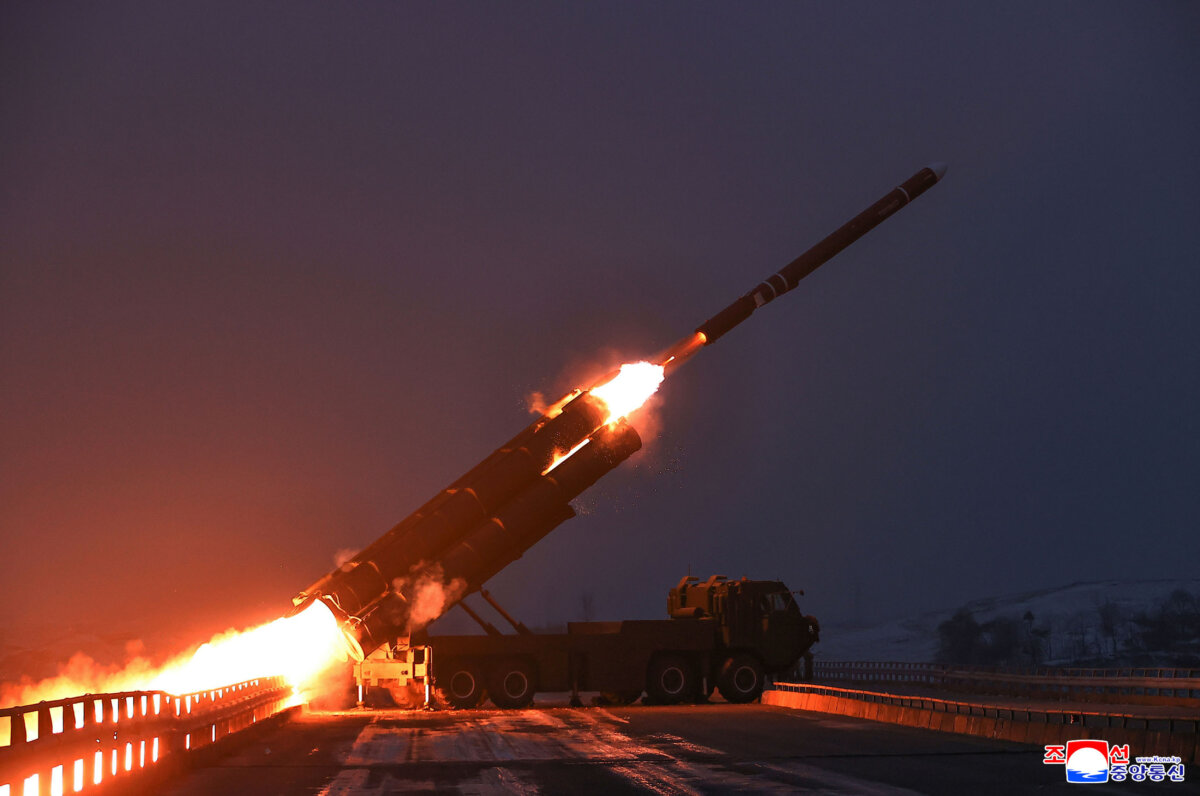

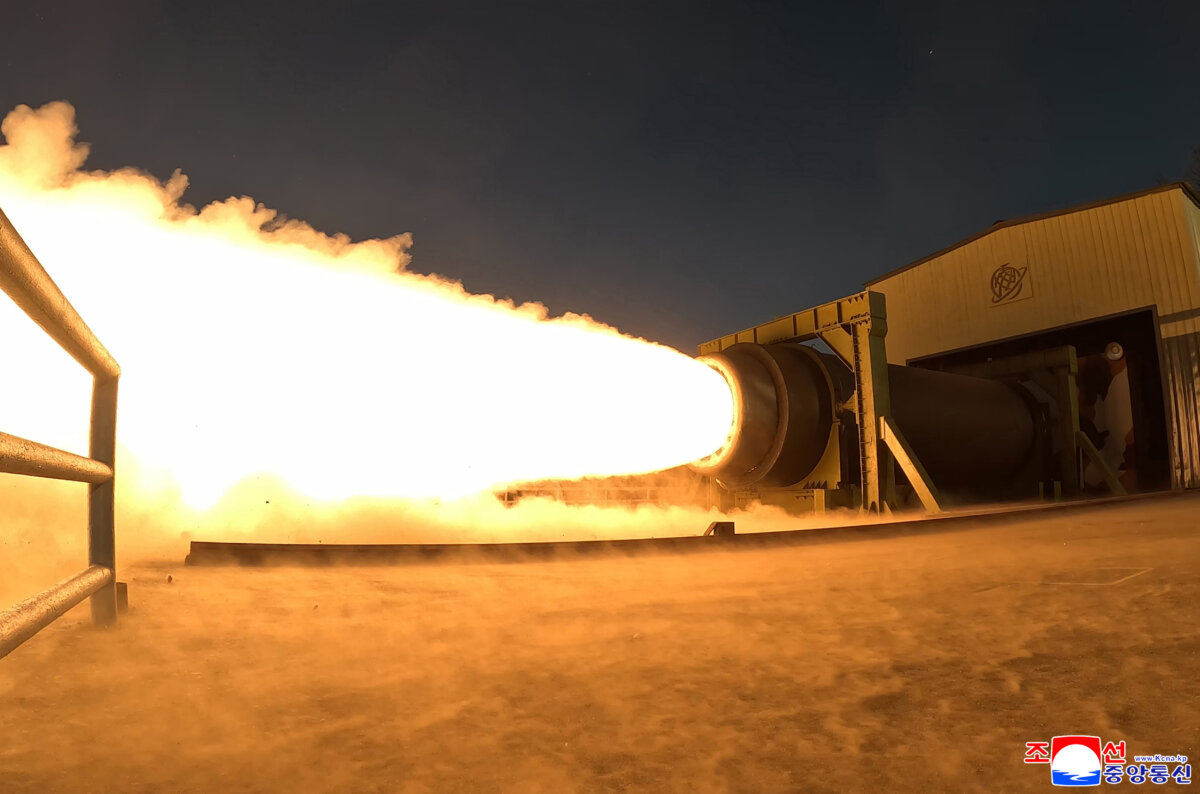
North Korea tested a new cluster-bomb warhead on a ballistic missile and an electromagnetic weapon this week, according to the regime’s state news agency.
Pyongyang’s Academy of Defence Science and the Missile Administration also trialed carbon-fiber bombs and a mobile short-range anti-aircraft missile system, KCNA reported on April 9. Gen. Kim Jong Sik, who oversaw the tests, said the electromagnetic weapon system and carbon-fiber bombs were “special assets” for North Korea’s military, according to the news agency.
The tests were carried out on April 6, 7, and 8, KCNA said, reporting that they “confirmed that the surface-to-surface tactical ballistic missile Hwasongpho-11 Ka tipped with the cluster bomb warhead can reduce to ashes any target covering an area of 6.5~7 hectares with the highest-density power.”
The Hwasong-11 ballistic missiles, which resemble Russia’s Iskander missiles in their design for low-altitude, are maneuverable in flight to evade missile defense systems.
The incidents follow launches in January and March.
Both South Korea and Japan reported the launches on April 8. South Korea’s Joint Chiefs of Staff (JCS) said its neighbor unleashed an unidentified missile at about 2:20 p.m. on April 8 from the Wonsan area toward waters off its eastern coast, South Korean news agency Yonhap reported. It flew about 435 miles.
Earlier the same day, Pyongyang fired several unidentified short-range ballistic missiles from around the same area, the JCS stated.
Those missiles flew about 150 miles, the JCS said, and it stated that South Korean and U.S. authorities were conducting a detailed analysis of the situation.
South Korea’s military also said it had detected the launch of a suspected ballistic missile from near Pyongyang on April 7.
The presidential Blue House in Seoul convened an emergency National Security Council meeting on April 8, calling the earlier launches a provocation that violated U.N. Security Council resolutions, and urging Pyongyang to end such tests.
Pyongyang rejects the U.N. ban, saying it infringes its sovereign right to self-defense.
The Japanese coast guard said the latest missile fell into the sea about 10 minutes after launch. Tokyo’s Ministry of Defense said that no missiles entered its territorial waters or exclusive economic zone.
Pyongyang’s actions “threaten the peace and security of Japan, the region, and the international community,” the ministry stated.
The tests followed North Korea, once again, characterizing South Korea as a “hostile enemy.”
In an April 7 statement, Jang Kum Chol, a first vice minister at Pyongyang’s Foreign Ministry, said Seoul would always remain the North’s “most hostile enemy state,” according to KCNA.
During a visit to Pyongyang on April 9, Chinese Foreign Minister Wang Yi told his North Korean counterpart that Beijing stands ready to work with North Korea to further improve ties, the Chinese foreign ministry said.
China is ready “to continue consolidating the positive momentum in the development” of bilateral ties, the Chinese diplomat said during a meeting with North Korea’s Foreign Minister Choe Son Hui, according to an official summary of the meeting released by the Chinese Foreign Ministry.
The Associated Press and Reuters contributed to this report.
 Friends Read Free
Copy
Facebook
Tweet
Friends Read Free
Copy
Facebook
Tweet