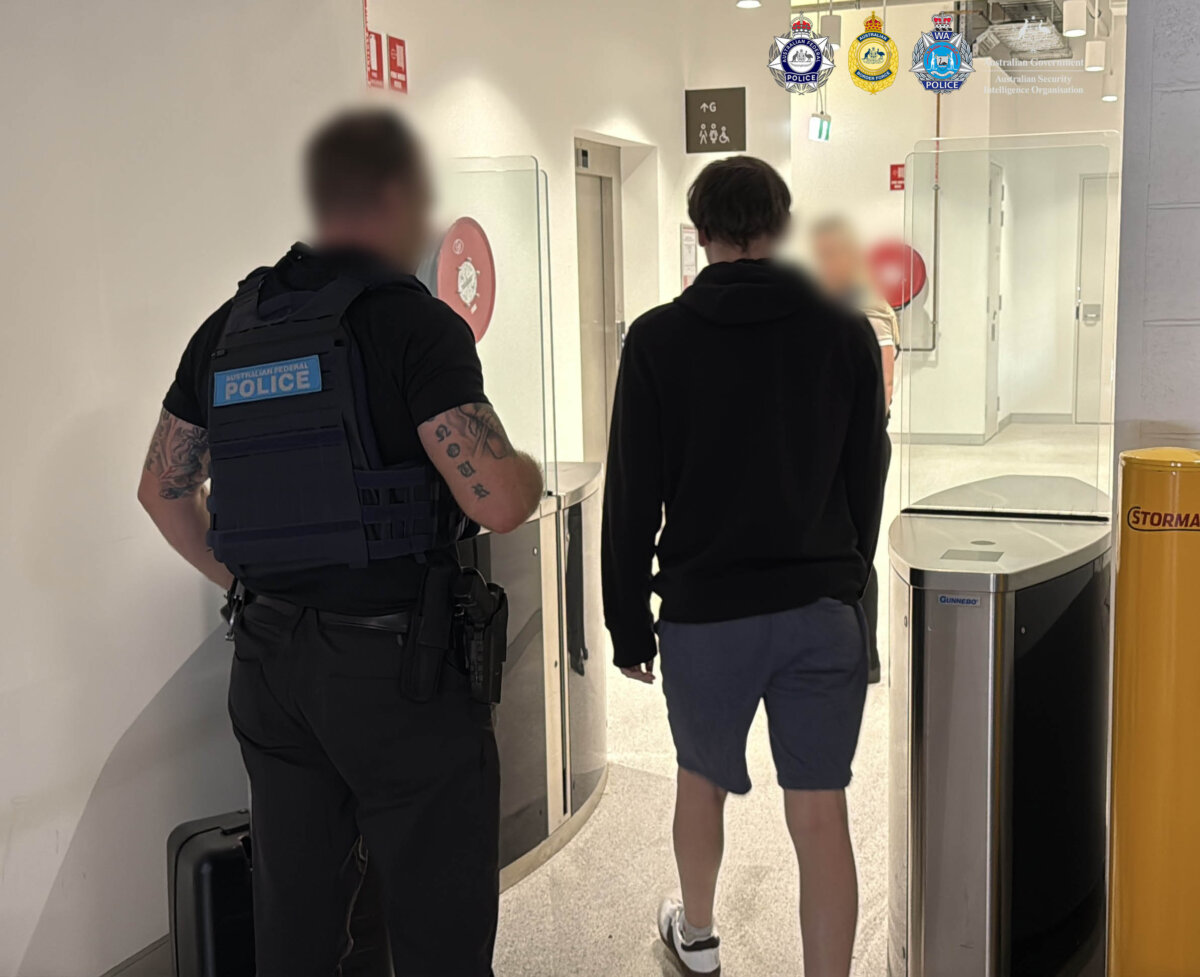

Police have arrested and charged a 24-year-old New Zealand national for allegedly possessing violent extremist material.
The man was stopped for a baggage examination at Perth Airport on Feb. 23 after arriving on an international flight. Australian Border Force officers allegedly found videos of multiple overseas terrorist incidents on his phone and referred the matter to the Australian Federal Police (AFP).
The arrest comes just a month after a 32-year-old man allegedly threw an explosive device into a crowd at an Invasion Day rally in January, an incident Perth authorities characterised as an act of terrorism.
The Western Australia Joint Counter Terrorism Team (WA JCTT)—which comprises the AFP, Western Australia Police Force, and the Australian Security Intelligence Organisation (ASIO)—later executed a search warrant at a Perth property and seized the man’s computer.
Police claimed he had used the internet to access extremist material, including videos of violent killings overseas linked to “varying ideologies,” as well as videos about manufacturing home-made explosives.
The 24-year-old has so far been charged with one count of possessing or controlling violent extremist material, which carries a maximum penalty of five years’ imprisonment, but the investigation is ongoing, including forensic analysis of the seized devices.
AFP Commander Nick Read said the spread of violent extremist material undermined Australia’s social cohesion.
“There is no place in Australian society for violent or extremist content, which terrorist organisations use as a tool to radicalise members of the community, particularly young or vulnerable people,” he said.
“Our top priority is to keep Australians safe from anyone who seeks to do them harm.”
The man was scheduled to appear in Perth Magistrates Court on Feb. 24.
Escalating Terrorism Threat
During a 2024 parliamentary inquiry into right-wing extremist movements in Australia, ASIO Director-General Mike Burgess said his organisation divided violent extremism into two categories—religiously motivated and ideologically motivated.
“These terms better reflect the nature of the threats,” he explained. “ASIO does not investigate people solely because of their political views or their religion, and terms like ‘left’ and ‘right’ no longer capture the spectrum of beliefs we are seeing.”
The AFP also told the Senate Legal and Constitutional Affairs Committee that there had been an increase in the number of young people being investigated by Joint Counter Terrorism Teams across several Australian states and territories.
“Since July 2021 [to April 2024], the AFP has commenced investigations and conducted operational activity against a number of individuals 16 years old or younger, with the youngest being 11 years old,” its submission said.
“This caseload includes a number of youths on a path to radicalisation or demonstrating concerning behaviours, including planning for possible attacks at schools on students and teachers, and the production of explosives or possession or use of weapons.”
 Friends Read Free
Copy
Facebook
Tweet
Friends Read Free
Copy
Facebook
Tweet