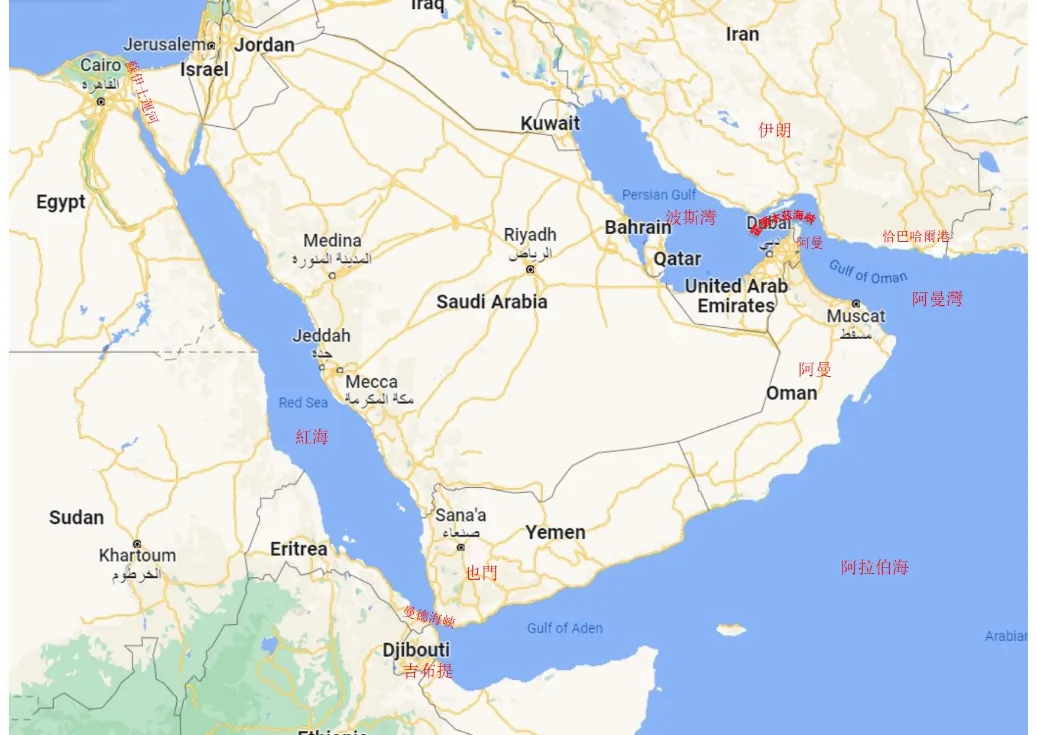

Two ships collided on June 17 in the Gulf of Oman, close to the Straits of Hormuz, one of the most crucial chokepoints in the global oil trade.
The United Arab Emirates (UAE) National Guard stated that it had evacuated 24 people from the crude oil tanker Adalynn, which was headed toward the Suez Canal in Egypt at the time of the incident. The Adalynn sails under the flag of Antigua Barbuda.
Video footage on social media appeared to show the Adalynn, which was apparently not carrying any oil, ablaze.
The UAE stated that its coast guard deployed search-and-rescue boats to the collision site and took the crew of the Adelynn to the port of Khor Fakkan.
The Adalynn collided with the Liberia-flagged tanker Front Eagle, owned by the Norwegian company Frontline. Frontline said the crew was safe after a fire briefly broke out on the ship’s deck.
TankerTrackers.com, an independent online service that tracks and reports shipments of crude oil, said on the social media platform X, “The Front Ealge executed a starboard [right] turn, resulting in a collision with the port quarter [aft port side] of the Suezmax tanker Adalynn, which was proceeding southeast at 4.8 knots speed towards the Suez Canal.”
The Epoch Times is unable to verify this information.
UK Maritime Operations (UKMTO), an organisation led by Britain’s Royal Navy, stated on June 16 that it had received multiple reports of “increasing electronic interference” in the Persian Gulf and the Straits of Hormuz.
UKMTO stated, “Whilst the level of electronic interference continues to rise across the wider region, the levels and intensity inside the Gulf are having a significant impact on vessels positional reporting through automated systems.”
‘Transit With Caution’
“Vessels are advised to transit with caution and continue to report incidents of electronic interference to the UKMTO,” the UKMTO stated.
Large commercial vessels, such as oil tankers, use Automatic Identification System (AIS) trackers, which use GPS technology to notify other ships and land-based operators of their exact position.
If electronic interference is being used in the area, it could cause the AIS to fail, making it harder for ships’ captains to steer a course to avoid other vessels.
Israel and Iran have effectively been at war since June 13, when the Israelis launched Operation Rising Lion in an effort to take out Tehran’s leadership and destroy its nuclear facilities.
It is estimated that 20 million barrels of oil per day—20 percent of the world’s global consumption—passes through the Straits of Hormuz, which is at the southern end of the Persian Gulf.
Saudi Arabia, Kuwait, Qatar, the United Arab Emirates, Bahrain, Iraq, and Iran all export oil and liquefied natural gas (LNG) via the Strait of Hormuz.
On June 13, the Financial Times reported that the world’s largest publicly listed oil tanker company, Frontline, stated that it would turn down new contracts to pass through the Strait of Hormuz until the conflict between Iran and Israel was over.
During the 1980 to 1988 war between Iran and Iraq, both sides frequently targeted oil tankers traveling up and down the Persian Gulf.
At the latter stage of the so-called Tanker War, Kuwait resorted to reflagging its tankers as U.S. ships in order for them to receive U.S. naval escorts.
The price of crude oil rose by 7 percent on June 13, when the war broke out, but it leveled out on June 16, before rising again on June 17.
A barrel of benchmark U.S. crude rose 2.8 percent to $72.19.
Brent crude, the international standard, went up by 3 percent to $75.40 per barrel.
The Associated Press and Reuters contributed to this report.
 Friends Read Free
Copy
Facebook
Tweet
Friends Read Free
Copy
Facebook
Tweet